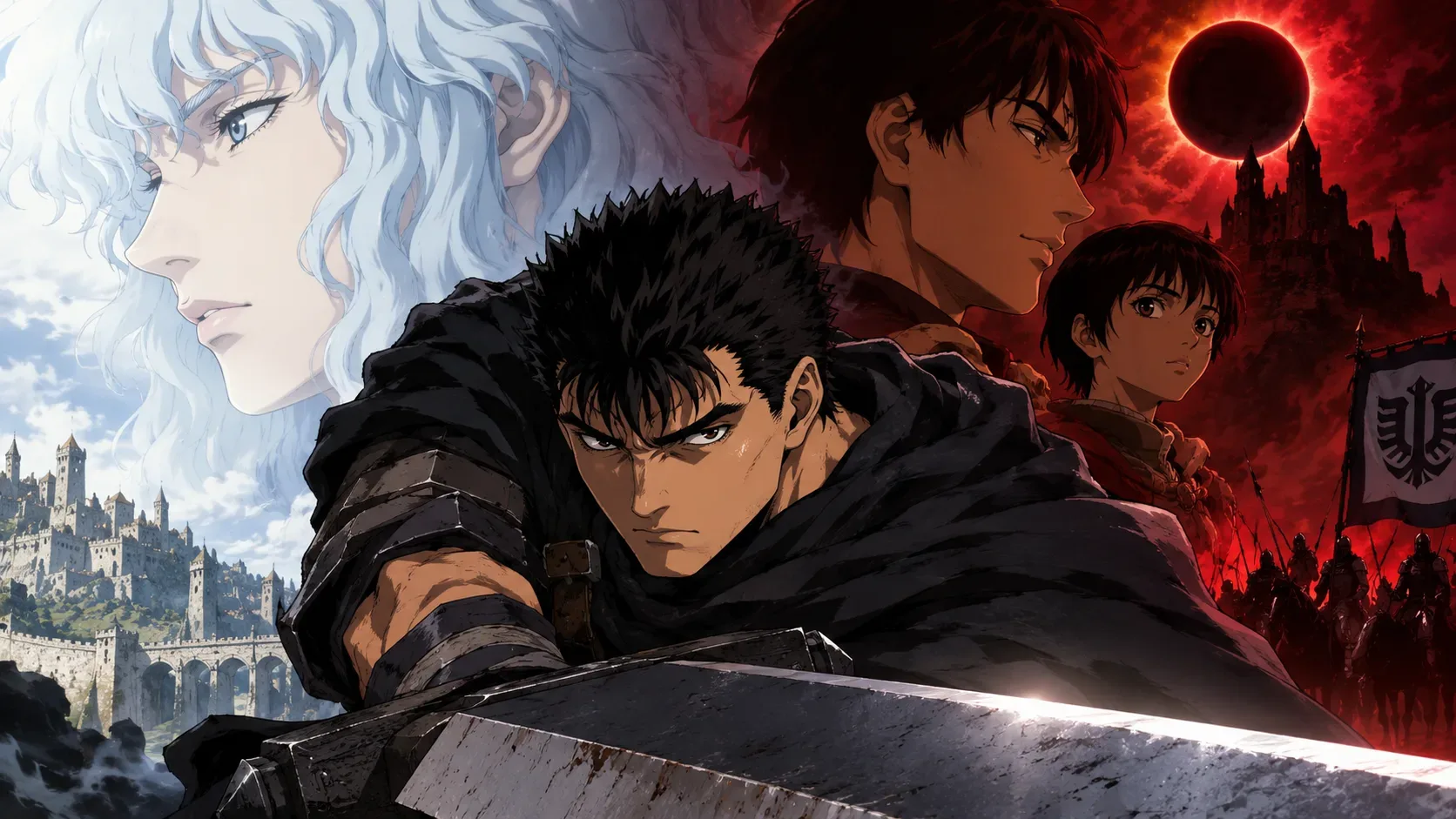
Berserk: The Golden Age Arc - Memorial Edition, released in 2022, repackages the three Golden Age movies as a 13-episode series, but it does more than split the films into installments. Studio 4°C confirms scenes not included in the trilogy, revisions to hundreds of shots, and new music by Susumu Hirasawa and Shiro Sagisu. The clearest documented addition is the sequence commonly known as “Bonfire of Dreams,” which was absent from the theatrical cut.
For viewers who only want to follow this story once, Memorial Edition brings together the revised material. The films remain the option for experiencing the original theatrical edit. Both versions adapt the same arc of Kentaro Miura's manga; the 2022 series is neither a sequel nor a new adaptation of the entire manga.
Three movies or 13 episodes: what changes?
The trilogy directed by Toshiyuki Kubooka was released in 2012 and 2013: The High King's Egg (82 minutes), The Battle for Doldrey (93 minutes), and The Advent (113 minutes). Studio 4°C gives the combined running time as 288 minutes. Memorial Edition, directed by Yuta Sano, premiered on Japanese television in October 2022 with 13 episodes of approximately 24 minutes each.
| Aspect | Original film trilogy | Memorial Edition (2022) |
|---|---|---|
| Format | Three films released in 2012 and 2013, totaling 288 minutes according to the studio. | A 13-episode TV series, with each episode running approximately 24 minutes. |
| Story | A theatrical adaptation of the Golden Age arc. | The same overall storyline reorganized for television; not a sequel. |
| Scenes | Does not contain the sequence known as "Bonfire of Dreams," later highlighted by the production team. | Adds "Bonfire of Dreams" and other new scenes, without a complete official inventory of every insertion. |
| Visuals | The films' original animation and editing. | Hundreds of existing shots revised and remastered, primarily computer-generated imagery. |
| Music | Score by Shiro Sagisu and the theme "Aria" by Susumu Hirasawa. | Additional cues from both composers; "Aria" remains and the series has its own ending themes. |
One important caveat: multiplying 13 episodes by 24 minutes and subtracting the films' combined runtime does not measure the amount of new footage. Television episodes include openings, endings, and episode breaks, in addition to editing changes. The studio did not publish a total runtime for the added sequences in the documents examined here.
“Bonfire of Dreams”: the best-documented new scene
In its August 9, 2022 announcement, Aniplex specifically named Yume no Kagaribi (夢のかがり火), known in English as Bonfire of Dreams, among the manga scenes missing from the films that would be animated for television. Episode 5 of the revised series is titled Campfire of Dreams, with the Brazilian Portuguese catalog using Acampamento de Sonhos.
The significance of this restoration is narrative: the Golden Age follows Guts's relationship with Griffith and the Band of the Hawk, and the question of personal dreams is central to that bond. Restoring a passage associated with this subject creates more space for the arc's personal dimension between major confrontations. That is an interpretation of the sequence's purpose, not a claim that every comparable exchange from the manga has been restored.
Studio 4°C and Aniplex also confirm other added scenes, but the announcements examined here provide no exhaustive list pinpointing every insertion. It would therefore be inaccurate to assign supposed additions to specific episodes without a documented shot-by-shot comparison of the two edits.
What was remastered in the animation?
The production states that hundreds of existing shots were worked on, particularly passages featuring computer-generated imagery (3DCG). The work was overseen by chief animation director Naoyuki Onda, who was also involved in the original movies. Here, “remastering” refers to revisions of existing images and shots, not the creation of a different story.
Nothing in the official production information consulted establishes that the entire series received a 4K restoration. Nor does it establish that every 2D drawing was recreated. The producers describe two distinct efforts: animating additional scenes and improving hundreds of older shots.
How the soundtrack changed
Shiro Sagisu, who scored the trilogy, and Susumu Hirasawa contributed new pieces to the TV version. In September 2022, the official website introduced Hirasawa's composition Ensei (遠征) in a promotional video that also showed part of “Bonfire of Dreams.” This documents music made for the revised edition without implying that the films' entire score was replaced.
Hirasawa's Aria was retained as the opening theme. The series added Wish by Mika Nakashima as its ending theme, along with a special presentation of Mirage with Shiro SAGISU in episode 8. These sound and television-credit changes help distinguish Memorial Edition even where the narrative footage is familiar.
Is there an uncut version?
Yes, although the label depends on both the edition and the territory. The official Japanese broadcast schedule distinguished a version edited for certain TV broadcasts from an “uncensored original version” carried by selected channels and services. According to Aniplex, the Japanese Blu-ray released on March 29, 2023, contains all 13 episodes in that uncensored version, as well as bonus material.
This does not mean every international streaming service automatically carries the same cut. Age ratings, language options, and catalog availability vary by country and platform. Likewise, “uncensored” should not be confused with a claim that every scene from the manga was adapted.
Which version should you watch?
Choose Memorial Edition if your priority is the officially added footage, visual revisions, and new music, without then needing to watch the same story again in movie form. Choose the trilogy if you prefer the original theatrical presentation or want to compare the editorial choices yourself.
Both versions cover the Golden Age. The confirmed difference lies in how that material is presented, not in the addition of a subsequent story arc. For a first viewing, the 13 episodes contain the set of changes announced by the team; for an exact inventory of what was inserted, direct comparison of the two versions remains essential.
Sources and references
- Studio 4°C: original film trilogy (2012-2013)
- Studio 4°C: Memorial Edition production details
- Official site: edition introduction
- Aniplex: announcement of added scenes and revisions
- Aniplex: new music announcement
- Official site: announcement of a new Hirasawa piece
- Aniplex: special ending for episode 8
- Official site: Japanese broadcast edits
- Aniplex: Japanese Blu-ray specifications
- Crunchyroll Brazil: episode 5, Campfire of Dreams