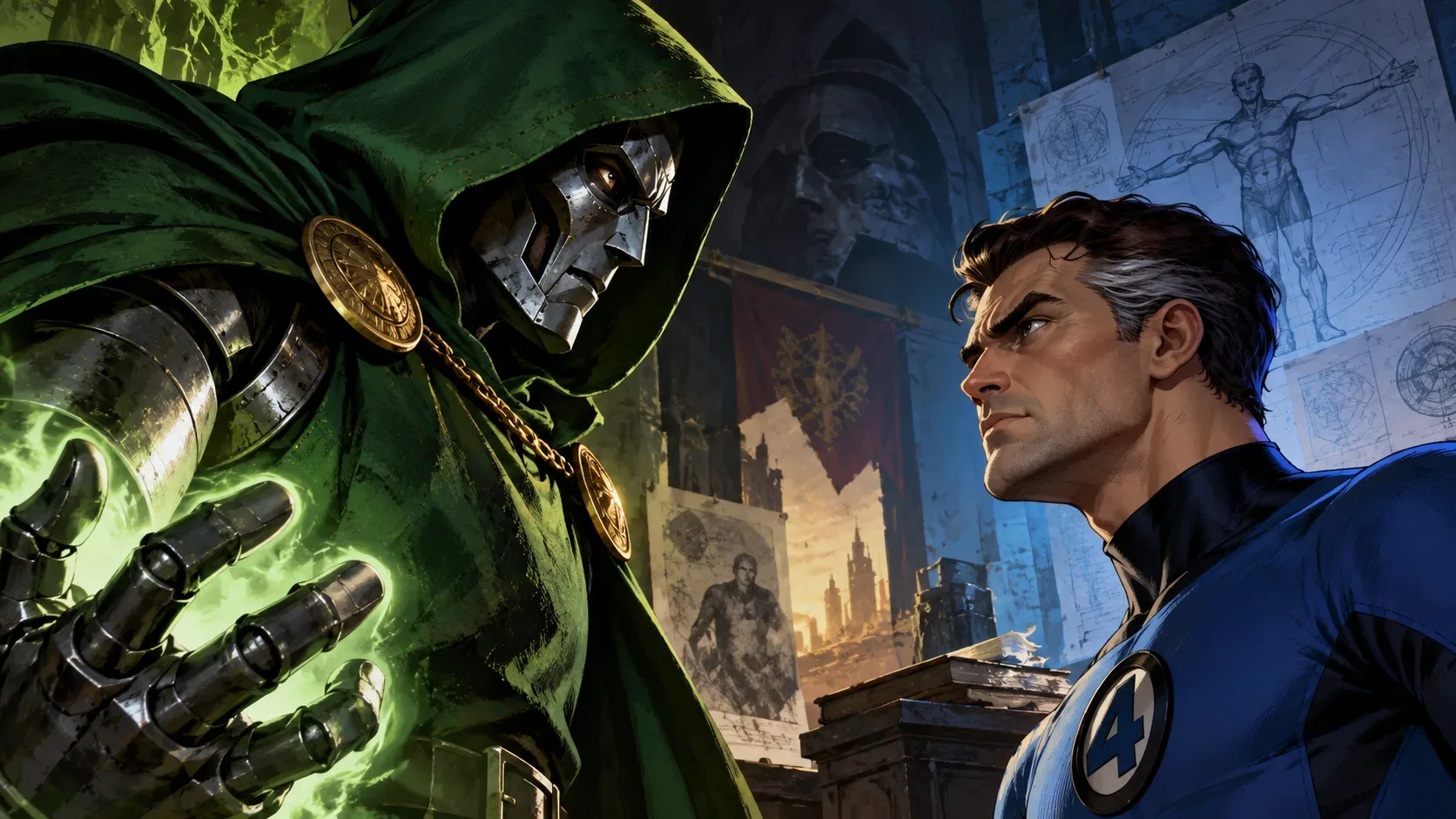
Doctor Doom hates Reed Richards because he turned a rivalry between two brilliant students into an obsession with proving his superiority. In the classic comics, Victor von Doom blames Reed for the university accident that scarred his face, even though Reed had pointed out a problem in his calculations. Humiliation, Victor's pride, and his refusal to accept responsibility turned the feud into much more than a scientific competition.
The explanation has evolved from Fantastic Four #5 (1962) through Fantastic Four Annual #2 (1964) and later retellings such as Books of Doom and Challenges of Doom: Mr. Fantastic #1 (2026). These are events from Marvel's comic books, not confirmed events in their film adaptations.
Spoiler warning: the following sections reveal major events in Victor von Doom's comic-book origin.
What happened between Victor von Doom and Reed Richards at university?
As students in the United States, both men already stood out for their exceptional intelligence. Victor was also conducting experiments involving magic and other dimensions. In the classic origin, he builds a machine connected to this pursuit, and Reed notices a flaw in the calculations. Victor does not take the warning as assistance: he sees it as interference from someone he regards as a rival.
Victor carries out the experiment, the device explodes, and his face is injured. He leaves the university after the disaster. Rather than acknowledge that he ignored the warning, he starts holding Reed responsible for his failure. That distinction is crucial: the classic version does not establish that Reed sabotaged the experiment. The hatred stems from Victor's interpretation of what happened, not from any proven betrayal by Richards.
The villain's debut in Fantastic Four #5, by Stan Lee and Jack Kirby, already established the university connection through Reed's recollections. The 1964 annual expanded that account, providing more context for the explosion, Victor's rise, and the creation of his Doctor Doom identity.
Why does Doom's childhood make his reaction more complicated?
Victor was born into a Romani family in the fictional nation of Latveria and grew up amid persecution of his community. His story includes the loss of his parents, including Cynthia von Doom, who practiced the mystic arts. The fate of his mother's soul and her connection to Mephisto received particularly significant attention in Doctor Strange & Doctor Doom: Triumph and Torment (1989).
This background helps explain why his pursuit of knowledge combines science, sorcery, and a need for control. None of it makes Reed responsible for Victor's family tragedies. A grounded editorial interpretation is that the young inventor already carried profound losses when the explosion became, to him, another unbearable sign of defeat.
How have the comics changed the rivalry's origin?
| Publication | What it added to the story |
|---|---|
| Fantastic Four #5 (1962) | Introduces Doom, his university history with Reed, and the accident in an initial account. |
| Fantastic Four Annual #2 (1964) | Develops his childhood in Latveria, Reed's warning, the explosion, and the rise of the masked enemy. |
| Fantastic Four #278 (1985) | John Byrne revisits the scarring: the initial injury is relatively limited, and the still-hot mask worsens the disfigurement. |
| Triumph and Torment (1989) | Explores the fate of Cynthia's soul and the personal importance of magic to Victor. |
| Books of Doom #1-6 (2005-2006) | Retells Victor's formative years, his education, and his path to ruling Latveria. |
| Challenges of Doom: Mr. Fantastic #1 (2026) | Returns to the rivals' youth and introduces new nuances about their closeness and the mistakes each sees in the other. |
These publications do not present six entirely separate origins. They expand or reinterpret elements of a shared history. The mask is a good example: John Byrne's 1985 explanation, in which Victor's impatience makes his injuries worse, underscores the idea of pride-driven self-destruction. It should not be presented as though every detail had already appeared in 1962.
What did the 2026 comic change about their relationship?
Published on July 1, 2026, Challenges of Doom: Mr. Fantastic #1, written by Al Ewing and illustrated by Mike Henderson, revisits the meeting of the young scientists. Marvel's official synopsis describes a battle of intellects and an examination of the events that shaped their feud.
In an analysis published by SuperHeroHype, Matt Morrison describes two new details: Victor spots a possible mistake in Reed's calculations for an experimental rocket, and the two establish a closer personal connection than in most earlier versions, even talking about family losses. That account is secondary reporting on the story; Marvel's listing confirms the issue and its premise but does not, by itself, describe those scenes.
The reversal matters: Reed is no longer the only one to point out the other's mistake. Even so, the observation about the rocket does not prove that Victor was right about a later spaceflight accident, or that Reed caused Doom's laboratory explosion. The retelling creates room for a friendship that failed without erasing the responsibility the classic origin places on Victor's choices.
Why does the resentment never go away?
The rivalry endures because Victor sees Reed as someone who can challenge him in the area most central to his identity: intellect. Marvel describes Doom's compulsion to demonstrate his superiority over Richards as so powerful that it can destroy even temporary alliances with the Fantastic Four.
- Intellectual competition: recognizing Reed's abilities would force Victor to accept that he is not infallible.
- Shame turned into accusation: the accident becomes a story of personal injustice, despite Reed's warning coming before the explosion.
- Different concepts of power: Reed generally seeks solutions alongside his family and teammates; Doom ties his genius to a claimed right to command others. This comparison interprets the characters' recurring portrayals rather than quoting a statement from their earliest comics.
So saying Doom hates Reed simply out of jealousy oversimplifies their conflict. Envy and competition are part of it, but so are wounded pride, family grief, and a struggle over who deserves to shape the future. The published events establish a feud that began long before Reed became the Fantastic Four's leader.
Was Reed Richards responsible for Doctor Doom's transformation?
The classic origin provides no basis for claiming that Reed deliberately caused the accident. He identifies a danger; Victor proceeds anyway. Later versions make their emotional relationship more ambiguous and revise details of Victor's appearance, but that is not the same as revealing an act of sabotage.
To follow the development without confusing the versions, start with Fantastic Four #5 and Annual #2, compare the retelling in Fantastic Four #278, then move on to Books of Doom and Challenges of Doom: Mr. Fantastic #1. This is a publication-and-context reading route, not an official list of required issues. The idea connecting them is consistent: Reed represents the limitation Victor refuses to acknowledge in himself.
Sources and references
- Marvel: Kirby 100 and Doctor Doom’s Fantastic Four #5 debut
- Marvel: Fantastic Four Annual #2 (1964)
- Marvel: collection featuring Fantastic Four #278 (1985)
- Earth’s Mightiest Blog: analysis of John Byrne’s retelling
- Marvel: Cynthia von Doom and Mephisto’s history
- Marvel: Books of Doom, six-issue collection
- Marvel: Challenges of Doom: Mr. Fantastic #1 (2026)
- Matt Morrison, SuperHeroHype: narrative changes in the 2026 issue
- Marvel: Fantastic Four history and the Doom rivalry