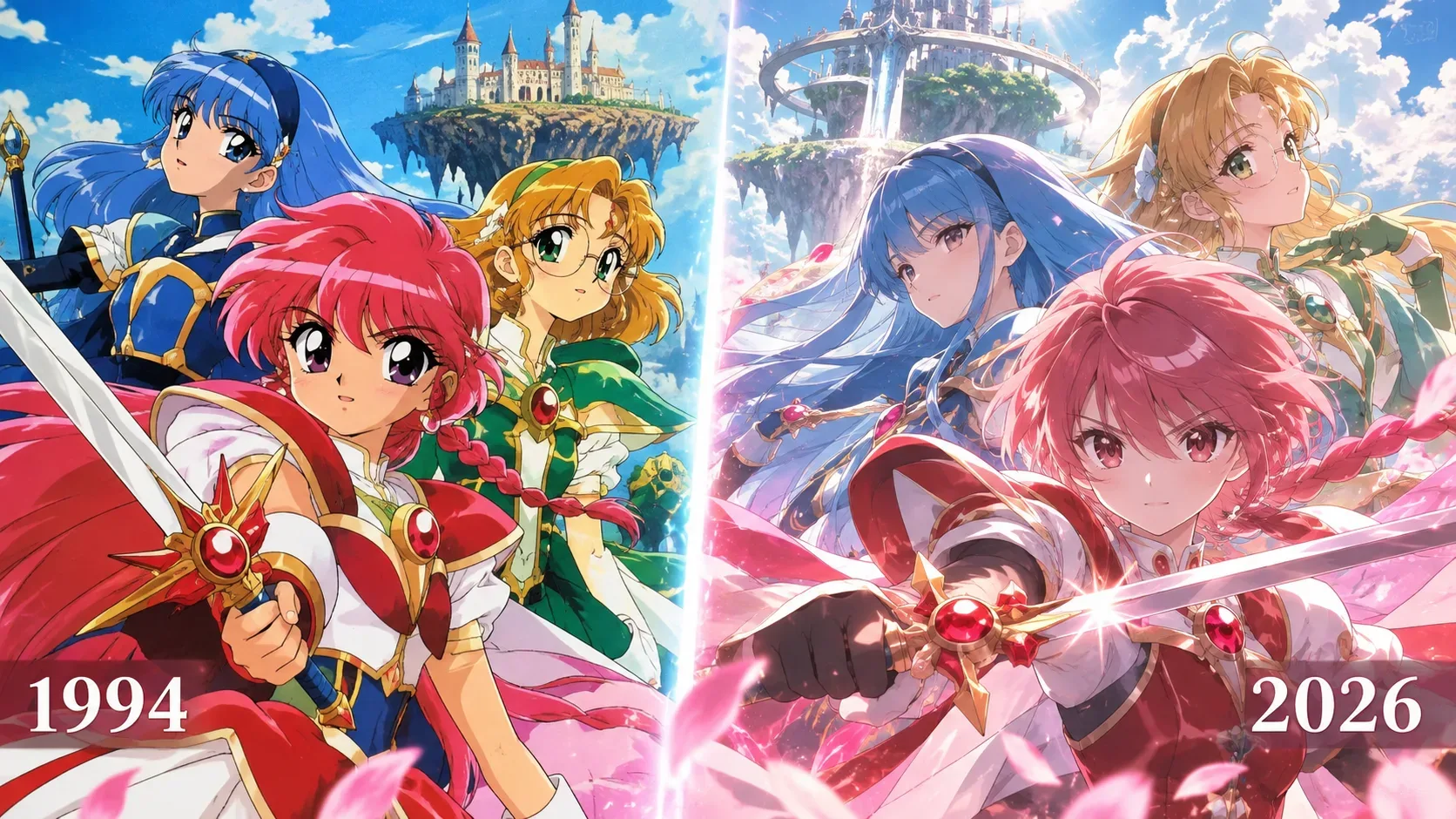
Magic Knight Rayearth (2026) is a new adaptation of CLAMP's work, not a sequel to the anime that began airing in 1994. The production starts again with Hikaru, Umi and Fuu in Cephiro and has a different creative team, new principal voice actors and its own broadcast format. Crunchyroll describes it as a retelling of the classic series.
That means viewers do not need to treat the older show's 49 episodes as a preceding season of the 2026 version. Both anime share characters and source material, but the new series has not been announced as a story taking place after the original TV ending.
Where did the new Rayearth come from?
The manga Magic Knight Rayearth, created by the CLAMP collective and published by Kodansha in Nakayoshi magazine, first became a TV anime in 1994. According to TMS Entertainment's official catalog, the original series ran from October 17, 1994 to November 27, 1995, for a total of 49 episodes.
In July 2024, TMS announced a new animated adaptation project to mark 30 years since that premiere. The announcement concerned a new production rather than a continuation of events already shown on television. The new series premiered in Japan on October 7, 2026.
Rayearth in 1994 versus 2026: the official comparison
The production credits show a clear change in format and personnel. Tokyo Movie Shinsha was involved in making the older series; for 2026, E&H production handles animation, while TMS Entertainment takes part in producing and planning the project.
| Aspect | 1994 anime | 2026 anime |
|---|---|---|
| Production | Original TV anime, 49 episodes | New TV adaptation, two consecutive cours |
| Japanese broadcast | October 17, 1994 to November 27, 1995 | Began October 7, 2026 |
| Studio and production | Tokyo Movie Shinsha, with Yomiuri TV | Animation by E&H production; produced by TMS Entertainment, Kodansha and TV Asahi |
| Director | Toshihiro Hirano | Yui Miura |
| Series composition | Keiko Maruo and Nanase Ohkawa | Shigeru Murakoshi |
| Character design | Atsuko Ishida | Satomi Watanabe |
The two consecutive cours announced for 2026 mean two successive television programming blocks. That is not the same as the original show's 49 episodes, and it does not establish an exact episode count for the new version.
The lead Japanese voice cast has also changed
Comparing TMS's historical catalog with the 2026 official website confirms new performers for the three heroines and Princess Emeraude. These are the original Japanese voice actors, not the cast of any Brazilian Portuguese dub.
| Character | 1994 Japanese voice | 2026 Japanese voice |
|---|---|---|
| Hikaru Shidou | Hekiru Shiina | Ayane Sakura |
| Umi Ryuuzaki | Konami Yoshida | Rumi Okubo |
| Fuu Hououji | Hiroko Kasahara | Rie Takahashi |
| Princess Emeraude | Megumi Ogata | Saori Hayami |
This comparison does not claim that every professional connected to the franchise was replaced or rule out other kinds of participation. It establishes only the role changes listed in the table.
Is the story different? What the documentation actually shows
The premise released for 2026 begins at Tokyo Tower once again: Hikaru, Umi and Fuu are transported to the magical world of Cephiro, learn about a crisis involving the captive Princess Emeraude, and are tasked with becoming the legendary Magic Knights. That matches the basic starting point described in the official synopsis of the 1994 production.
Changes in staff, character designs and voice performances are documented. A list of deleted scenes, altered character fates or a different ending would require a comparison of the relevant episodes from both versions. The announcements and production profiles reviewed here are not sufficient evidence for such claims.
There is one confirmed musical connection: Yuzurenai Negai, performed by Naomi Tamura and used as the first opening song in 1994, appears as an insert song in the first episode of the 2026 anime, according to the official website. This tribute does not make the new series a sequel.
Release and streaming availability in Brazil
The 2026 anime began its Japanese television broadcast on October 7, 2026 in TV Asahi's IMAnimation W slot, with two consecutive cours scheduled. This is the Japanese TV premiere date, not a confirmed time of day for Brazilian streaming.
Crunchyroll lists South America, including Brazil, among its licensed regions and reported in October that the new series was available on its service. Exact release times and audio, subtitle or dubbing options should be checked on the title's Brazilian catalog page; a territorial lineup alone does not verify all those formats.
Do you need to watch the 1994 anime first?
No. Because the 2026 adaptation retells the original premise, it has been presented as a fresh entry point to the adventure. Watching the 1994 anime can help viewers recognize creative decisions, music and production differences, but it is not a documented narrative requirement for understanding the newer adaptation's beginning.
The distinction is straightforward: a remake or new adaptation offers another interpretation of an existing story; a sequel treats previous events as the new plot's history. The announcements reviewed support the former description, not the latter.
Sources and references
- TMS Entertainment: official profile of the 1994 anime
- TMS Entertainment: 2024 announcement of a new anime adaptation
- Official Rayearth (2026) website: staff and cast
- Official Rayearth (2026) website: Japanese broadcast and two cours
- Official Rayearth (2026) website: music and use of the classic opening
- Crunchyroll Brazil: October 2026 seasonal lineup
- Crunchyroll News: streaming availability and production credits