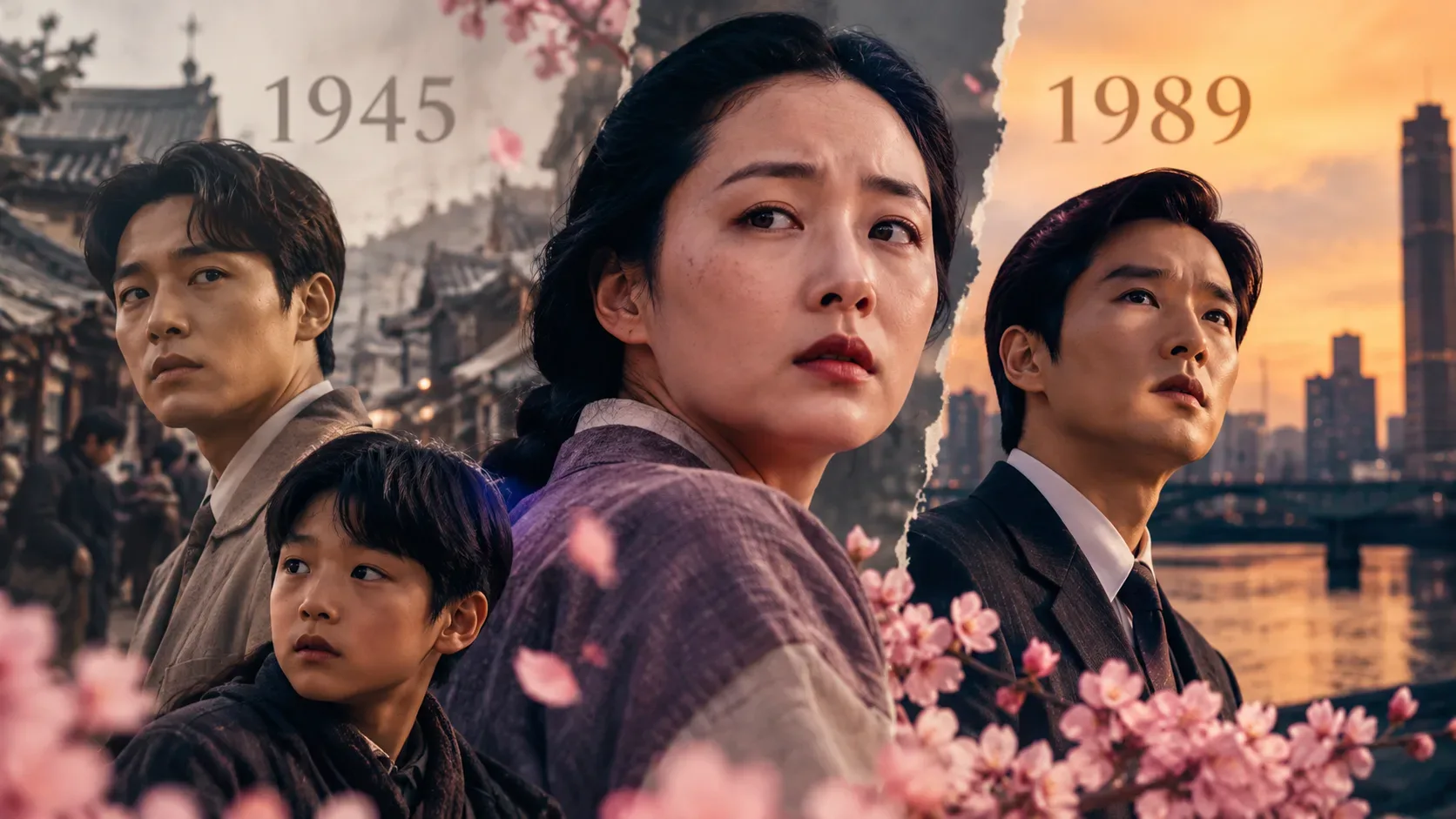
The second season of Pachinko moves between 1945 and 1989 to connect Sunja's struggle to keep her family alive during World War II with her grandson Solomon's life decades later. This editing choice shows how one generation's decisions, losses, and opportunities shape the next. The two strands belong to the same family rather than separate, unrelated stories.
Light spoiler warning: this guide discusses basic family relationships and details from official episode descriptions, but does not reveal the second season's major turns or ending.
Why does the story start in 1945 and return to 1989?
According to Apple's official description, the 1945 storyline opens in Osaka, Japan, where Sunja tries to keep her family safe in the closing months of the war. The other follows Solomon in Tokyo in 1989 as he attempts to rebuild his professional life. These starting points are 44 years apart, but the family's story has not stood still in between.
In the earlier period, Minha Kim plays Sunja. She is already the mother of Noa and Mozasu, and the danger of war directly affects the household's choices. Apple's episode guide states, for example, that she flees Osaka with her children in the season's third episode. Yuh-Jung Youn plays the older Sunja in the later period, which also features adult Mozasu and Solomon.
1945 and 1989 are starting points, not fixed dates for every scene. The earlier storyline moves forward. In the official description of episode six, Apple places the action five years after the end of the war, around 1950. Saying the entire second season takes place in only those two years would therefore leave out part of its chronology.
Family tree: Sunja, Noa, Mozasu, and Solomon
The simplest way to identify the faces and relationships is to put Sunja at the center of the family tree. Noa and Mozasu belong to her children's generation; Solomon comes afterward. The Baek family name also appears across several characters, which can make some connections seem more direct than they are.
- Yangjin → Sunja: Yangjin is Sunja's mother. The family's story begins before the two periods at the center of season two.
- Sunja → Noa: Noa is her older son. He was raised by Baek Isak, Sunja's husband. Questions about Noa's biological parentage become important to the plot and are left unresolved here to preserve a revelation from the season.
- Sunja and Isak → Mozasu: Mozasu is Sunja's younger son and Isak's biological child. Noa and Mozasu are brothers through their mother.
- Mozasu → Solomon: Solomon is Mozasu's son and Sunja's grandson. That is why Yuh-Jung Youn's Sunja is Solomon's grandmother in 1989.
- Isak, Yoseb, and Kyunghee: Yoseb is Isak's brother, and Kyunghee is Yoseb's wife. She is Sunja's sister-in-law and the boys' aunt by marriage, not Sunja's biological sister.
Koh Hansu, played by Lee Minho, is also linked to Sunja's past and to her children's story. The particular connection developed around Noa is something viewers can discover during the season; understanding the basic family tree does not require revealing it ahead of time.
Parallel timeline: which years do we see?
| When | Storyline followed | What defines the period |
|---|---|---|
| 1920s and 1930s | Young Sunja, Korea, and her arrival in Japan | Background covered mainly in season one; the introduction of Sunja, Isak, and the family's formation. |
| 1945 | Sunja, Noa, Mozasu, and relatives in Osaka | World War II; the struggle to survive and the family's relocation, documented in the official episode summaries. |
| Around 1950 | The same generation several years later | Season two's sixth episode jumps five years beyond the end of the war; the past storyline keeps moving forward. |
| 1989 | Older Sunja, adult Mozasu, and Solomon, especially in Tokyo | Solomon's working life and family relationships shaped by the consequences of the past. |
This table organizes narrative periods; it is not a scene-by-scene list in viewing order. The series intercuts the storylines across episodes and can spend different amounts of time with each one. Season one already used this editing approach.
Who plays each generation?
| Character | In the earlier period | In 1989 |
|---|---|---|
| Sunja | Minha Kim, now an adult and mother of two | Yuh-Jung Youn, the same Sunja decades later |
| Noa | Kim Kang-hoon and Kang Tae-ju at different ages | Not part of the main group of characters shown in 1989 |
| Mozasu | Kwon Eun-seong and Mansaku Takada as a child and teenager | Soji Arai as adult Mozasu, Solomon's father |
| Solomon | Not part of Sunja's children's generation depicted in 1945 | Jin Ha, Sunja's grandson and Mozasu's son |
A change of actor marks a character's age or the period on screen, not a different person with the same name. Sunja and Mozasu are especially useful reference points because both appear at very different stages of life.
Does the series alternate periods like the novel?
The alternating timeline is a choice made for television, not a recreation of the order of Min Jin Lee's novel. In an interview with Vogue Singapore, creator Soo Hugh described the book as linear. She explained that intercutting Sunja's past with Solomon's present from the start allowed the show to explore generational burdens, sacrifices, and consequences at the same time.
In a conversation with TVLine, Hugh described another change within the series itself: while season one relied more on comparing the time periods, season two aims for a more continuous conversation between them. That is the showrunner's stated creative intention; it does not mean every 1945 scene corresponds literally to a scene from 1989.
The show also develops its own plotlines and expands characters, particularly in Solomon's section of the story. The editing, length of individual arcs, and some events should therefore not be treated as a chapter-by-chapter index to the book. The novel helps explain the generations, but the order of the episodes was designed for television.
How to follow season two without getting lost
At every shift in time, ask two questions: how old is Sunja? and which generation is at the center? When Noa and Mozasu are children, the story is in the family's past. When Mozasu is already a father and Solomon drives the action, it is the 1989 storyline.
The second season premiered on August 23, 2024, and its eight episodes concluded on October 11, 2024, according to Apple. In Brazil, the official Pachinko page lists the series on the Apple TV service. The reason the split timeline matters is that it makes the distance between the grandmother's experience and the grandson's choices visible without treating one generation's story as finished.
Sources and references
- Apple TV Press Brazil: series page and season two premiere
- Apple TV Press: announcement and description of the two periods
- Apple TV Press: official episode guide and synopses
- Vogue Singapore: Soo Hugh interview about the timeline structure
- TVLine: Soo Hugh interview about transitions between periods
- AsianWiki: cast listed separately for 1945 and 1989
- Akhil Arora: season two character and family relationship guide