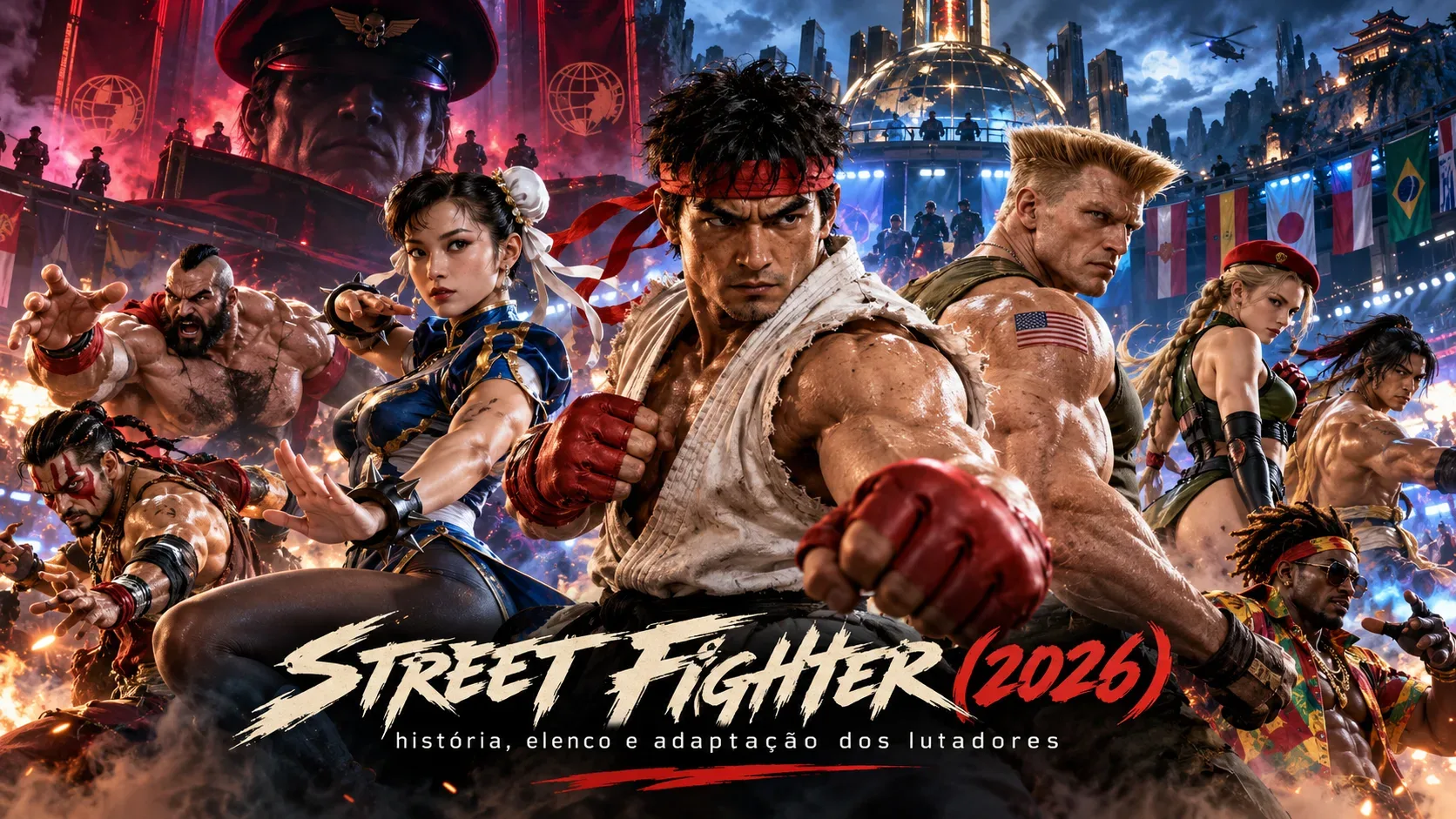
The 2026 Street Fighter movie opened in Brazilian theaters on October 15, 2026. Directed by Kitao Sakurai and set in 1993, it brings Ryu (Andrew Koji), Ken Masters (Noah Centineo), and Chun-Li (Callina Liang) together around the World Warrior Tournament. The premise retains familiar Capcom fighters and combat elements but tells a separate movie story focused on the characters’ relationships and a conspiracy behind the competition.
Cinemark’s Brazilian release date differs from Paramount’s October 16 opening in the United States. The comparison below relies on the official synopsis and cast, Capcom’s published character profiles, and identified reviews of the released film. It does not treat the movie as a scene-by-scene retelling of any single game.
No ending spoilers: this article discusses the premise, the roles of the characters, and how the tournament works, without revealing the ending or post-credits scenes.
What is the story of Street Fighter (2026)?
According to the official synopsis, two former fighting companions have drifted apart. Chun-Li approaches them about entering a new World Warrior Tournament, an international contest that brings together recognizable franchise fighters. Their reunion also revives unresolved conflicts, while a larger threat is hidden behind the championship.
Reviews by Alexandre Almeida at Omelete and Diego Corumba at Canaltech describe how the film draws on the protagonists’ shared past and Ryu’s connection to a dangerous power to give the drama its stakes. M. Bison, played by David Dastmalchian, stands at the center of the conspiracy. These details come from named critics; they are not a complete synopsis or an independently verified account of every scene.
Setting the story in 1993 helps evoke arcade culture, but it does not establish that the film follows the games’ official chronology year by year. The movie has its own version of events.
Who plays Ryu, Ken, Chun-Li and the other fighters?
The official movie website credits characters drawn from different periods of the series. Cammy, played by Mel Jarnson, is also identified in Omelete’s review. This table records casting, not how much screen time each character receives.
| Character | Actor |
|---|---|
| Ryu | Andrew Koji |
| Ken Masters | Noah Centineo |
| Chun-Li | Callina Liang |
| M. Bison | David Dastmalchian |
| Akuma | Joe “Roman Reigns” Anoa’i |
| Guile | Cody Rhodes |
| Dan Hibiki | Andrew Schulz |
| Dhalsim | Vidyut Jammwal |
| Blanka | Jason Momoa |
| Balrog | Curtis “50 Cent” Jackson |
| Vega | Orville Peck |
| Zangief | Olivier Richters |
| E. Honda | Hirooki Goto |
| Juli | Rayna Vallandingham |
| Don Sauvage | Eric André |
| Cammy | Mel Jarnson |
How do the movie versions differ from the games?
Capcom’s character profiles establish the fighters’ identities in the games. The film column describes adaptation choices supported by its official synopsis or the published reviews consulted, without assuming the timelines are identical.
| Character | In the Capcom games | In the 2026 film |
|---|---|---|
| Ryu | A traveling martial artist trained in Ansatsuken who seeks to master the Satsui no Hado. | Andrew Koji plays a fighter haunted by the past, estranged from Ken and drawn back into the tournament; his struggle with his own power becomes a dramatic focus. |
| Ken Masters | Ryu’s training partner and rival, a wealthy family man who practices the same martial art. | Noah Centineo portrays a more celebrity-like Ken with grievances linked to his falling-out with Ryu, according to the reviews. |
| Chun-Li | A kung fu fighter and investigator pursuing Shadaloo, with a personal reason to oppose Bison. | Callina Liang’s character recruits Ryu and Ken. Canaltech also discusses her investigation and desire for revenge. |
| M. Bison | Shadaloo’s leader, associated with Psycho Power and the ambition to dominate other fighters. | David Dastmalchian plays the antagonist who engineers the tournament as part of a wider conspiracy. |
| Akuma | A fighter connected to the Satsui no Hado, embodying the pursuit of extreme power. | Joe Anoa’i portrays a key figure in Ryu’s supernatural conflict, according to published reviews. |
| Guile | An American military fighter who repeatedly opposes threats from Shadaloo. | Cody Rhodes brings Guile into the ensemble, although Omelete argues that his action scenes are limited. |
| Blanka | A Brazilian fighter known for his green appearance, electricity, and rolling attacks. | Jason Momoa plays the live-action version. Omelete comments on the digital makeup and limited role. |
| Dan Hibiki | A humorous fighter associated with the Saikyo style across several games. | Andrew Schulz gets a comic role and meaningful narrative presence, according to Omelete and Canaltech. |
Is the tournament the same as Street Fighter II?
No. The film borrows the most recognizable idea from Street Fighter II: fighters representing varied countries and styles entering a competition. In the games, players advance through successive matches and individual character stories. In the film, the event also brings the cast together, renews Ryu and Ken’s conflict, and advances Bison’s scheme.
That distinction separates faithfulness to the roster from faithfulness to the fighting format. The large cast evokes the games, but the editing does not present every match like a playable stage. Omelete criticizes fights that are cut short or take place largely off-screen. Canaltech, by contrast, praises the special moves and the interplay of action, comedy, and storytelling.
Likewise, the 1993 setting should not be read as proof that every fighter must match the roster of one particular arcade release. The movie draws characters from different eras of the franchise, an adaptation choice rather than a claim of strict continuity.
Special moves, costumes and nostalgia: what survives?
Official promotional material mentions Hadoukens and the franchise’s signature kicks. The reviews consulted note recognizable costumes, bright colors, a soundtrack evoking the 1990s, and animated sequences. Capcom’s own material provides context for these references: Ryu and Ken share a fighting tradition, Bison wields Psycho Power, and Blanka uses electricity and body-first attacks.
That visual familiarity does not mean the story is identical. The adaptation reshapes recognizable identities and relationships into a new plot, while judgments about execution belong to critics rather than to studio announcements.
What have Brazilian critics said?
The two reviews consulted reach different conclusions. Writing at Omelete on October 15, Alexandre Almeida praises aspects of the visuals and Callina Liang’s performance but argues that choppy editing weakens the fights and the crowded cast scatters the story. At Canaltech on the same date, Diego Corumba praises the humor, core cast, and translation of the fighting moves, while questioning the open-ended conclusion.
These are the named reviewers’ opinions, not a first-hand review written after watching the film or a claim that all critics agree.
When did it open in Brazil, and where can you watch it?
Cinemark Brazil lists a October 15, 2026 theatrical opening, Paramount distribution, a Brazilian age rating of 14, and a running time of roughly 120 minutes. As of October 18, 2026, theaters are the confirmed viewing option in Brazil; this research did not verify any date for inclusion in a subscription streaming catalog. Showtimes and formats vary by location.
Sources and references
- Official Street Fighter website: synopsis, cast and crew
- Cinemark Brazil: release, age rating and running time
- Capcom: official film production announcement
- Capcom: Ryu character profile
- Capcom: Ken Masters character profile
- Capcom: Chun-Li character profile
- Capcom: M. Bison character profile
- Capcom: Akuma character profile
- Capcom: Blanka character profile
- Omelete: review by Alexandre Almeida, October 15, 2026
- Canaltech: review by Diego Corumba, October 15, 2026