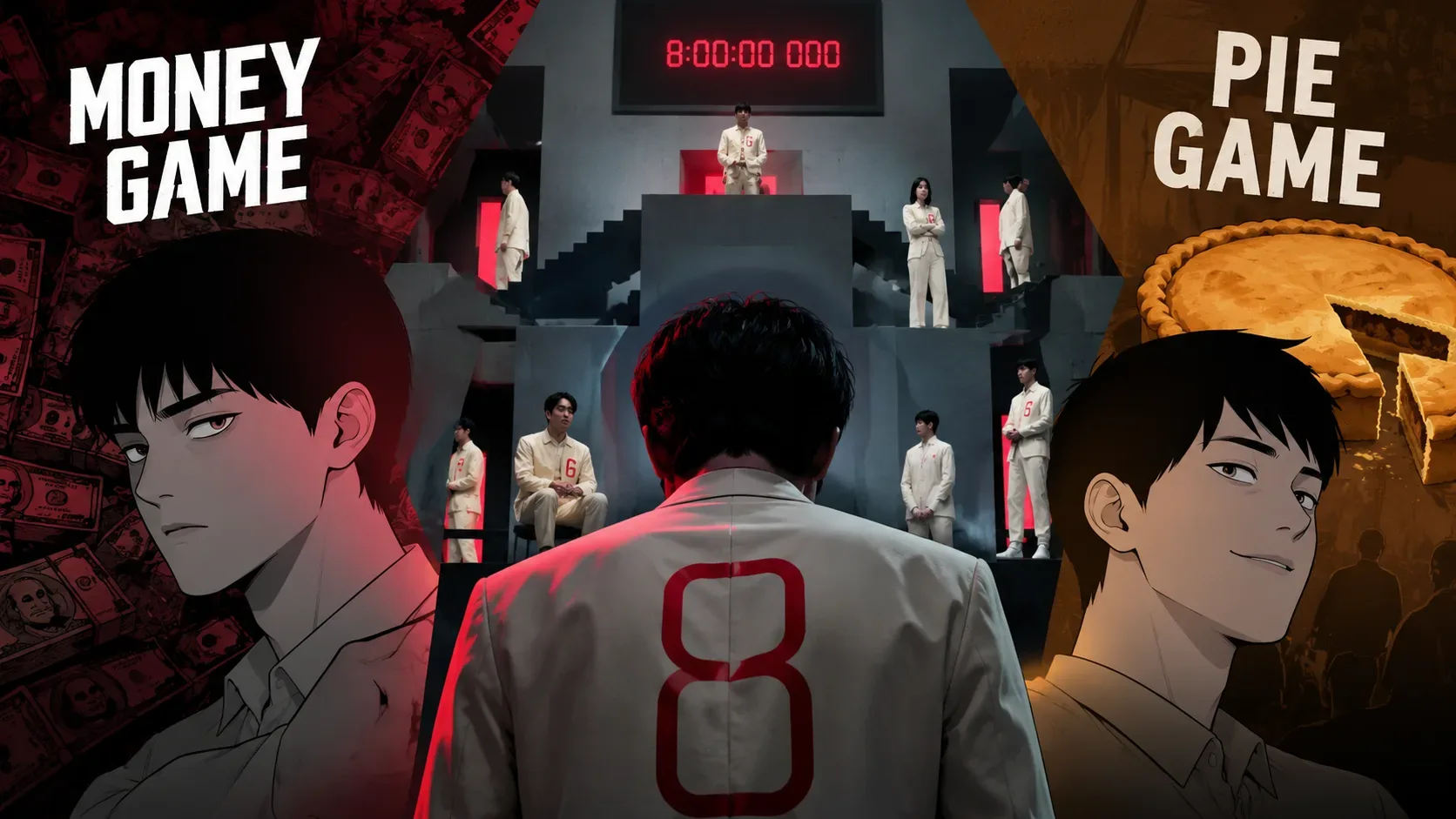
The 8 Show draws on two separate webtoons by Bae Jin-soo. From Money Game, it takes a premise built around confined contestants and an economic experiment that puts them under pressure. From Pie Game, it draws on time as a resource that can be increased or spent, individual earnings, and the need to cooperate with people who are also competitors. Netflix’s series reshapes these concepts into one eight-floor contest with its own rules.
Notice: mild spoilers for the premises and general rules, with no ending revealed. This comparison relies on WEBTOON’s official descriptions, Netflix’s explanations, and remarks by director Han Jae-rim. It is not a chapter-by-chapter account of the comics or a scene-by-scene breakdown of the adaptation.
Money Game, Pie Game and The 8 Show: how do the rules differ?
WEBTOON identifies Pie Game as a sequel to Money Game, yet their official descriptions set out distinct competition formats. Netflix confirms a third setup for its eight-episode series, released on May 17, 2024.
| Feature | Money Game (webtoon) | Pie Game (webtoon) | The 8 Show (series) |
|---|---|---|---|
| Contestants and setting | 8 contestants in an enclosed set. | 7 contestants in a 7-floor set. | 8 contestants assigned to 8 floors. |
| Time in the premise | A 100-day period. | An initial 24-hour countdown that can be extended. | A countdown clock; activities can add time. The consulted sources do not establish the same initial deadline as either comic. |
| Prize money | A shared 44.8 billion won fund that contestants try to preserve. | Individual prize pots that grow as time passes. | Time-based earnings, with unequal amounts depending on the floor. |
| Cost of purchases | Every purchased item costs 1,000 times its normal price. | Purchases, apart from the daily rations noted in the synopsis, use up time. | The consulted official material does not establish a direct equivalent of either purchase-pricing rule. |
| Main incentive | Spend as little as possible to preserve more of the shared fund. | Extend the available time and increase individual prize pots. | Keep the clock running to benefit the group, despite unequal payouts and internal conflicts. |
What did the series take from each webtoon?
The connection to Money Game is clearest in the number of contestants and the confinement experiment: a group faces artificial economic rules and must decide what to sacrifice for money. The crucial distinction is the mechanism. The comic’s official synopsis specifies 100 days and a shared 44.8 billion won fund, depleted by purchases priced at 1,000 times their usual cost. Netflix does not describe the television series as operating under that exact prize formula.
Pie Game provides closer parallels for the link between time and personal reward. Its WEBTOON page describes seven people on seven floors, beginning with 24 hours; money accumulates individually, while buying items reduces the available time. The synopsis also says bloodshed can increase the game’s duration. That is part of the webtoon’s description: the consulted official sources do not establish that every such mechanism works identically in the adaptation.
In the television version, Netflix places eight contestants on eight floors. Earnings increase as time passes, but not at the same rate for everyone. The official episode descriptions also indicate that contestants discover activities that add time to the clock. Preserving a shared prize and extending the contest, once parts of separate setups, therefore feed into a single dramatic conflict.
Why did the director combine the two stories?
Han Jae-rim explained his decision at a Seoul press conference reported by Yonhap on May 10, 2024. While developing a survival narrative, he had been considering the limitations of a format in which characters are progressively eliminated. In Pie Game, he found a no-killing rule that required the participants to cooperate in order to win. Combining it with Money Game, with the creator’s permission, allowed him to explore the tension between necessary cooperation and personal interests.
Netflix also describes a rule in The 8 Show under which everyone loses the prize money if any participant dies. Without discussing later plot developments, the dramatic consequence is clear: inequality does not remove the need to coexist. Contestants depend on one another while competing for different outcomes.
What is the biggest difference for viewers?
The two webtoons are not interchangeable names for the same plot, and the series is not a complete, sequential retelling of both. Money Game centers its premise on preserving a common fund; Pie Game shifts attention toward the available time and individual prize pots. The 8 Show brings those tensions together with the floors’ visual hierarchy, which Netflix itself describes as a metaphor for social inequality.
This is why the differences in contestant counts, time limits, and reward systems can already be explained through public documentation. Claims about specific scenes, complete character arcs, or endings would require examining the full narratives of each version; the synopses alone cannot establish them.