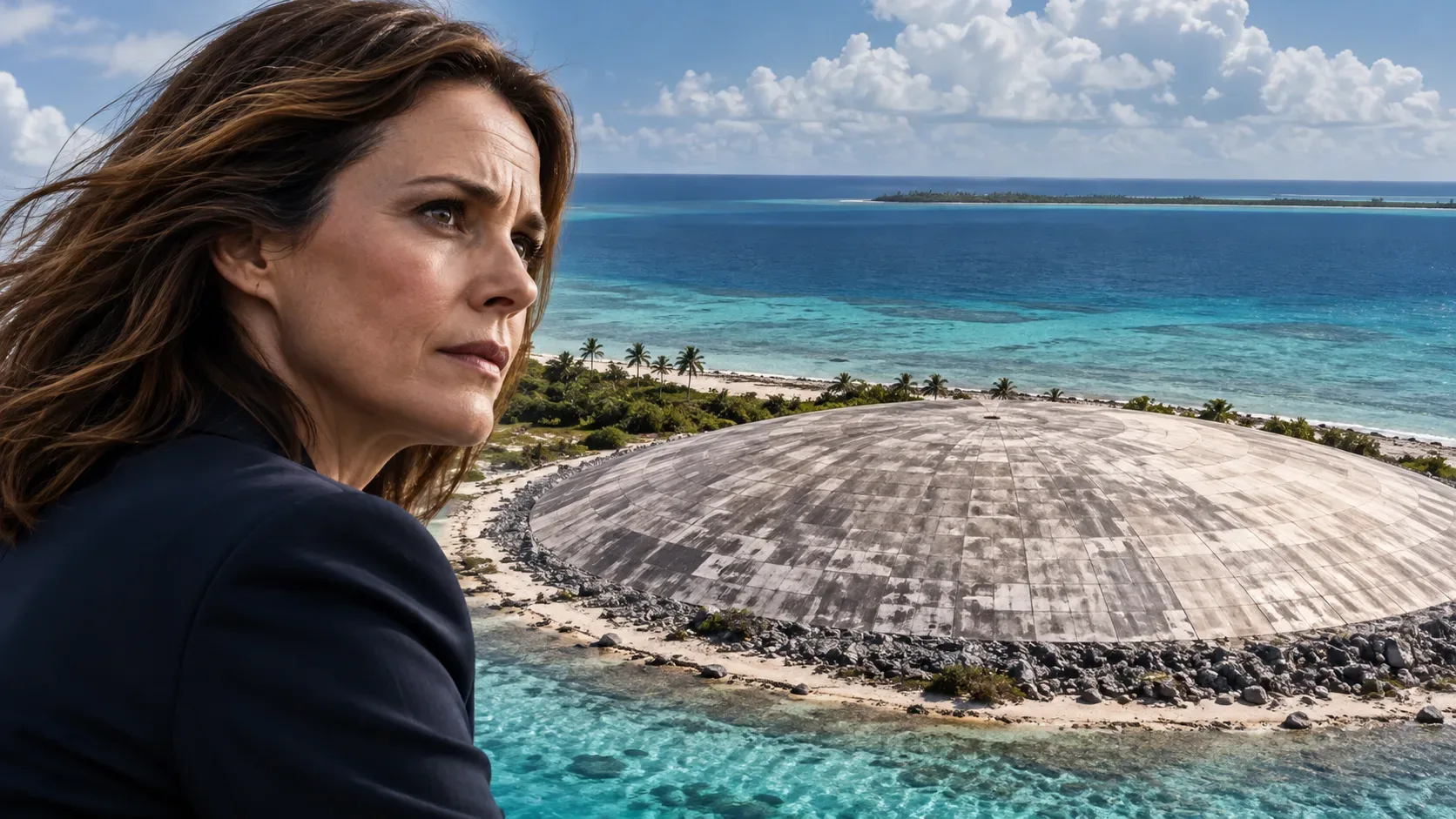
The Runit Dome mentioned in The Diplomat is real. It is a concrete containment structure built over a crater holding soil and debris contaminated by U.S. nuclear weapons testing in the Marshall Islands. The invention is the show’s use of that history as the model for a plan to neutralize a Russian submarine and its nuclear weapon. Neither the espionage scheme nor the weapon’s fate is a documented event at Runit.
Warning: full spoilers for the end of The Diplomat Season 3, particularly Episodes 7 and 8.
How the series turns Runit Dome into an answer to the nuclear crisis
In Season 3, Russia loses contact with a submarine that, within the story, carries the Poseidon nuclear torpedo. The resulting crisis draws in the United Kingdom and the United States, with the possibility that another power might gain access to the weapon. British prime minister Nicol Trowbridge distrusts American motives and pushes back against proposed responses.
Hal Wyler suggests that Kate offer Trowbridge a solution modeled on Runit: cover the submarine and its weapon in concrete so no country can use them. Kate brings the argument into the negotiations. The Marshall Islands site serves as a political analogy within the story, not as evidence that a real submarine-disposal operation took place there.
The finale overturns the apparent resolution. Callum Ellis reports that the submarine has been found, but Poseidon is missing. Kate uncovers signs that President Grace Penn and Hal sent an American submarine to remove the weapon despite describing the mission as drone reconnaissance. Netflix’s subsequent-season recap treats the theft as an event within the fictional plot. None of this should be confused with operations at the real Runit Dome.
Where is the real Runit Tomb, and why was it built?
Runit is an island in Enewetak Atoll, in the Republic of the Marshall Islands in the Pacific Ocean. Between 1948 and 1958, the United States carried out 43 atmospheric nuclear tests at Enewetak. One of them, the 1958 Cactus test, created the crater later used for radiological cleanup.
The Enewetak cleanup, conducted mainly from 1977 to 1980, brought contaminated soil and debris to Runit. According to the U.S. Department of Energy’s November 2022 report, about 100,000 cubic yards of contaminated soil and another 6,000 cubic yards of debris were placed in Cactus Crater, which was not fitted with an impermeable bottom liner. The material was incorporated into cement mixtures and protected with a concrete cap.
The report describes an exterior cap made of 357 trapezoidal panels plus an upper section. The structure is approximately 114 meters across and 7.3 meters high. Its stated purpose was to reduce erosion of the deposited material, not to make an airtight vault completely isolated from its surroundings. Runit remained uninhabited after other parts of Enewetak were resettled.
What do the records say about cracks and environmental risk?
Visual inspections in 2013 and 2018 identified cracks and surface spalling around some joints and edges. In its 2022 report, the Department of Energy found that the observed defects were not structural and that the concrete cap continued to function as a barrier against erosion. Lawrence Livermore National Laboratory also documents repairs and a drone survey in 2018.
Based on the evidence available at the time, that report concluded that no significant change in health risks to Enewetak residents from the structure’s contents had been demonstrated. It also found no clear evidence of a measurable impact from crater-derived radioactivity on offshore waters under the conditions studied. These are findings within a defined study, not claims of zero risk, complete cleanup of the lagoon, or permanent safety.
The Department of Energy itself acknowledges that the dome remains a major concern for people in the Marshall Islands. Enewetak Lagoon also contains historic contamination in its sediments, which cannot automatically be attributed to the dome. The federal program calls for visual surveys and radiochemical groundwater testing at least every four years, with separate work addressing climate-change impacts.
As checked on October 30, 2026, the official page for the 2026 report described the period covered by its activities but still said the full report was coming soon. It would therefore be inaccurate to present final findings from that document as already published.
Fact versus fiction: side-by-side
| Question | Real-world documentation | Role in Season 3 |
|---|---|---|
| Does the dome exist? | Yes. It is the Cactus Crater containment structure on Runit Island. | Yes. Hal and Kate invoke it as a historical precedent. |
| What was placed inside? | Contaminated soil and debris from Enewetak testing and cleanup. | The proposal applies concrete covering to a submarine carrying a nuclear weapon. |
| Is the site completely sealed? | No. The crater lacks a bottom liner, and the cap was designed to reduce erosion. | The plan promises to keep the weapon out of reach without establishing comparable engineering. |
| Was there a Poseidon operation at Runit? | No such operation appears in the public sources consulted. | The submarine mission and the maneuver by Hal and Grace are fictional plot events. |
| What risk is documented? | There is a legacy of contamination and ongoing monitoring; the 2022 findings have specific limits. | The show uses the comparison to frame a fictional military threat and diplomatic conflict. |
Why the comparison only goes so far
The writers draw on a real place with a serious environmental history, but the situations differ greatly. At Enewetak, containment was a historical response to waste already present after decades of nuclear testing. In the series, that image becomes a proposed way to immobilize a weapon aboard a submarine at sea during an international crisis.
The public documents consulted do not establish that this adaptation would be technically feasible, nor do they document an identical real-world operation. The answer has two parts: the Runit Tomb and the Marshall Islands’ nuclear legacy are real; the conspiracy, the removal of Poseidon, and the submarine solution belong to The Diplomat’s story.
Sources and references
- Netflix Tudum: Season 3 ending explained
- Netflix Tudum: Season 3 recap
- U.S. Department of Energy: Marshall Islands Program
- U.S. Department of Energy: November 2022 technical report (PDF)
- Lawrence Livermore National Laboratory: Enewetak Atoll history
- Lawrence Livermore National Laboratory: Runit Dome inspection and documentation
- U.S. Department of Energy: 2026 report page, full report not yet posted when checked