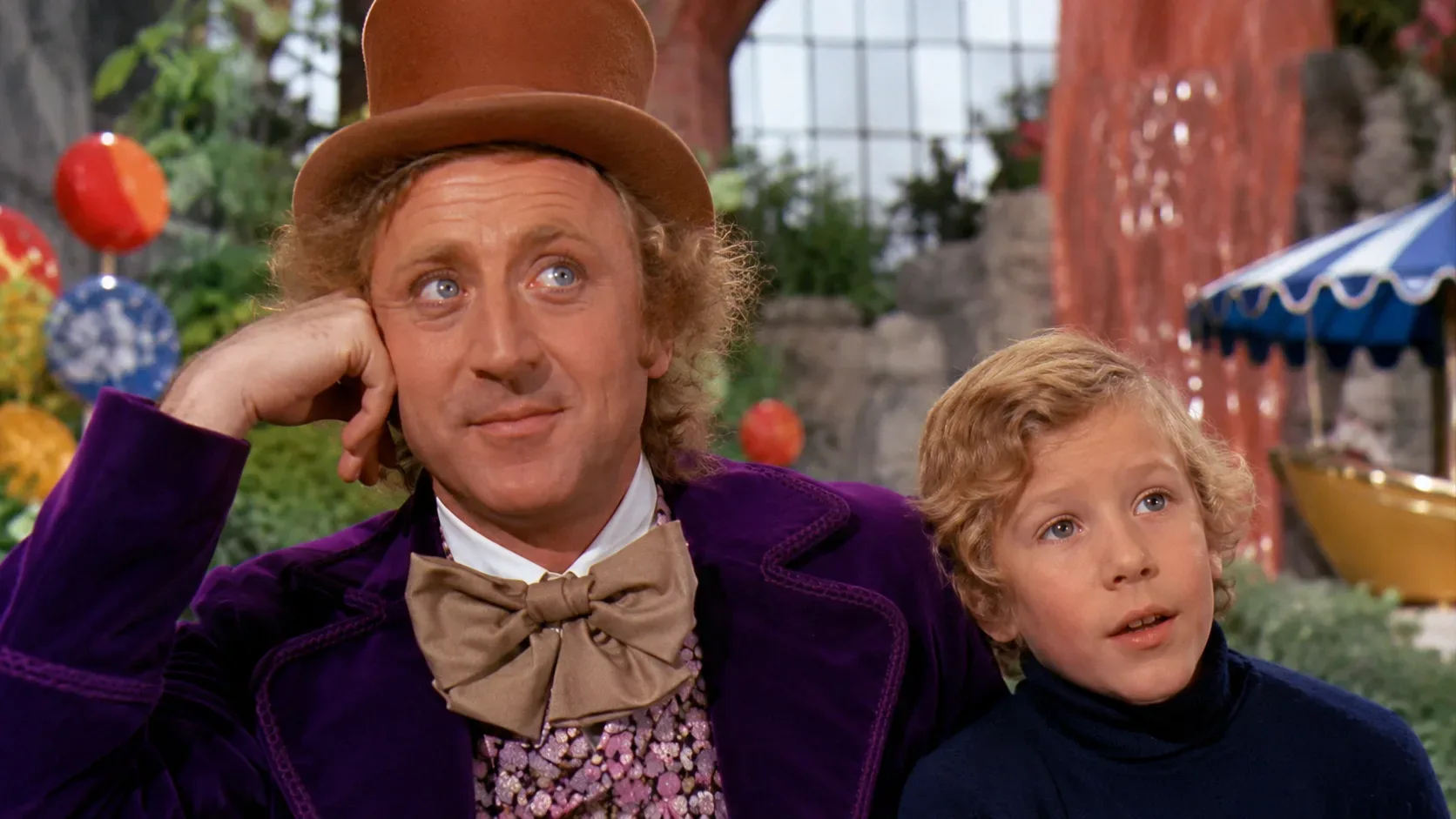
Spoiler warning: this article reveals the entire plot and ending of the 1971 film.
Willy Wonka chooses Charlie Bucket because the boy shows honesty when he has every opportunity to take advantage. At the end of Willy Wonka & the Chocolate Factory (1971), Charlie returns a secret candy to Wonka despite being told he has forfeited his prize by breaking the rules. That decision completes a test set up by the factory owner and explains why Charlie receives something far more valuable than a lifetime supply of chocolate.
This recap covers only Mel Stuart’s 1971 musical, starring Gene Wilder as Wonka, Peter Ostrum as Charlie and Jack Albertson as Grandpa Joe. It adapts Roald Dahl’s novel, but several crucial plot elements were expanded or altered for the film.
How Charlie finds the Golden Ticket
Charlie lives in a modest home with his mother and four grandparents. His family struggles financially, but he remains fascinated by the huge candy factory nearby. Grandpa Joe explains that confectioner Willy Wonka once closed it after rival companies’ spies stole secret recipes. The factory later resumed production, although nobody saw its new workers entering or leaving.
Wonka announces that five chocolate bars contain Golden Tickets. Their owners will be admitted to the factory and promised chocolate for life. Augustus Gloop, Veruca Salt, Violet Beauregarde and Mike Teevee find the first four tickets. When reports say the fifth has been claimed by a man in Paraguay, Charlie thinks his chance has gone. But the ticket is exposed as a forgery.
Soon afterward, Charlie finds money on the street, buys one chocolate bar and gets another for his grandfather. The second purchase reveals the genuine fifth ticket. On his way home, a man calling himself Slugworth offers Charlie a fortune if he hands over one of Wonka’s inventions, the Everlasting Gobstopper, a candy that never gets smaller. The offer sounds like a route out of poverty, but it introduces the story’s central moral dilemma.
What happens to the other four children inside the factory
The next day, Charlie enters the factory with Grandpa Joe, who gets out of bed and walks again to attend the tour. Wonka approaches the guests with a limp, then surprises everyone by performing a somersault. According to the British Film Institute, Gene Wilder proposed that introduction to establish Wonka as unpredictable. The visitors sign a contract before seeing the Chocolate Room, its chocolate river and the Oompa-Loompas who work there.
The tour alternates astonishing inventions with warnings the guests ignore. A boat trip through a frightening tunnel reinforces the sense that ordinary rules do not apply inside the factory. One by one, the other winners leave the group after persisting in behavior Wonka warned them against.
| Child | What they do | Consequence in the 1971 film |
|---|---|---|
| Augustus Gloop | Drinks from the chocolate river against instructions. | Falls into the river and is sucked into a pipe; factory workers are sent to help. |
| Violet Beauregarde | Chews experimental gum before it is ready. | Swells up and turns blue like a blueberry; Oompa-Loompas take her away for treatment. |
| Veruca Salt | Demands one of the geese that lay golden eggs. | The egg sorter judges her a bad egg, and she falls down a disposal chute; her father follows. |
| Mike Teevee | Uses the device that transmits chocolate through television. | Is shrunk to a tiny size and taken away so his original height can be restored. |
The Oompa-Loompas sing about each guest’s flaws, connecting the mishaps to traits such as gluttony, entitlement or obsession with television. The film frames these episodes as fantastical consequences and sends the children for help; it does not show any of them dying.
Charlie breaks the rules too: why the Fizzy Lifting Drinks matter
Charlie’s behavior on the tour is not spotless. He and Grandpa Joe secretly sample the Fizzy Lifting Drinks, fizzy beverages that make them float. Their adventure turns dangerous as they approach a ceiling fan. They manage to descend by burping and rejoin the tour, but their rule-breaking has consequences.
After everyone else has left, Wonka abruptly dismisses Charlie and Joe. Asked about the promised chocolate, he points to the contract the boy signed: using the drink without permission disqualifies them from the prize. Joe reacts angrily and suggests that Charlie give the secret candy to Slugworth as revenge.
This is the detail that changes the meaning of the ending. Charlie is not rewarded for never making a mistake. He really did disobey. What matters next is how he responds to his own failure and to the chance of making money by betraying Wonka’s trust.
Who Slugworth really is and how the honesty test works
Instead of taking his grandfather’s advice, Charlie walks back to Wonka’s desk and leaves the Everlasting Gobstopper he received during the visit. He asks for no money and does not bargain. The gesture changes Wonka’s attitude: the confectioner drops his hostility and tells the boy he has won.
Wonka then reveals that the man who approached the ticket holders as Slugworth was actually Mr. Wilkinson, one of his employees in disguise. The mysterious visitor was not acting for a competitor: he was part of a setup devised by Wonka. The name Slugworth had previously been mentioned as a rival candy maker, but the man offering Charlie money was using a false identity.
The plan was designed to find out whether the children would protect a valuable invention even when offered a tempting reward. Charlie’s response is especially significant because his family needs money and he has just been told he will get nothing. The decisive test is less about perfection than about integrity under pressure. That is the behavior on which Wonka bases his choice.
Ending explained: why the glass elevator carries Charlie out of the factory
Once the test is revealed, Wonka invites Charlie and Grandpa Joe into the Wonkavator, a glass elevator that can travel in different directions. Charlie presses a button, and it bursts through the glass roof, taking all three above the town. Wonka then explains the Golden Ticket contest’s real purpose: to find an honest child who can inherit the factory and care for the Oompa-Loompas when Wonka steps aside.
The true prize, then, is the factory itself. Wonka also makes clear that Charlie’s entire family can move in. The offer answers the financial hardship established at the start of the story without separating the boy from his family. The lifetime chocolate supply is no longer the most important reward.
The flight does not reveal a second contest or a hidden punishment. In the story, it introduces Charlie’s new life. As a visual interpretation, rising beyond the factory walls can represent the change from a boy who could only look at the building from outside to the person who will own it. The film treats that transition as a happy ending.
What is distinctive about the 1971 adaptation
The American Film Institute’s catalog notes that the adaptation expanded elements mentioned in Roald Dahl’s novel, especially Slugworth, the everlasting candy and the fizzy drinks that make people float. These additions made room for the espionage offer, Charlie’s own rule-breaking and his return of the candy as a decisive test. That chain of events is distinctive to the 1971 film and should not automatically be attributed to other versions.
Other easily confused details matter as well: in this version, Veruca falls through the chute in a room filled with geese that lay golden eggs, whereas the book features squirrels sorting nuts. Tim Burton’s 2005 film, starring Johnny Depp, is a separate adaptation of the same novel, not a continuation of Gene Wilder’s story. To understand Charlie’s victory in 1971, follow the events of that film: the forbidden drink, the threatened loss of the prize, the decision to return the Gobstopper, Wilkinson’s reveal and the inheritance of the factory.