Spoiler warning: this article reveals the complete story and ending of The Texas Chain Saw Massacre (1974).
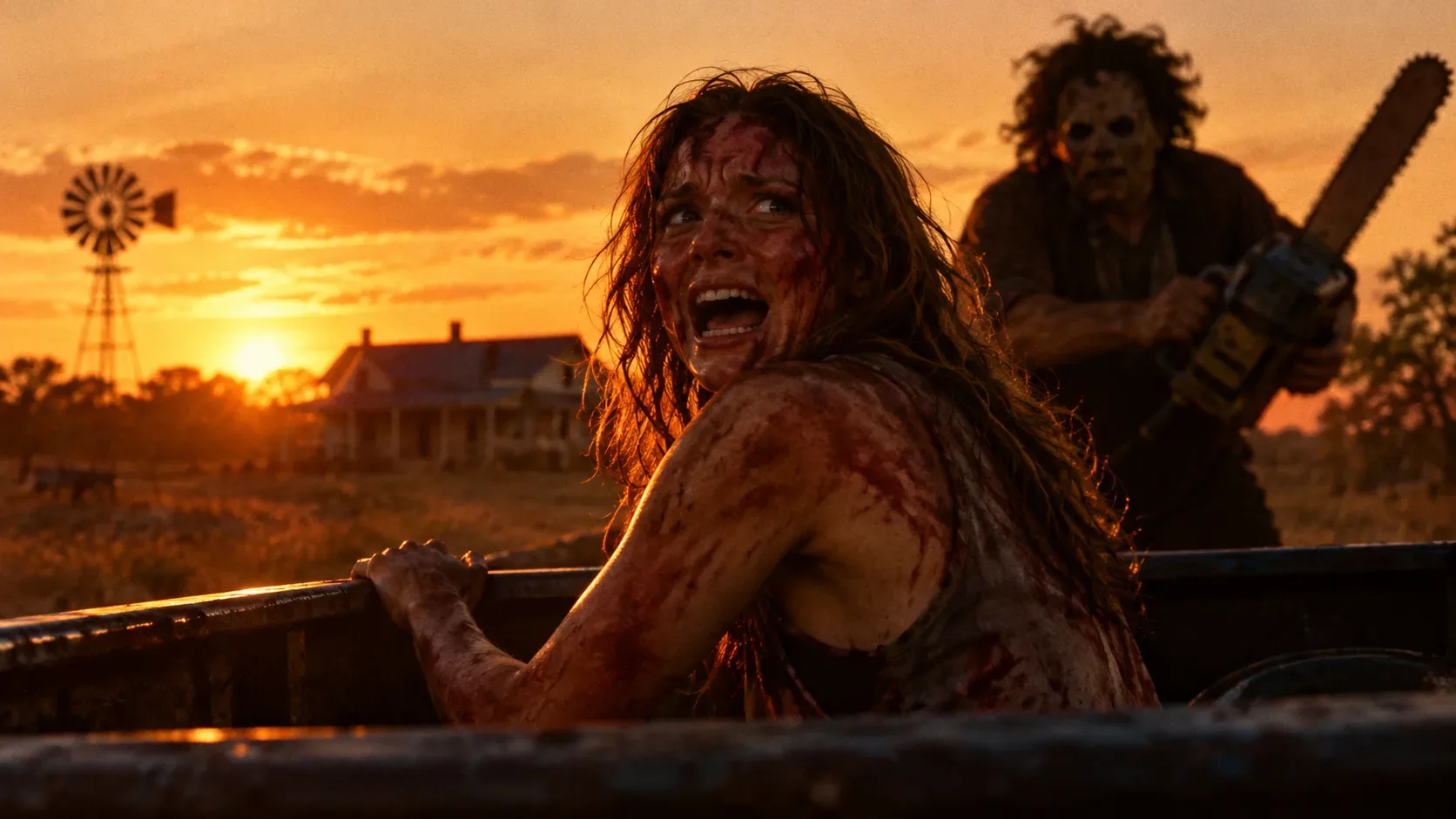
Sally Hardesty survives by escaping the killers' house and reaching the road at dawn. A large truck runs over the hitchhiker pursuing her, and its driver then strikes Leatherface with a wrench. Sally does not leave in that truck, however: she escapes in the bed of a second vehicle, a passing pickup. The film ends with her laughing uncontrollably as Leatherface, still alive, swings his chainsaw. The killers are not arrested, and the film does not confirm what happens to Sally after her escape.
This is the ending of the original The Texas Chain Saw Massacre, directed by Tobe Hooper and released in 1974, not the 2022 Texas Chainsaw Massacre. Here is how the story arrives at that final pursuit.
Why do Sally and her friends travel to rural Texas?
Set in 1973, the story begins with news of desecrated graves. Sally and her brother Franklin Hardesty, who uses a wheelchair, travel to check their grandfather's grave. They are joined in a van by Jerry, Pam and Kirk. The grave is undisturbed, but the group decides to visit the old Hardesty family home nearby.
Along the way, the travelers pick up a stranger who talks about slaughterhouses, displays disturbing photographs and cuts his own hand. When Franklin refuses to buy a photograph taken of him, the man slashes Franklin's arm with a blade. Thrown out of the van, the hitchhiker leaves a bloody mark on it. The group then stops at a gas station whose owner says there is no fuel available. They continue toward the Hardesty house without realizing that they have encountered members of a dangerous family.
What happens to Kirk, Pam, Jerry and Franklin?
The search for gasoline and the missing friends draws the travelers toward another house, home to Leatherface, a man who wears a mask made of human skin. The victims disappear one after another:
- Kirk: hearing a generator, he approaches the neighboring house hoping to obtain gasoline. He walks through the door and Leatherface hits him in the head with a sledgehammer.
- Pam: searching for Kirk, she finds a room filled with bones and disturbing furniture and tries to escape. Leatherface catches her and places her on a meat hook. Later, she is found barely alive inside a freezer.
- Jerry: he goes looking for the couple. At the same house, he opens the freezer and discovers Pam, but Leatherface ambushes and kills him with a sledgehammer.
- Franklin: after dark, he accompanies Sally to search for the others. Leatherface suddenly attacks in the woods and kills him with the chainsaw. Sally runs away alone.
With all four companions gone, Sally is left on her own. From Franklin's death onward, the story follows her struggle to survive the night.
Who belongs to Leatherface's family?
Fleeing the chainsaw, Sally enters the killers' house believing she might find safety. Upstairs she discovers extremely aged human figures that appear to be dead. She jumps from a window and reaches the gas station, where the proprietor initially offers help. It is a trap: he attacks her, ties her up and drives her back to the house.
The gas station owner acts as the family's leader and is identified in the AFI's account as the father of Leatherface and the hitchhiker who attacked Franklin. The hitchhiker is therefore Leatherface's brother. The household also includes Grandpa, so frail that he initially resembles a corpse even though he is alive. The indications of cannibalism are tied to the family's slaughterhouse practices, furnishings made from human remains and treatment of their victims.
During the dinner scene, Sally is restrained and tormented by the family. They cut one of her fingers so Grandpa can suck her blood, then try to make him kill her with a hammer, as though reenacting an old slaughterhouse skill. His weakness, the men's arguments and Sally's resistance create an unexpected chance to escape.
How exactly does Sally escape in the 1974 ending?
- She breaks free: Sally escapes her captors, jumps through another window and runs toward the road as daylight appears. Leatherface and the hitchhiker chase her.
- The hitchhiker dies: while trying to catch Sally, he is run over by a large truck passing on the road. The accident stops one pursuer but does not eliminate Leatherface.
- The truck driver intervenes: Sally tries to take refuge near the truck. As Leatherface approaches, the driver throws a wrench at him. The blow knocks him down and his own chainsaw injures his leg. The driver flees on foot without taking Sally with him.
- A different pickup takes her away: still pursued, Sally waves down an approaching pickup and climbs into its bed. The vehicle pulls away before Leatherface can catch her.
The distinction between the two vehicles matters: the larger truck helps stop the attackers, while the pickup that arrives afterward actually carries Sally away. She does not defeat Leatherface in a direct confrontation. Her survival depends on continuing to run as well as on what happens on the road.
Why does Sally laugh while Leatherface swings the chainsaw?
The final image contrasts two movements. Covered in blood, Sally rides away in the truck bed, laughing hysterically; Leatherface is left behind, spinning and brandishing the chainsaw in frustration. What the film establishes is Sally's physical escape and her pursuer's immediate failure to catch her. He is still alive at the end.
As an interpretation, Sally's laughter can be read as an extreme response to the terror and violence she has just endured, not as proof that she is unharmed or that the ordeal has no lasting effects. The film offers no medical assessment of her emotional state, nor does it tell us whether she reaches the police or how she lives after that dawn. Leatherface's movements visually express rage and helplessness at her escape, rather than another killing or a victory.
Was the 1974 story real, and what about the 2022 film?
The original film's opening presents its events as true, but that framing is a storytelling device. The American Film Institute connects the film's conception to stories involving the criminal Ed Gein and the tradition of horror fiction; there is no evidence that Sally's road trip, the family and her escape happened as depicted.
The Netflix film released in 2022 revisits elements and characters from the franchise, but it is a separate production. The road chase, the two vehicles and the final scene described here belong solely to Tobe Hooper's original.
Sources and references
- American Film Institute: 1974 film record, credits and detailed synopsis
- Dark Sky Films: distributor's page for the original film
- British Film Institute: film identification and historical context
- Texas State Historical Association: production history and influences
- Netflix Tudum: franchise timeline and distinction from the 2022 sequel