Spoiler warning: the following text reveals the entire story and ending of Predator (1987).
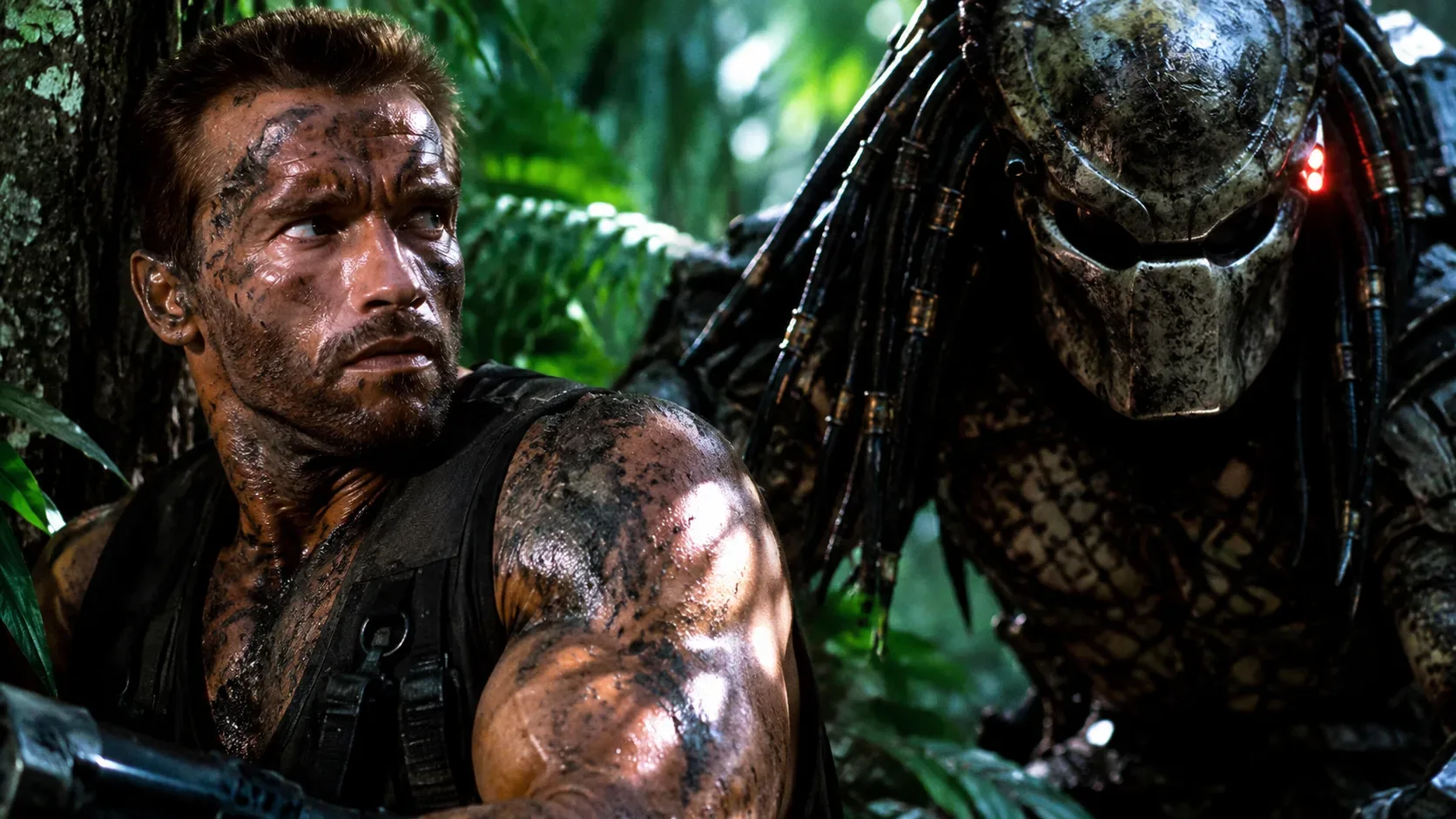
Dutch defeats the alien by discovering that cool mud makes him harder to detect through thermal vision and by luring the creature into a trap built around a heavy log. The Predator is gravely injured but still activates a self-destruct device on its wrist. Dutch escapes the explosion and is rescued. The mud does not kill the enemy: it gives the protagonist the chance to plan and carry out his strategy.
Directed by John McTiernan, Predator follows Major Dutch Schaefer (Arnold Schwarzenegger), CIA operative Dillon (Carl Weathers), and a team deployed to a Latin American jungle. This recap covers only the 1987 film and follows the events documented in the American Film Institute's (AFI) detailed synopsis, with additional context from the studio and the Walt Disney Archives.
Predator (1987) plot recap: the mission built on a lie
General Phillips recruits Dutch and his men to rescue supposed hostages in guerrilla-controlled territory. Dillon, an old acquaintance of Dutch who now works with the CIA, insists on going along. The unit includes Billy, Blain, Hawkins, Poncho, and Mac, experienced soldiers accustomed to dangerous operations.
Deep in the jungle, they find a downed helicopter and skinned bodies hanging from trees. One of the dead men belonged to Jim Hopper's unit; Hopper was a soldier Dutch knew. The brutality does not resemble a conventional ambush, but the operation continues to a guerrilla camp. Dutch's men assault the base and capture Anna (Elpidia Carrillo), one of the few survivors.
Only then does the real objective emerge. The alleged rescue was a cover for an intelligence operation against the guerrillas. Dillon admits the deception, and Dutch realizes his men have been used. Yet the force now stalking them is on neither side of that conflict: an extraterrestrial creature has already been watching their movements from the trees.
How the Predator turns the soldiers into prey
The first attack on the unit kills Hawkins as he pursues Anna after an escape attempt. She struggles to describe what she saw: something seemed to blend into the jungle itself. Blain is killed next. Gunfire and defensive preparations fail to solve the problem because the attacker can hide its appearance, move through the treetops, and locate people by their body heat.
Anna reports seeing green blood from the creature, evidence that it can be wounded. She also recounts a local story about a hunter that collects human trophies in unusually hot years. Her account helps the team recognize a pattern, although it does not explain where the visitor came from. The alien is caught in an improvised trap but escapes; Poncho is injured in the chaos.
Mac gives chase, and Dillon follows him. Both are killed confronting the creature. Billy dies later, followed by Poncho. With only Dutch and Anna remaining, the major tells her to head for the helicopter unarmed. The creature does not attack her under those circumstances; its hunt remains focused on Dutch. Alone, injured, and outmatched, he jumps from a cliff to escape and plunges into water.
Why does Dutch cover himself in mud?
When Dutch reaches the riverbank, he is covered in mud. The Predator comes close but fails to recognize him as a target through thermal vision. Dutch notices the failure and turns an accident into a tactic, coating more of his skin with mud as he prepares to fight back.
The explanation is thermal, not supernatural. The alien's equipment emphasizes temperature differences, making human bodies stand out from their surroundings. The layer of cool mud temporarily conceals Dutch's heat signature, reducing the hunter's advantage. The Walt Disney Archives explicitly describe how cool river mud interferes with the Predator's infrared vision.
That does not mean Dutch becomes invisible to the naked eye, or that mud prevents detection forever. He still has to manage his movements, choose his ground, and avoid giving away his position in other ways. It is a limited opening, but it lets him replace a desperate retreat with a planned ambush.
Optical camouflage and thermal vision are different systems
The Predator uses camouflage to hide its outline against the surroundings and thermal vision to track living targets. These systems serve different purposes: the first makes the alien difficult for people to see, while the second makes its victims easier to find. Dutch's plunge into the water coincides with a failure of the creature's camouflage, allowing him to see it more clearly. The mud, by contrast, affects the way the alien sees Dutch.
This distinction helps explain why the team's gunfire and physical strength were not enough. The commandos could not establish where their attacker was. Once Dutch identifies a limitation in the enemy's technology, the fight no longer depends solely on firepower. He still faces an overwhelmingly stronger opponent, but for the first time he can choose the battlefield.
How Dutch defeats the Predator: the decisions that determine the final fight
- He turns mud into thermal camouflage. After escaping through the water, Dutch realizes the hunter cannot easily distinguish him while his skin is coated in cool mud.
- He improvises weapons and traps. Using what he can find in the jungle, he prepares a fighting position instead of continuing to run without a plan.
- He draws the enemy onto his chosen ground. Dutch risks attracting the Predator, hoping preparation will compensate for the alien's superior strength and technology.
- He survives close combat. When the creature finally finds him, it removes its mask and fights him hand to hand. Dutch is overpowered; the advantage provided by the mud cannot make him strong enough to win a direct contest.
- He delivers the decisive blow with a log. Dutch manages to lure the Predator into his trap and drops a heavy log onto it. The impact leaves the creature mortally wounded.
His victory therefore comes from a sequence of choices: understanding thermal vision, exploiting temporary protection, preparing the surroundings, surviving the failed physical confrontation, and relying on a trap. The movie does not show Dutch beating the creature to death with his bare hands, nor is the mud an offensive weapon.
Ending explained: why does the alien self-destruct?
Injured by the trap, the Predator deliberately activates a mechanism on its wrist. Dutch recognizes the danger and runs for cover before a huge explosion tears through the jungle. Anna, already aboard a helicopter, sees the blast; the rescue team returns and finds Dutch alive. He has won the hunt, but the ordeal has left its mark.
The explosion is not how Dutch kills the Predator. First comes the falling log. Then the alien itself initiates self-destruction. The act can be read as a final attempt to kill the victor or to avoid leaving evidence behind, but the 1987 movie does not provide a definitive spoken explanation of the creature's motive. Presenting either interpretation as an explicit rule would go beyond what the ending establishes.
The same caution applies to the supposed rule about hunting only armed people. In the first film, the decision to spare Anna while she is unarmed is observable and shapes Dutch's decision to send her to the helicopter. It tells us something about this particular hunter's behavior at that moment without requiring explanations from sequels, comics, or other creatures in the franchise.
The final contrast matters most: the unit begins the story relying on training and weapons, yet Dutch survives only when he understands how his enemy hunts. His victory does not undo the massacre. The closing scene shows an exhausted survivor being taken out of the jungle after a triumph built more on observation and adaptation than brute force.