Spoiler warning: this article reveals the plot and ending of Planet of the Apes (1968). It also briefly compares the ending with the 2001 film.
The Statue of Liberty appears at the end of Planet of the Apes (1968) because astronaut George Taylor was never on an alien planet. He had landed on Earth, roughly two thousand years in the future. The ruined monument confirms that human civilization collapsed before apes took control. The film connects that destruction to humanity's own violence, although it never shows the catastrophe itself.
Directed by Franklin J. Schaffner and starring Charlton Heston as Taylor, the 112-minute film adapts Pierre Boulle's novel. Its story moves through survival, pursuit and an investigation before turning an astronaut's predicament into a discovery about the human species.
What happens in the 1968 film?
A space mission travels across an immense stretch of time. When the spacecraft crashes in a seemingly unfamiliar place, astronaut Stewart has already died during suspended animation. Taylor and fellow crew members Landon and Dodge escape before the ship sinks, then cross barren terrain in search of water, food and signs of life.
They eventually find greenery and humans who cannot speak. At first the discovery seems encouraging, until a hunt reveals who really controls the territory: intelligent, armed gorillas riding horses. Dodge is killed; Landon falls into the authorities' hands; Taylor suffers a throat injury that temporarily leaves him unable to speak, and he is imprisoned.
That reversal drives the conflict. Apes have built a society with science, laws and rigid hierarchies, while humans are treated as animals. Taylor, who expected to encounter a less advanced culture, is now studied as a creature whose intelligence threatens accepted beliefs.
Zira, Cornelius and Zaius: why does Taylor pose a threat?
In captivity, Taylor meets Nova, a mute human woman being held alongside other prisoners, and attracts the attention of a chimpanzee named Zira. By showing that he understands language and can write, he demonstrates abilities the apes generally deny humans possess. Zira, a researcher interested in human behavior, tries to understand him.
Cornelius, an archaeologist and Zira's partner, also questions the official version of history. Orangutan Dr. Zaius, by contrast, embodies an authority determined to protect the accepted account of ape origins and superiority. A human who can think, speak and argue threatens that account.
During his confrontation with the authorities, Taylor regains his voice and struggles to establish who he is. He also discovers what happened to his companions: Dodge was killed and displayed as a museum specimen, while Landon underwent a lobotomy. Facing the prospect of the same fate, Taylor relies on Zira, Cornelius and young Lucius to escape with Nova.
The Forbidden Zone and the evidence of a lost civilization
Their escape leads them into the Forbidden Zone, a devastated region avoided by ape society. Cornelius had previously uncovered archaeological remains there that contradict the claim that apes have always ruled the world. Among the objects is a human doll able to say a word, particularly troubling evidence that people once possessed developed language and culture.
The finds do not immediately solve Taylor's mystery. He still thinks he has reached a different planet. For Zaius, however, the objects expose an old and dangerous truth. When ape soldiers arrive, Taylor holds Zaius at gunpoint and secures permission to leave with Nova.
Zaius acknowledges knowing something of the human past and warns that the answer may be worse than Taylor expects. After the fugitives depart, he orders the excavation sealed off. The decision shows that those in power are actively protecting the secret, rather than the rest of ape society simply being unaware of it.
Timeline of the revelation: from astronaut to witness of the ruins
| Stage | Revelation |
|---|---|
| 1. Space journey | The mission crosses roughly two thousand years relative to the astronauts' point of departure. |
| 2. Crash landing | Stewart has died; Taylor, Landon and Dodge survive and make their way across the desert. |
| 3. The hunt | Gorillas capture humans; Dodge is killed and Taylor is taken to an ape facility. |
| 4. Captivity | Zira recognizes Taylor's intelligence, while Cornelius investigates a hidden past. |
| 5. Suppression | Zaius tries to silence Taylor; Landon's fate makes the danger of captivity clear. |
| 6. Forbidden Zone | Human artifacts, including a speaking doll, contradict official history. |
| 7. Beach and statue | Taylor identifies the Statue of Liberty and realizes he is on future Earth. |
Ending explained: why does Taylor find the Statue of Liberty?
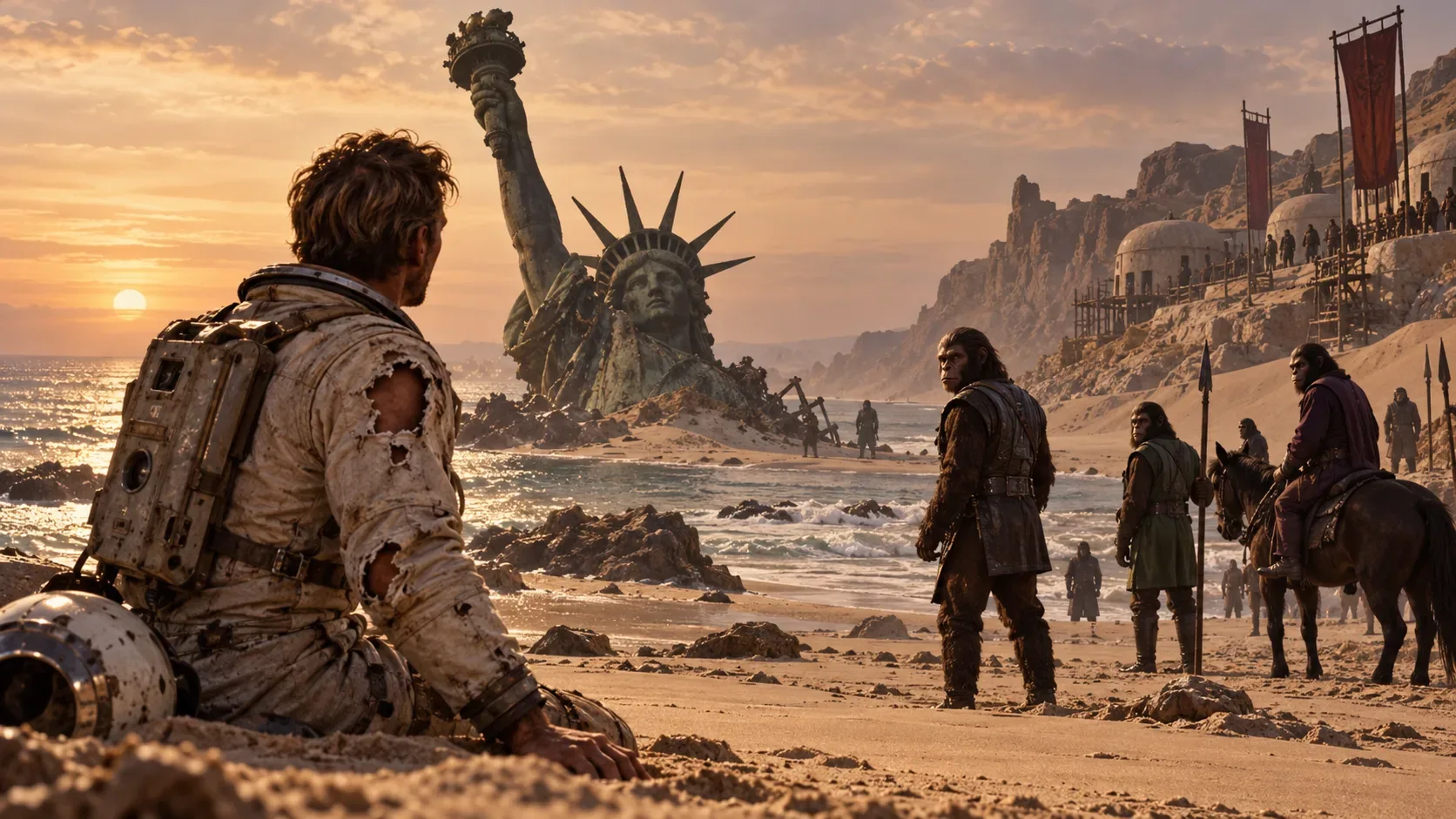
Taylor and Nova continue along the shore, leaving the excavation site behind. When they come upon the partially buried wreckage of the Statue of Liberty, he recognizes a monument from old New York City. The strange landscape now has a location: the world ruled by apes is Earth, changed by the passage of centuries.
The statue does not mean Taylor has somehow returned to his own time. His space voyage had already carried him far into the future. What changes in this scene is his understanding of where he has been ever since the crash. His despair comes from realizing that humanity destroyed the civilization to which he belonged.
The film ends with Taylor facing the ruins and Nova beside him. The 1968 film does not show Taylor dying, being rescued or traveling back home. Events from later installments should not be folded into this particular ending.
Does the film confirm a nuclear war?
Human self-destruction is the unmistakable point of the ending, and the historical context of 1968 lends itself to an interpretation involving nuclear catastrophe. The British Film Institute discusses the movie as a warning about self-destruction and atomic danger. It is nevertheless important to distinguish that reading from what the scene actually establishes: the first film does not depict the war or visually identify the weapon that caused the devastation.
Zaius's warning about humanity's dangerous nature, combined with the ruined Statue of Liberty, supports the conclusion that humans brought about their own downfall. Other works offer more specific details about that devastated history, but they are not needed to understand the 1968 revelation.
What does Zaius's silence tell us about ape society?
Zaius knows more than he publicly admits and tries to prevent the past from undermining his society's doctrine. The speaking doll matters because it turns an archaeological possibility into hard-to-dismiss evidence: humans had language, technology and a history that predates the existing ape order.
The film's social commentary comes from this reversal. The new rulers reproduce hierarchies, violence and censorship of the kind they associate with humans. Taylor seeks freedom and knowledge, but encounters institutions intent on controlling who may speak and which facts may be known. The last image broadens the criticism: even a technologically advanced civilization can destroy itself through its own choices.
Is the 1968 ending the same as the 2001 remake?
No. Franklin J. Schaffner's film reveals that Taylor has been on a future Earth all along when he discovers the shattered Statue of Liberty. In Tim Burton's 2001 reimagining, the protagonist is Leo Davidson, played by Mark Wahlberg, and the closing surprise involves his arrival on an Earth where the Lincoln Memorial has the face of an ape associated with General Thade.
The characters, journeys and final images are different. UOL's comparison helps separate the two versions, but the explanation above concerns only the film released in 1968. The Statue of Liberty confirms where Taylor has been; it is not a scene borrowed from the remake.