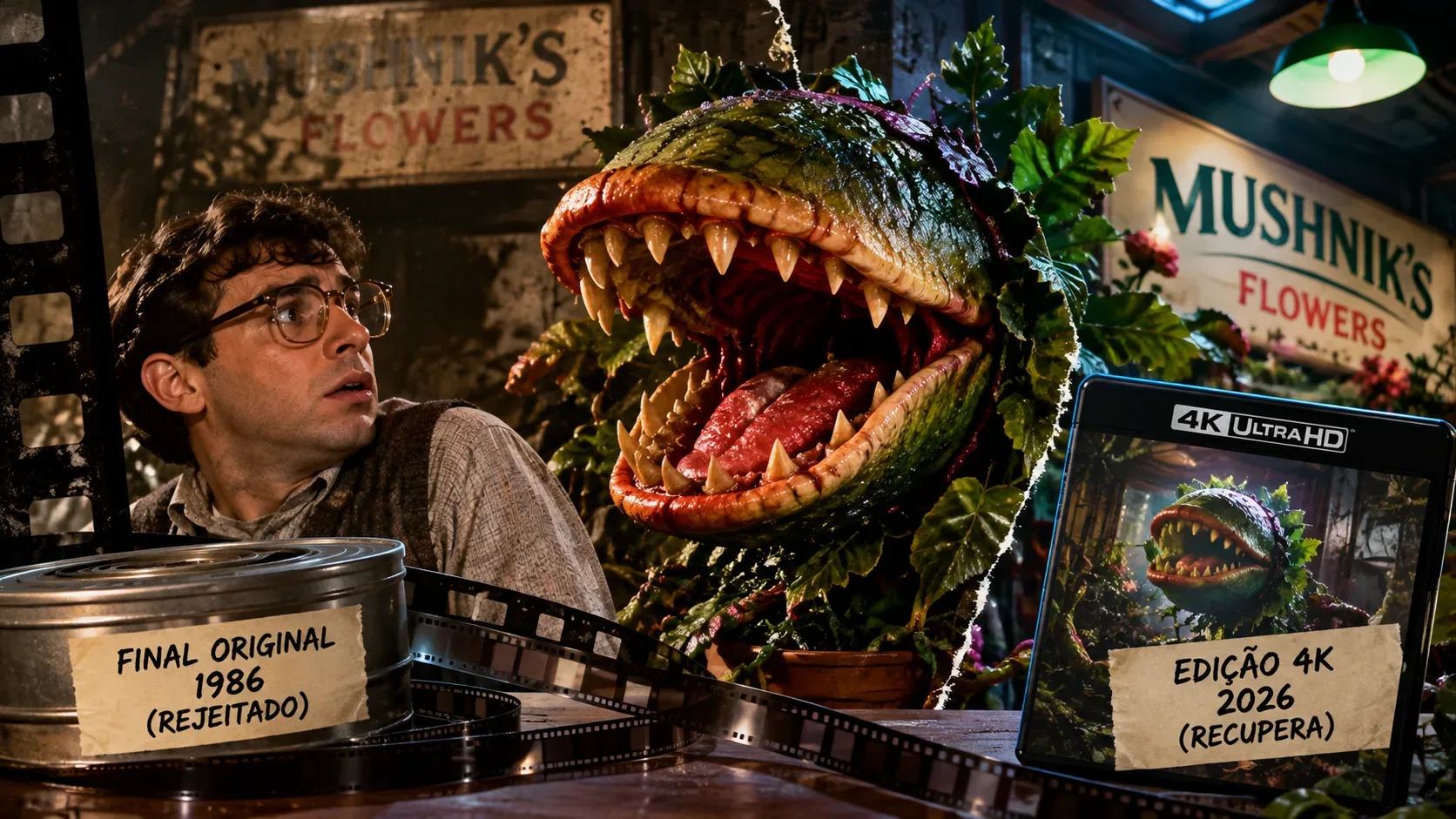
The original ending of Little Shop of Horrors (1986) was replaced because preview audiences rejected its tragic conclusion. The 4K edition released in the United States on October 6, 2026 brings together the theatrical and director’s cuts, with a new picture and sound presentation and additional supplements. One distinction matters, though: the abandoned ending had already been restored in color and reintegrated into the feature in 2012. The 2026 release does not unveil it for the first time.
Why did the studio want a different ending?
Frank Oz directed an adaptation of Howard Ashman and Alan Menken’s stage musical, itself inspired by Roger Corman’s 1960 film. The initial plan was to preserve the stage show’s bitter logic. In a 2012 Disc Dish interview, Oz described it as a story of a bargain and its consequences: Seymour gains success by feeding people to the plant and should pay for those choices.
At a San Jose preview, Oz said, only 13% of respondents marked that they would recommend the film, versus an expected benchmark of 55%. Film at Lincoln Center also reports a negative response at a subsequent Los Angeles screening. This does not mean that 87% objected specifically to each scene of the finale: the 13% referred to a recommendation question about the entire movie. Oz, Ashman and the production interpreted the ending as the decisive problem.
Nor was this simply a studio deleting footage without the director’s involvement. Oz said the studio needed Seymour to be heroic and that he and Ashman accepted rewriting and reshooting the ending, although they preferred the tragedy. The BFI points to a difference between media: onstage, dead protagonists can return to take their bows; onscreen, death feels final. The replacement was filmed over several weeks and used for the 1986 theatrical release.
Warning: full spoilers for both endings
The comparison below reveals what happens to Seymour, Audrey and Audrey II, including the apocalyptic conclusion of the director’s cut. If you only want the 2026 format details without learning the endings, skip ahead to the 4K-edition section.
What changes between the theatrical and director’s cuts?
In the theatrical cut, Seymour manages to defeat Audrey II, he and Audrey survive, and the story moves toward the domestic life she dreamed of. A last glimpse of the plant adds an ironic hint of danger, but it does not reverse the couple’s happy outcome.
In the originally filmed ending, Audrey is mortally wounded by the plant and is ultimately fed to it; Seymour is also devoured when he tries to stop the creature. The sale of new plants turns Audrey II into a consumer craze and leads to a devastating invasion. The large-scale finale closes the musical with the threat victorious, in keeping with the stage version’s fate for the characters.
| Comparison | Theatrical cut (1986) | Director’s cut (restored in 2012) |
|---|---|---|
| Fate of the leads | Seymour and Audrey survive | Both die because of Audrey II |
| Fate of the plant | Audrey II is defeated; a warning remains | The plants multiply and the invasion destroys the city |
| Story emphasis | Reconciliation and the couple’s victory | The bargain’s consequences and the threat’s triumph |
| Listed running time in 2026 | 94 minutes | 103 minutes |
How did the lost ending return in 1998 and 2012?
The ending was not lost forever. A 1998 special-edition DVD briefly included a black-and-white workprint, but it was recalled. In a contemporary Los Angeles Times report, producer David Geffen attributed his objection to that unfinished material’s poor quality, rather than declaring that he wanted the dark ending permanently suppressed.
In 2012, Warner restored the version Oz had intended. The 103-minute cut was shown at the New York Film Festival on September 29, with the complete ending in color. Film at Lincoln Center’s publicity described about 20 minutes of footage not previously seen in that restored form. That does not mean the complete film is 20 minutes longer: some sequences replace scenes from the theatrical version.
What does the 2026 4K edition actually contain?
Warner Bros. Discovery Home Entertainment’s August 18, 2026 announcement set October 6 as the US date for 4K digital purchases and 4K Ultra HD Blu-ray, including a SteelBook option. The release contains both complete versions: approximately 94 minutes for the theatrical cut and 103 for the director’s cut. It is a new 4K presentation of the movie and an alternate cut already restored in 2012, not a previously unseen third edit.
Reviews published in October 2026 by Jordan Cronk and Jake Cole for Slant Magazine and by Kyle Nolan for No(R)eruns describe both cuts in 4K, HDR with Dolby Vision and Dolby Atmos audio. The reviewers report clearer sets, costumes and practical plant effects, as well as a more spacious soundstage for the musical numbers. Those are the named critics’ assessments, not technical testing performed by Dantverse.
The announced offering concerns the United States. The US date, audio tracks and subtitles on an import do not establish an official Brazilian release, Portuguese dubbing or identical digital access in Brazil. The disc should also be distinguished from the bundled digital-copy code: the unit reviewed by No(R)eruns provided the theatrical version through that code, even though both cuts were on the disc.
Which supplements are new and which return?
Two featurettes are new: To Feed or Not to Feed: For the Love of Little Shop, in which Frank Oz and Ellen Greene discuss production and the film’s legacy, and Mean Green Mother: Creating Audrey II, about building the plant, featuring Oz, Greene, Bran Ferren and Richard Conway.
The package also carries over Oz’s commentary on the theatrical cut, Frank Oz and Little Shop of Horrors: The Director’s Cut, A Story of Little Shop of Horrors, outtakes and deleted scenes with optional commentary, plus a separate presentation of the director’s-cut ending with Oz commentary. That stand-alone extra should not be confused with the full director’s cut, which is included as well.
Why does recovering the ending matter?
The two edits show how the same fable changes meaning: the 1986 theatrical version gives Seymour a conciliatory escape, while the originally planned cut makes his choices irreversible and ends its satire of desire and consumption in catastrophe. The 2026 4K release makes that comparison accessible in a single US edition, but its genuinely new contribution is primarily the audiovisual remaster and anniversary supplements, not the first recovery of the finale.
Sources and references
- Frank Oz interview with Disc Dish (2012)
- Film at Lincoln Center, restoration account (2012)
- Film at Lincoln Center, director’s cut screening (2012)
- BFI, musical adaptation and test screenings (2024)
- Los Angeles Times, the recalled DVD (1998)
- Warner Bros. Discovery Home Entertainment, press release reproduced by Screen-Connections (2026)
- Slant Magazine, 4K edition review by Jordan Cronk and Jake Cole (2026)
- No(R)eruns, Kyle Nolan’s disc review (2026)