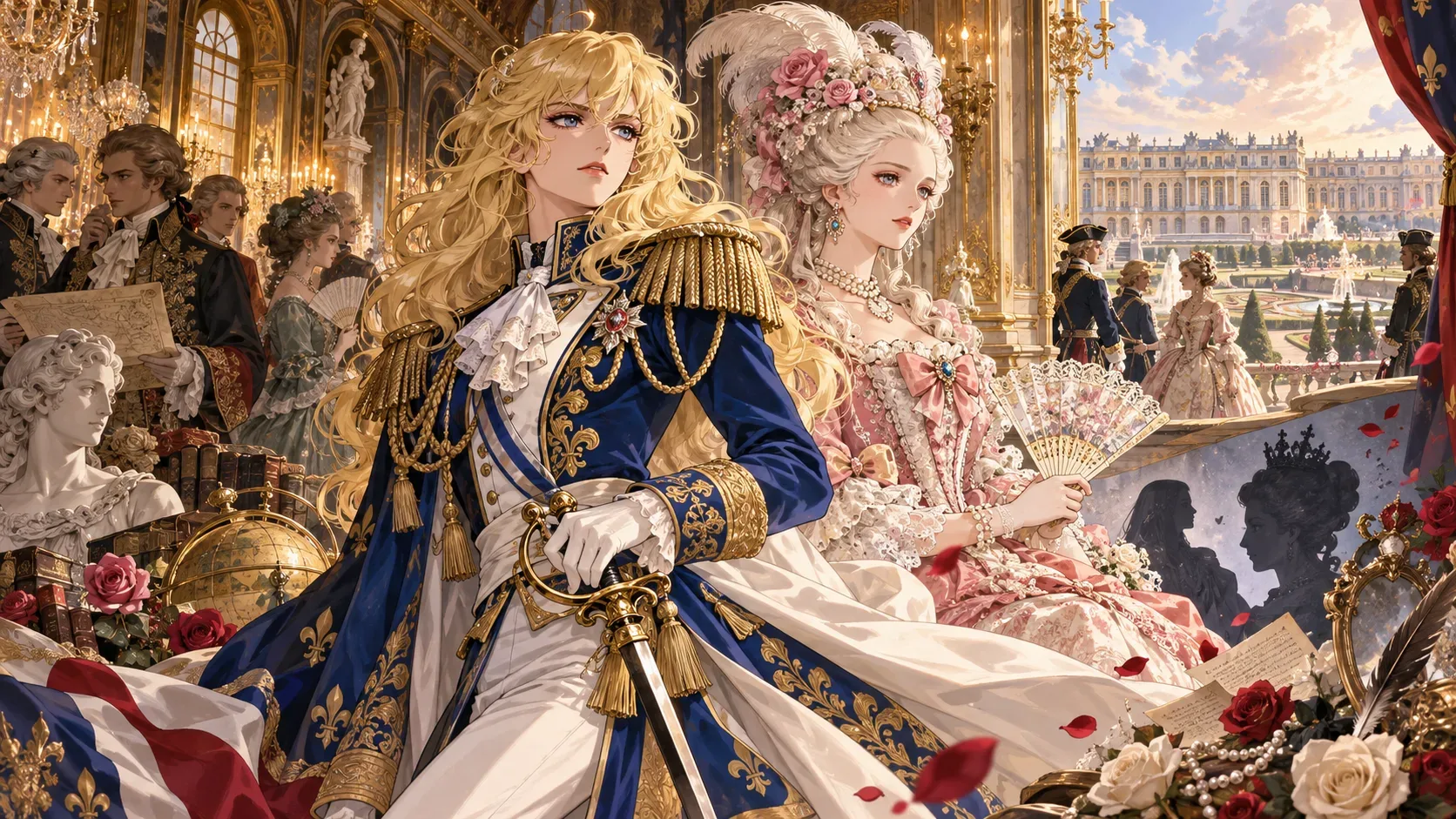
Oscar François de Jarjayes was not a real person, but The Rose of Versailles did not invent its entire cast. Marie Antoinette, Louis XVI, the Swedish count Axel von Fersen and Madame du Barry all existed. Riyoko Ikeda created Oscar, while characters such as Rosalie and General Jarjayes require a more careful distinction: historical names and inspirations were given substantially rewritten lives.
That distinction comes from comparing the story with historical records. The manga, serialized from 1972, the 1979-1980 television anime and the 2025 animated film all use the French Revolution as their setting. None should be treated as a documentary record of everything that happened at Versailles.
Why was Oscar not a historical person?
Oscar is the woman raised by her father as a male heir and trained for service in the royal guard. This is Ikeda’s fictional creation, not evidence for an eighteenth-century officer with Oscar François de Jarjayes’s career. Netflix’s official synopsis presents her upbringing as the central conflict between gender expectations and duty.
Her family name does have historical roots. The local heritage association in Jarjayes identifies the real François Augustin Reynier de Jarjayes and explains that the fictional heroine was imagined as his daughter. It would be misleading, however, to treat the general in the story as a faithful biography of that soldier. A real surname is not proof that Oscar or her military exploits existed.
Marie Antoinette and Fersen: real people, dramatized romance
Marie Antoinette was born in 1755, arrived at the French court in 1770 and became queen when Louis XVI ascended the throne in 1774. The Palace of Versailles documents these dates and her political position. Her personal relationship with Oscar, however, belongs to Ikeda’s story.
Hans Axel von Fersen was also real. According to the Palace of Versailles, the Swedish count first met the future queen in 1774, entered her trusted circle and helped organize the royal family’s attempted flight to Varennes in 1791. Their closeness is documented, but claiming with certainty that they were lovers, as a fictional portrayal may imply, would exceed the evidence. The Palace states that no solid historical proof establishes such a relationship.
Which characters existed and which were invented?
| Character | Classification | What the evidence supports |
|---|---|---|
| Oscar François de Jarjayes | Fictional | The military heroine and her life were invented, although her surname has historical inspiration. |
| André Grandier | Fictional | Oscar’s childhood companion belongs to Ikeda’s invented storyline, not to an identified historical biography. |
| Marie Antoinette | Historical | The Austrian-born French queen is documented in the Versailles archives. |
| Louis XVI | Historical | King of France from 1774 and Marie Antoinette’s husband. |
| Hans Axel von Fersen | Historical, dramatized | A Swedish count close to the queen; their bond is documented, but a lovers’ relationship remains unproven. |
| Madame du Barry | Historical | Jeanne Bécu, a favorite of Louis XV, took part in court politics. |
| Duchess of Polignac | Historical, dramatized | Yolande de Polastron was close to Marie Antoinette; fictional family conflicts are not biographical proof. |
| Rosalie Lamorlière | Historical name, heavily rewritten | A servant of the queen bore this name; Rosalie’s links to Oscar and family intrigue are fictional. |
| General Jarjayes | Historical basis, fictional portrayal | The name recalls François Augustin Reynier de Jarjayes; being Oscar’s father is fiction. |
| Bernard Châtelet and Alain de Soissons | Fictional | Characters in the revolutionary drama, without established one-to-one historical counterparts. |
Rosalie: a real namesake, not the same life story
Rosalie Lamorlière is the clearest example of why simply labeling a character "real" can be misleading. Historical accounts record a woman by that name who worked at the Conciergerie and served Marie Antoinette during the queen’s imprisonment in 1793. The name therefore has a documentary basis, but that does not validate the story the manga gives Rosalie.
In fiction, Rosalie forms a relationship with Oscar and becomes caught up in aristocratic family conflicts, including the Polignac household. Those invented connections do not become historical facts simply because a servant named Rosalie lived at the time. The Palace of Versailles also confirms that the Duchess of Polignac existed, but her biography does not prove Ikeda’s invented plot twists.
What differs between the manga, the 1979 anime and the 2025 film?
The real-versus-fictional distinction applies to all three, but that does not mean they contain identical scenes or give every character the same emphasis. The Japanese television series broadcast in 1979-1980 ran for 40 episodes. The 2025 film, directed by Ai Yoshimura and animated by MAPPA, condenses and rearranges the material. Real Sound’s comparison places the 40-episode series alongside the 113-minute feature and discusses the difference in narrative choices.
The feature opened in Japanese theaters on January 31, 2025, and Netflix announced streaming from April 30 of that year. These dates belong to the new adaptation, not to the manga’s original run or the first television broadcast. Netflix’s character description places Oscar, Marie Antoinette, André and Fersen at the center of the drama; it does not certify that all four existed.
Spoiler note: the paragraphs below mention the political context of the French Revolution without disclosing individual character endings.
How to spot artistic license without erasing history
Louis XVI’s monarchy, the social tensions of late eighteenth-century France and Fersen’s closeness to Marie Antoinette belong to the historical record. Oscar’s career and changing political loyalties, by contrast, let audiences experience that world through an invented protagonist. When a real historical figure speaks with Oscar, the figure’s existence does not make the meeting verifiable.
The safest approach is to separate a person, a relationship and an event. Fersen existed; the precise nature of his bond with the queen requires caution; his encounters with Oscar are fictional. Rosalie had a historical namesake; her family tree and relationship with the heroine cannot be read as archival fact. Ikeda’s historical drama comes from weaving those documented lives together with invented ones.
Sources and references
- Netflix, official film introduction
- Official Japanese film website, characters
- MangaPedia, work and character entries
- Trois-Châteaux de Jarjayes association, local history and the manga
- Palace of Versailles, Marie Antoinette
- Palace of Versailles, Louis XVI
- Palace of Versailles, Axel von Fersen
- Palace of Versailles, Madame du Barry
- Palace of Versailles, Duchess of Polignac
- Antoinetthologie, historical documentation on Rosalie Lamorlière
- Real Sound, comparison of the television anime and the 2025 film