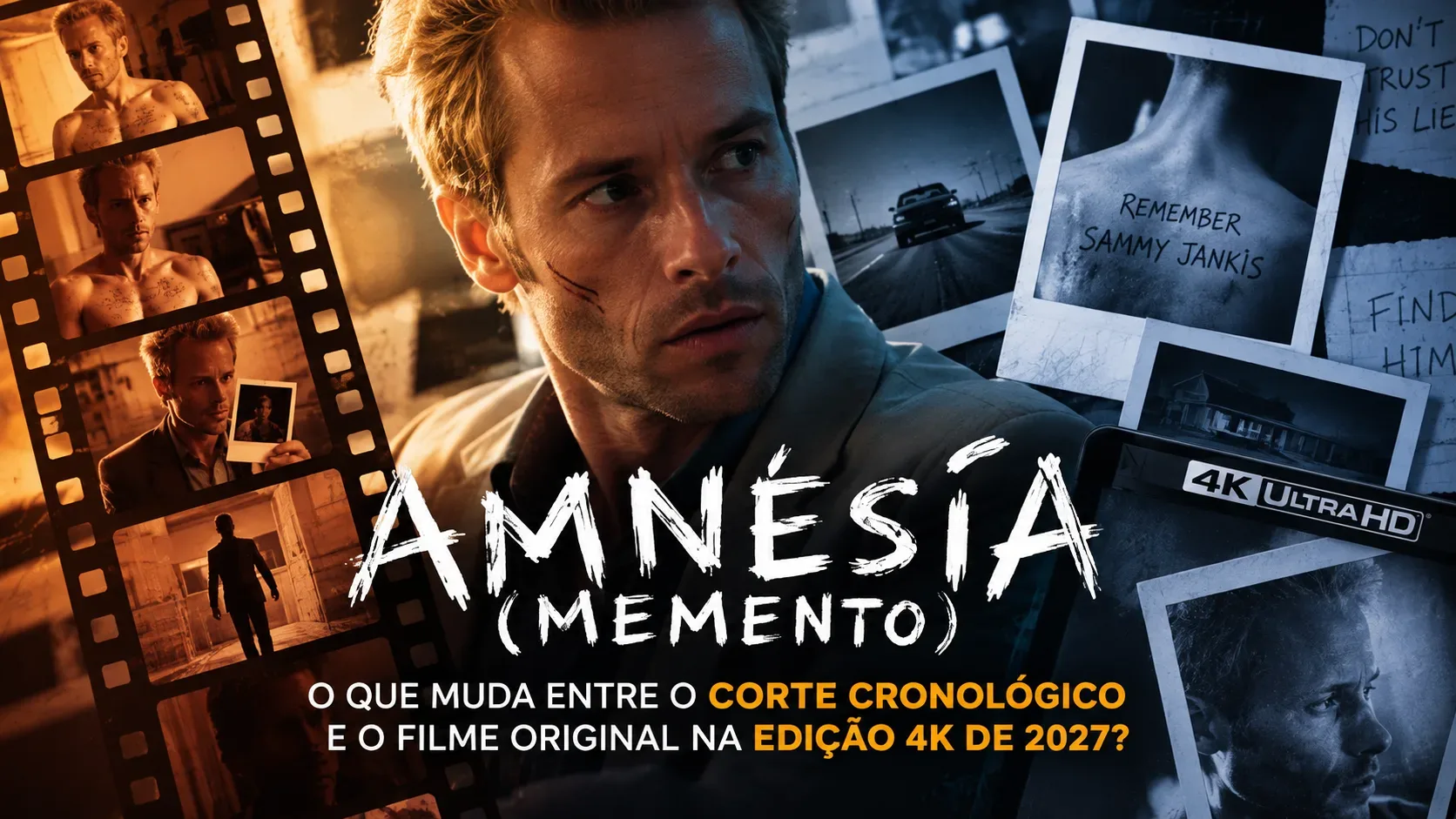
The Australian 4K edition of Memento is scheduled for January 27, 2027, with both Christopher Nolan's original theatrical structure and a chronological presentation listed. The crucial difference is the order of the sequences, and therefore when viewers receive each piece of information. This is not a newly written ending or a remake. Umbrella Entertainment's edition is still a preorder, so its advertised specifications may change before release.
What changes when Memento is watched chronologically?
In the original cut, black-and-white scenes move forward in time while the color sequences appear in reverse chronological order. The two strands eventually meet. This is the structure outlined by the Sundance Institute and by Nolan when discussing how he designed the film. Because Guy Pearce's character Leonard Shelby cannot form new memories, viewers learn the causes and connections of certain events only after seeing their consequences.
The chronological cut reorganizes the progression so events are followed from earlier to later. Viewers can recognize some cause-and-effect relationships sooner instead of reconstructing them retrospectively. That makes it easier to place an event on the timeline, but removes some of the disorientation the original editing uses to align the audience with Leonard's experience. This is an analysis of how information reaches the viewer, not evidence that the events of the story have been changed.
| Aspect | Original cut | Chronological cut |
|---|---|---|
| Sequence order | Alternates forward-moving black-and-white scenes with reverse-ordered color sequences. | Arranges sequences according to the story's timeline. |
| Revealing causes | Often shows consequences before explaining what caused them. | Lets viewers encounter causes before many of their consequences. |
| Viewer experience | Encourages clue reconstruction and identification with Leonard's disorientation. | Highlights the chain of events without the same need to reorder scenes mentally. |
| Ending | The story's last chronological events are not simply its last on-screen sequence. | Changes where the resolution appears in the viewing order, but does not announce an alternate ending. |
Why is the chronological version not a new invention for 2027?
A special-edition DVD already offered a chronological presentation of Memento in 2002. Viewers had to uncover a hidden feature in menus designed as memory tests. DVD Review's account from that year describes precisely such a rearrangement of scenes. The notable new promise for 2027 is therefore access to that viewing approach on the newly issued 4K disc, not a recently invented second storyline.
Umbrella also lists a feature named Final scene 3-option commentary, offering three commentary options for the final scene. That wording should not be read as a claim that three different endings are provided. Likewise, Nolan's approval of the new 4K master does not, on its own, establish that he created a new narrative edit for this release.
What has been announced for the two discs?
Umbrella's collector and regular product pages specify two discs. The 4K UHD carries the Nolan-approved master, the chronological cut in 4K, audio commentaries and a director's-script overlay. The Blu-ray includes the chronological option and further extras. The distributor says the restoration was made from original interpositive materials by Moodlab Film Looks and Fotokem, with disc authoring by Fidelity in Motion. That description does not amount to a claim that the original camera negative was scanned.
Listed extras include commentaries by Nolan, Christopher Winterbauer and Andrew Frost; Selective Memory, a comparison of earlier presentations; archival interviews with Guy Pearce, Nolan, Emma Thomas, Carrie-Anne Moss, Aaron Ryder, Jonathan Nolan and composer David Julyan; a 2011 discussion with Nolan and Guillermo del Toro; and new film analysis by Guy Davis. The collector's package adds physical items such as books, eight art cards and a reversible poster. Those physical extras should not be assumed to come with the standard package.
What remains to be confirmed ahead of January 2027?
As checked on October 26, 2026, Umbrella's listings gave the Australian date of January 27, 2027, and specified 2160p video, 5.1 and 2.0 audio, English language and subtitles, and a 2.35:1 picture ratio. That specification sheet does not establish Portuguese subtitles or an official physical-media release in Brazil.
One technical caveat matters: Cultsploitation's October 8 release listing calls both the restoration and chronological version Dolby Vision, while the Umbrella product pages accessed for this article use the broader 4K/2160p description without repeating that format. HDR and the remaining specifications should therefore be checked again against the final distributor listing. Nor can we claim first-hand improvements in sharpness, color or grain from a visual comparison with the unreleased master.
For now, the distinction is the purpose of each presentation: the original preserves the temporal puzzle built into the film; the chronological version offers a different route through the same narrative. The release date, tracks and extras remain subject to change until the Australian discs actually become available.
Sources and references
- Umbrella Entertainment: Memento 4K collector's edition
- Umbrella Entertainment: Memento 4K and Blu-ray edition
- Cultsploitation: Australian release listing and extras
- Sundance Institute: Memento's narrative structure
- DVD Review: 2002 DVD chronological cut
- I AM FILM: Christopher Nolan interview on editing and time