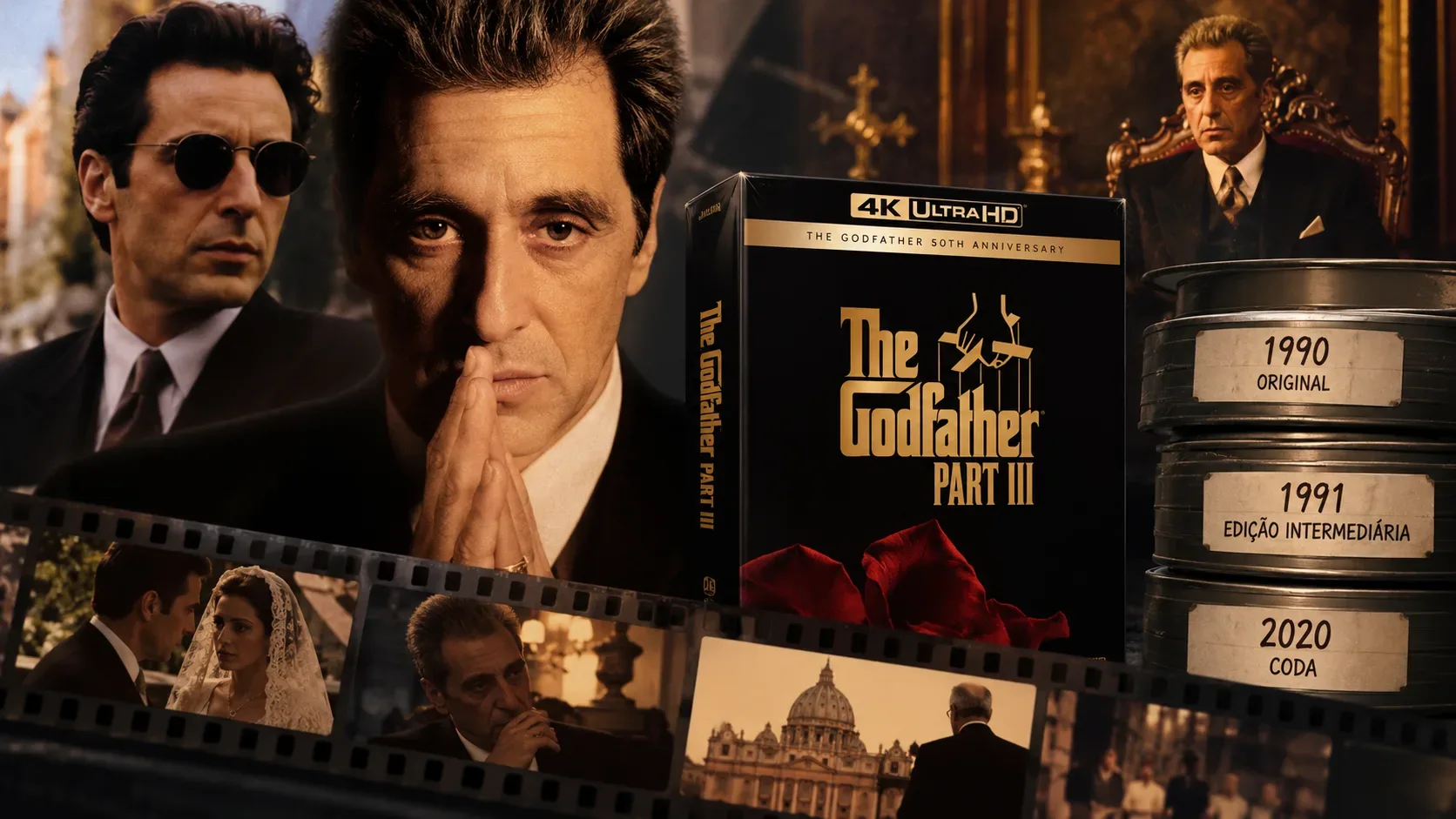
There are three edits of The Godfather Part III: the 1990 theatrical release, running about 162 minutes; the 1991 home-video re-edit, known as the Final Director’s Cut, running about 170 minutes; and 2020’s Mario Puzo’s The Godfather, Coda: The Death of Michael Corleone. In Paramount’s The Godfather Trilogy 4K Ultra HD box set released in 2022, Coda is the main presentation of the third film, while the 1990 and 1991 versions share a bonus 4K disc.
Those years mark editing decisions for the same Francis Ford Coppola film, not three separate movies. It also helps to distinguish a cut (which pictures and sounds are included, and in what order) from a 4K restoration (how the material is restored and presented). A restored copy is not automatically the original theatrical edit.
The three cuts compared
| Cut | How to identify it | Where it appears in the 2022 4K UHD collection |
|---|---|---|
| 1990 theatrical (about 162 min) | Original cinema edit; shorter than the 1991 home-video re-edit. | Bonus disc 4, in 4K UHD. |
| 1991 Final Director’s Cut (about 170 min) | Home-video revision with expanded scenes and reactions plus editing adjustments. | Same disc 4, in 4K UHD. |
| 2020 Coda (around 158 min in comparisons) | Restructured opening and ending, trims and changes to shots, dialogue and music. | Disc 3, as the main presentation of the trilogy’s conclusion. |
These running times are useful approximations for telling the versions apart, not guarantees for every file. Discs and credits may differ slightly; Paramount’s own Coda page even lists 162 minutes, conflicting with comparisons that put it around 157 to 158 minutes. To establish which edit you have, prioritize the cut name on the disc menu or product specifications.
What changed in the often-overlooked 1991 version?
The AFI Catalog records Paramount’s 1991 home-video release of The Godfather III: The Director’s Final Cut, running 170 minutes. The institute cites reporting from October of that year: after the Christmas 1990 theatrical release, Coppola returned to the editing room and expanded character reactions and encounters. This is a genuine alternate edit, not simply a higher-resolution presentation of the cinema release.
Examples documented by AFI include a more personal conversation between Michael and Mary and a longer reunion between Michael and Kay in Sicily, making their reconciliation more explicit. The net increase is roughly eight minutes over the theatrical cut. This longer version became a common point of reference for home viewing, helping explain why many comparisons call the 170-minute edition the “original” movie.
Why is the 2020 Coda more than a shorter version?
Paramount itself describes Coda as a new edit with a different opening and ending, altered shots and music choices. Michael’s meeting with Archbishop Gilday about the Vatican-linked business deal now opens the story, bringing forward a conflict that arrived later in the previous structure. Writing in Folha de S.Paulo and in his own analysis, Ivan Finotti and Pablo Villaça explain how that reversal changes the audience’s understanding of Michael’s interests from the outset.
Spoiler warning: the next paragraph reveals differences between the endings.
In the earlier versions, the final sequence shows an elderly, isolated Michael die. In Coda, the image ends before that explicit death and adds a message about remembrance and long life. The montage of dancing memories involving women in Michael’s life is also reduced to a focus on Mary. Villaça praises the new opening but questions the removal of the other memories. That is an attributed critical judgment, not a consensus on which edit is best.
Where is each cut in the five-disc 2022 4K box?
Paramount’s official listing confirms Coda plus the theatrical and 1991 cuts in the 4K collection. Bill Hunt’s technical review for The Digital Bits specifies the arrangement in the five-disc edition released in the United States:
- Disc 1, 4K UHD: The Godfather (1972).
- Disc 2, 4K UHD: The Godfather Part II (1974).
- Disc 3, 4K UHD: Coda (2020 edit), with a short introduction by Coppola.
- Disc 4, bonus 4K UHD: the 1990 and 1991 cuts of Part III, selectable on the same disc through seamless branching, which reuses shared footage and switches between differing segments.
- Disc 5, bonus Blu-ray: documentaries, archival features and other extras; it does not hold the two older cuts in 4K.
Check the edition you are buying: this layout describes the five-disc physical 4K Ultra HD set reviewed in 2022. Do not assume a standard Blu-ray edition, standalone Coda disc, digital purchase or regional release has exactly the same discs and cuts. The US announcement alone does not establish identical contents for every box sold in Brazil.
Why do some comparisons discuss only two versions?
The usual comparison pits an “original version” against Coda without distinguishing the 1990 cinema print from the 1991 home-video cut. Pablo Villaça, for example, gives 2h50 for the version he compares with the new 2h38 cut. The former runtime matches the longer 1991 edit, whereas the 1990 theatrical cut is about 2h42. That runtime suggests which material serves as the reference in the comparison; it does not replace an explicit identification of the edition the author used.
The distinction changes the question: saying a scene is missing from Coda relative to the long cut does not, without a separate check, prove the scene was present in the 1990 theatrical release. AFI documents the 1991 additions, Paramount identifies the 2020 revision, and the 4K box makes all three edits available for a direct comparison.
Which cut should you watch?
For the version originally seen in cinemas in 1990, choose Theatrical Cut. For the expanded 1991 revision and more material between Michael and his family, look for 1991 Cut or Final Director’s Cut. For Coppola’s later interpretation, more firmly focused on the Vatican deal and featuring a different ending, choose Coda. All three are in the five-disc 4K UHD box, though they do not occupy the same disc.