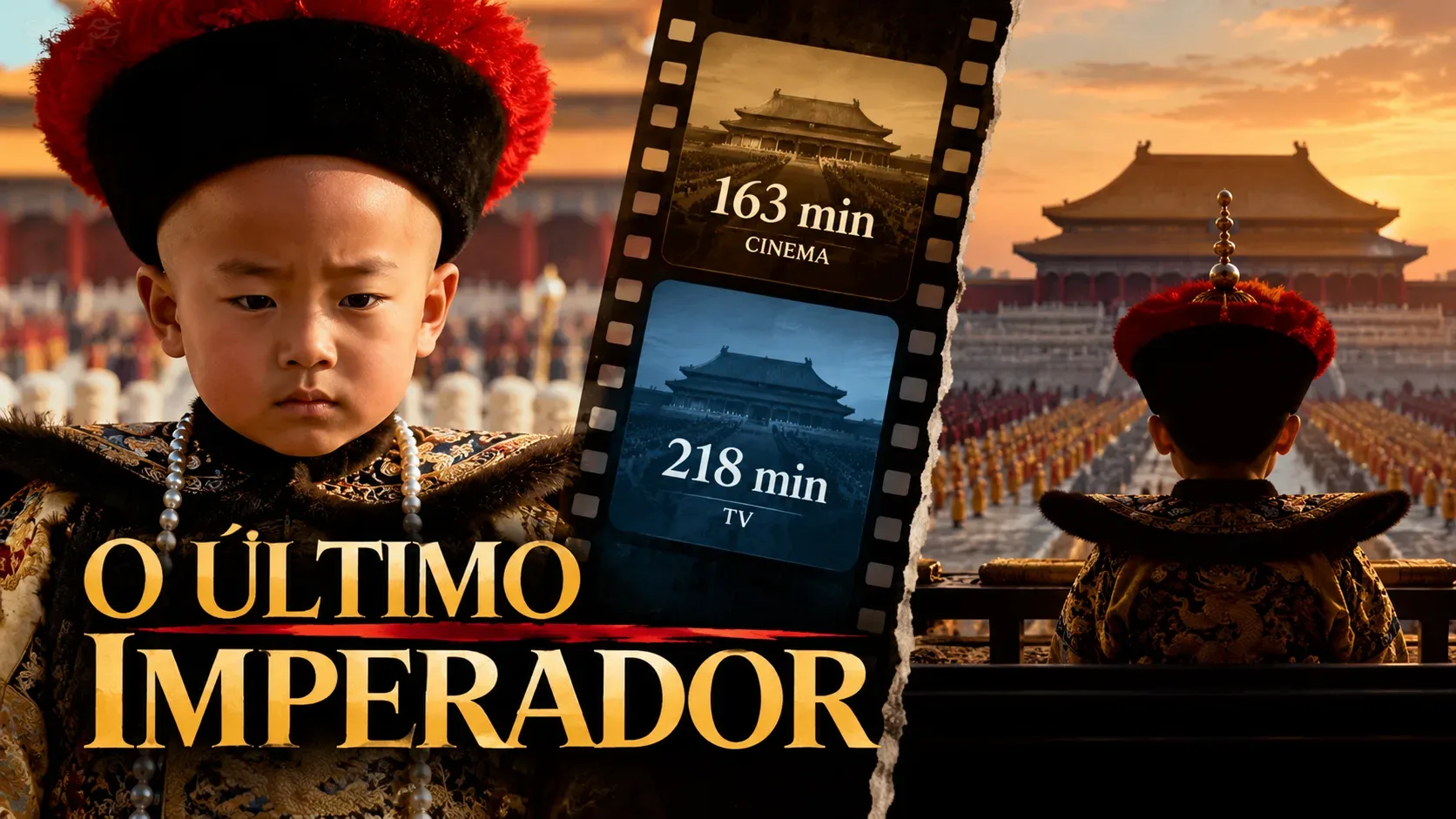
The 218-minute version of The Last Emperor (1987) is not Bernardo Bertolucci's preferred cut. It was prepared for television under a contractual production requirement. After that stage, the filmmaker and editor Gabriella Cristiani continued working until they arrived at the version shown in theaters in 1987. The Criterion Collection documented the director's preference for the theatrical edit and explained why the longer version came to be misleadingly labeled a director's cut.
The 218-minute version originated in a television commitment
In an explanation published on January 3, 2008, Criterion executive producer Kim Hendrickson recounted what cinematographer Vittorio Storaro had told her while a home-video edition was being prepared. The original production agreement required delivery of a television version lasting approximately four hours. The filmmakers assembled the material into four episodes running more than 50 minutes each, for a total of 218 minutes.
The sequence of events matters: according to this account, Bertolucci and Cristiani continued editing after delivering the television version. The greater running time therefore does not necessarily represent a later revision in which the director restored his definitive vision. The edit released theatrically in 1987 was the subsequent result of that refinement.
Which cut did Bertolucci regard as definitive?
Storaro told Criterion that the director-approved version was the theatrical one, which had also been used as the reference for an image transfer he supervised. To settle the matter, Hendrickson contacted Bertolucci himself. He confirmed his preference for the theatrical cut and described the longer version as not very different but, in his view, more boring. That is the filmmaker's attributed assessment, not a universal judgment about the merits of either cut.
This separates two questions that are often conflated: Bertolucci participated in creating the television version, but preferred the final theatrical edit. The phrase director's cut is useful only when it identifies the version the filmmaker selected as definitive, not automatically the one with the longest running time.
Why do sources list 163, 165 and 218 minutes?
Even the primary sources give different figures for the theatrical edit. Criterion's current catalog lists 163 minutes, while its 2008 editorial article refers to 165 minutes for the NTSC theatrical presentation. The consulted sources do not establish exactly why those figures differ by two minutes. The difference should therefore not be treated as evidence of a third narrative cut.
| Version or reference | Listed running time | What the source establishes |
|---|---|---|
| Theatrical version, current Criterion catalog | 163 minutes | The theatrical edit listed for the 4K edition. |
| Theatrical version, Criterion's 2008 account | 165 minutes | The figure quoted for the NTSC presentation, identified in that account as the director's preferred cut. |
| Television version | 218 minutes | An edit prepared as four episodes under the original production agreement. |
As an independent check that both presentations exist, the Indiana University Libraries catalog describes Criterion's 2008 DVD edition as having separate discs for the theatrical and television versions. Its record assigns 162 minutes to the theatrical disc and 218 to the television disc, further demonstrating that physical-media catalogs do not always report identical running times for the shorter cut. This does not change Bertolucci's documented preference.
Where did the incorrect director's cut label come from?
Hendrickson reported that some earlier releases had marketed the television version as the approved director's cut. Criterion's own team initially used that designation before consulting Storaro and Bertolucci. For its edition, the company explicitly distinguished the theatrical cut from the television version.
There is no contradiction in a director-approved edition containing both. Approval of its main presentation does not automatically make every bonus version in the set the definitive cut. Likewise, extended version can accurately describe a longer running time without establishing the filmmaker's final artistic intention.
Which version should you choose on DVD, Blu-ray or 4K?
To see the movie in Bertolucci's preferred form, choose the theatrical version. The 218-minute version is particularly useful for viewers interested in comparing the structure prepared for television with the more concentrated theatrical edit. It is a historical alternative rather than an essential replacement.
Criterion's 4K UHD + Blu-ray edition lists a 4K digital restoration, identifies the main film as 163 minutes long, and includes the 218-minute television version among its special features. These details refer to that specific release; they do not establish that every physical edition or streaming service in Brazil includes both cuts. Before purchasing, check the disc and bonus-feature listings rather than relying solely on a director's cut sticker.
The consulted documentation establishes the versions' origins, purposes and the director's preference. It does not provide a shot-by-shot inventory of exclusive scenes; attributing particular sequences to the longer cut without comparing the actual prints would go beyond the evidence.