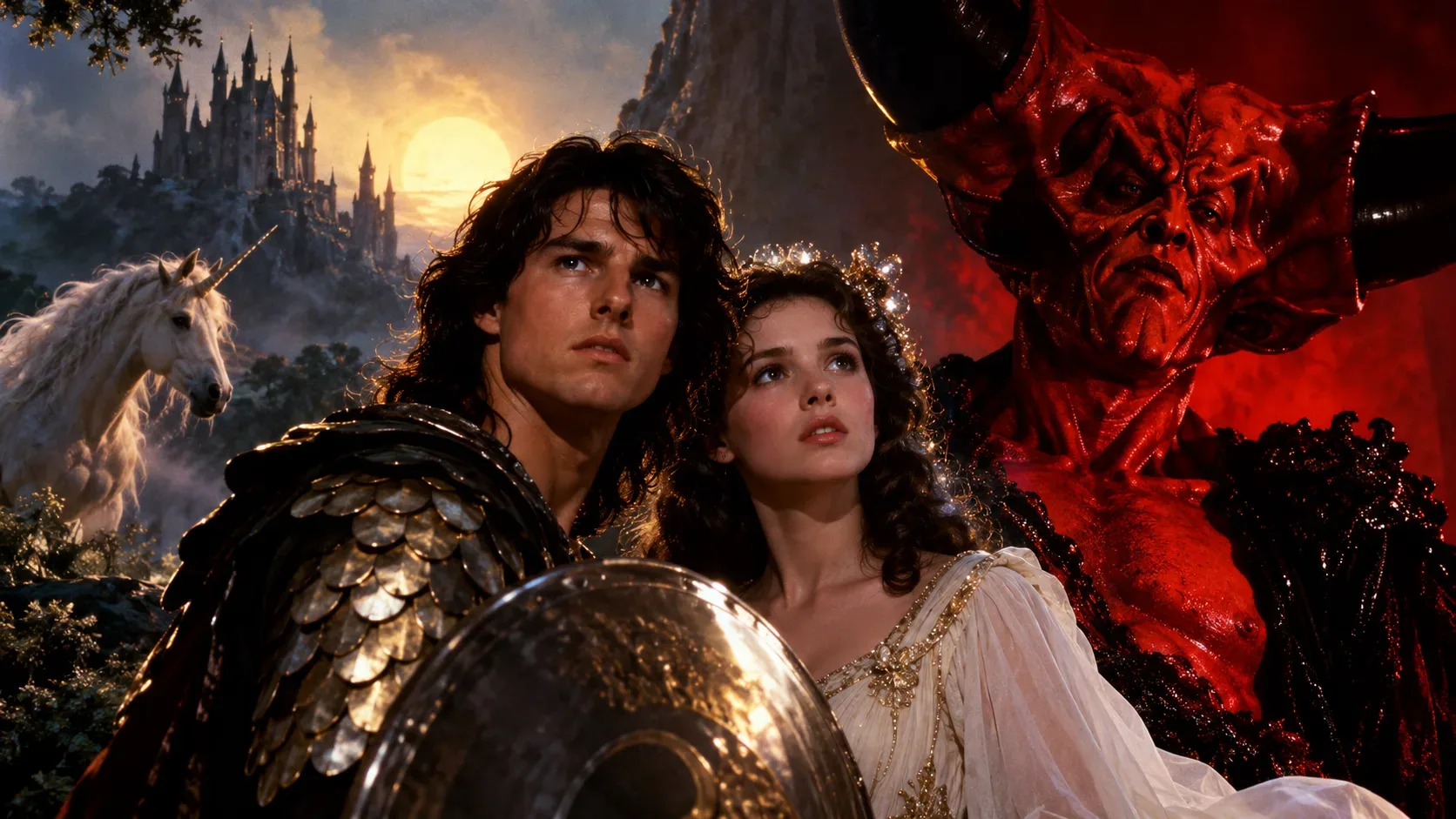
Ridley Scott did not replace Jerry Goldsmith's score in every version of Legend. The film reached European markets in 1985 with Goldsmith's orchestral music. For its American release in 1986, the film was shortened and given a new electronic score by Tangerine Dream. The change was intended to make the film more attractive to younger audiences in the United States and to fit the revised edit, although accounts of who ultimately drove the decision differ.
The distinction goes beyond musical taste: the versions have different edits, running times, and dramatic rhythms. Decades later, the director's cut brought back Goldsmith's music, while releases such as Arrow Video's Blu-ray made a direct comparison with the American cut possible.
Why was Jerry Goldsmith replaced by Tangerine Dream in the United States?
Goldsmith wrote a symphonic score rooted in the film's fairy-tale atmosphere, with choral passages and songs woven into its fantasy world. But test screenings and the overhaul for the American market put that music into question. In a January 1986 report, the Los Angeles Times quoted a Universal spokesman explaining that the label and studio wanted a more commercially exploitable sound and that the original score no longer suited the shortened edit.
Scott offered a different emphasis in that same report. He took responsibility for recutting and rescoring the picture, praised Goldsmith's work, and said the result felt too sweet for the version he wanted to make. He also said he wanted musicians with a more contemporary connection. Treating the switch solely as a studio order, or solely as Scott rejecting Goldsmith on artistic grounds, therefore oversimplifies a process marked by overlapping interests and conflicting accounts.
Goldsmith himself told The Washington Post, also in January 1986, that he had been surprised by the replacement and that his score remained in the version shown outside the North American circuit. Tangerine Dream's official history says the producers approached the band because they wanted more contemporary music, and recalls the responsibility Edgar Froese felt about replacing a composer he admired.
What are the differences between the three main cuts?
The European premiere took place in 1985, whereas the commercial release in United States theaters occurred in April 1986. The running times below are approximate: listings and physical formats can differ slightly, including because of playback standards. The European release year should not be mistaken for the American opening date.
| Version | Market and approximate length | Main score | Defining feature |
|---|---|---|---|
| European theatrical cut | Europe, 1985; about 94 minutes | Jerry Goldsmith | The international theatrical edit, distinct from both the American release and the later director's cut. |
| American theatrical cut | United States, 1986; about 89 minutes | Tangerine Dream | A shorter, rearranged edit for North American theaters, with a new musical identity and pop songs. |
| Director's cut | Reconstructed for DVD in 2002; about 113 minutes | Jerry Goldsmith | Restores narrative material and more of Scott's preferred longer structure; it is not automatically identical to an early working assembly. |
IMDb also lists a television version and other exhibition variations. That does not make all these variants equivalent releases. For determining which score belongs to which edition, the clearest distinction is between the European theatrical cut, the American cut, and the director's cut.
What changes besides the music?
The American reduction makes the narrative more concentrated and changes how parts of the fantasy tale are presented. IMDb's alternate-versions catalogue describes, among other changes, differences in Lili's scenes and the length of certain sequences with forest characters. As that is a catalogue of variants rather than a definitive transcription of every print, the exact treatment of any scene should be verified in the particular edition being viewed.
The musical language changes the film's feel as well. Goldsmith uses orchestral writing associated with enchantment and the relationships among the characters; Tangerine Dream employs electronic textures closer to 1980s popular music. Its soundtrack includes Is Your Love Strong Enough, performed by Bryan Ferry, and Loved By The Sun, sung by Jon Anderson, according to the band's official discography. This is more than replacing background cues with different instruments: the arrangements shape each edit's pacing and mood.
What did Arrow restore, and which cuts are on its Blu-ray?
Arrow Video's American edition of Legend contains the U.S. theatrical cut and the director's cut, both on 1080p Blu-ray. For the American theatrical edit, the distributor describes a 2K restoration from original elements, including a 4K scan of the original camera negative. A 4K scan does not make this edition a 4K UHD disc.
The director's cut runs approximately 113 minutes and retains Goldsmith's score. The American cut runs approximately 89 minutes and retains Tangerine Dream's music. Arrow also provides supplements about the different versions and scores, but the roughly 94-minute European theatrical cut is not included in the American set discussed here. Anyone specifically seeking that third edit needs to check a different release and its region.
The director's cut had already been recovered for DVD in 2002, before Arrow's Blu-ray. As Andy Dursin's historical discussion of that release notes, its reconstruction draws on surviving materials of differing quality; it should not be confused with the complete recovery of the earliest long assembly produced during post-production.
Which version of Legend should you watch?
To understand the more expansive musical and narrative approach associated with Ridley Scott, the director's cut with Goldsmith is the most informative starting point. To experience the movie released to American audiences in 1986, choose the theatrical cut with Tangerine Dream. The European 1985 cut preserves its own historical combination of Goldsmith's music and an edit shorter than the director's version.
Watching Arrow's two included cuts back to back makes the changes in editing and tone easier to identify without insisting that either score is objectively superior. Before buying a release or searching for a digital screening, always check the named cut, running time, audio, and region: the title Legend alone does not establish which experience is on offer.
Sources and references
- Arrow Video: Blu-ray edition featuring both cuts
- Tangerine Dream: official Legend soundtrack page
- Tangerine Dream: 1984 to 1988 history
- Los Angeles Times, Steven Smith: January 1986 interviews and context
- The Washington Post, Richard Harrington: Goldsmith's 1986 comments
- El País, Miquel Echarri: production and release retrospective
- IMDb: Legend alternate versions catalogue
- DVDCompare: technical comparison of editions and running times
- Andy Dursin's Aisle Seat: 2021 Arrow edition coverage