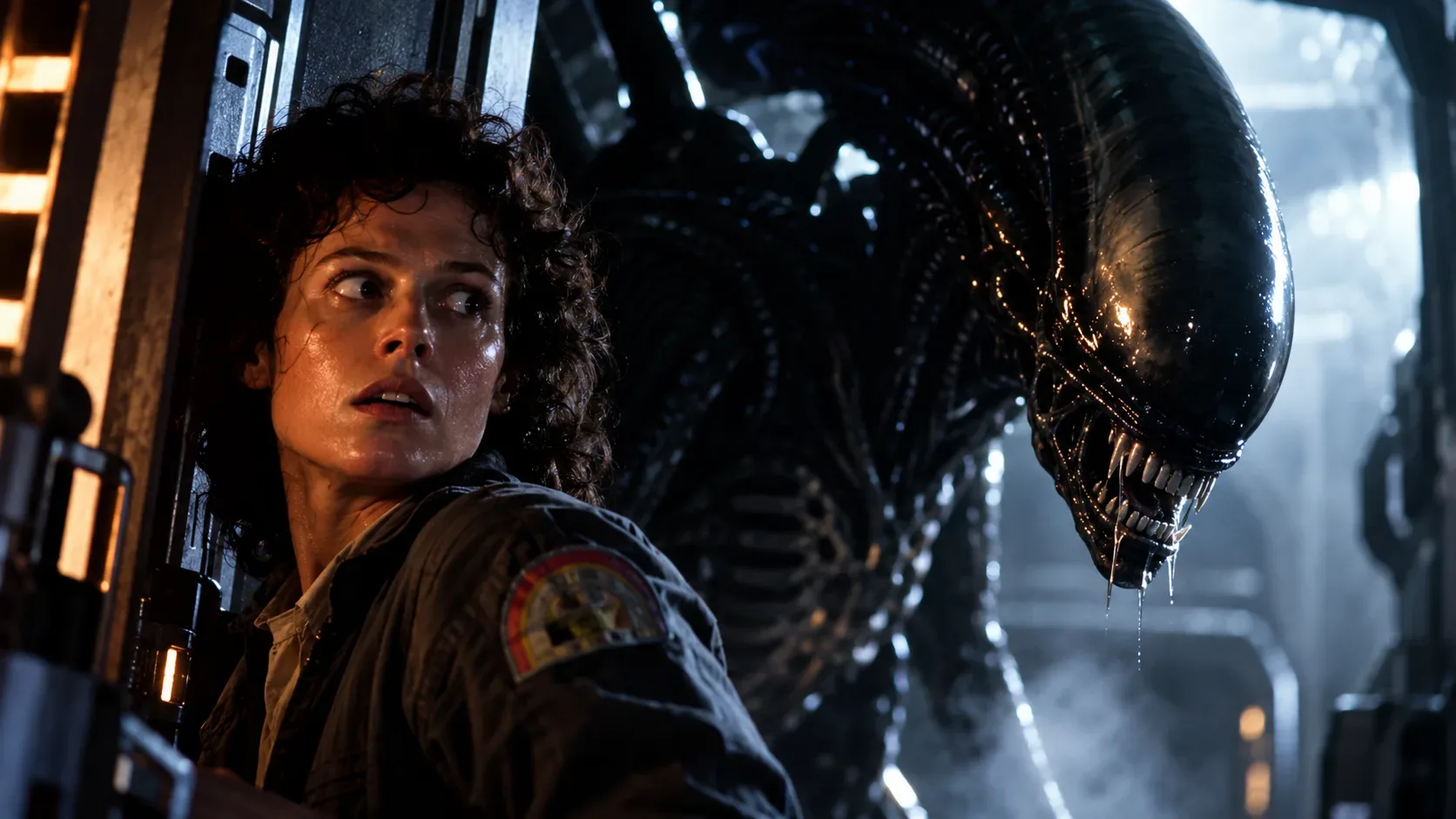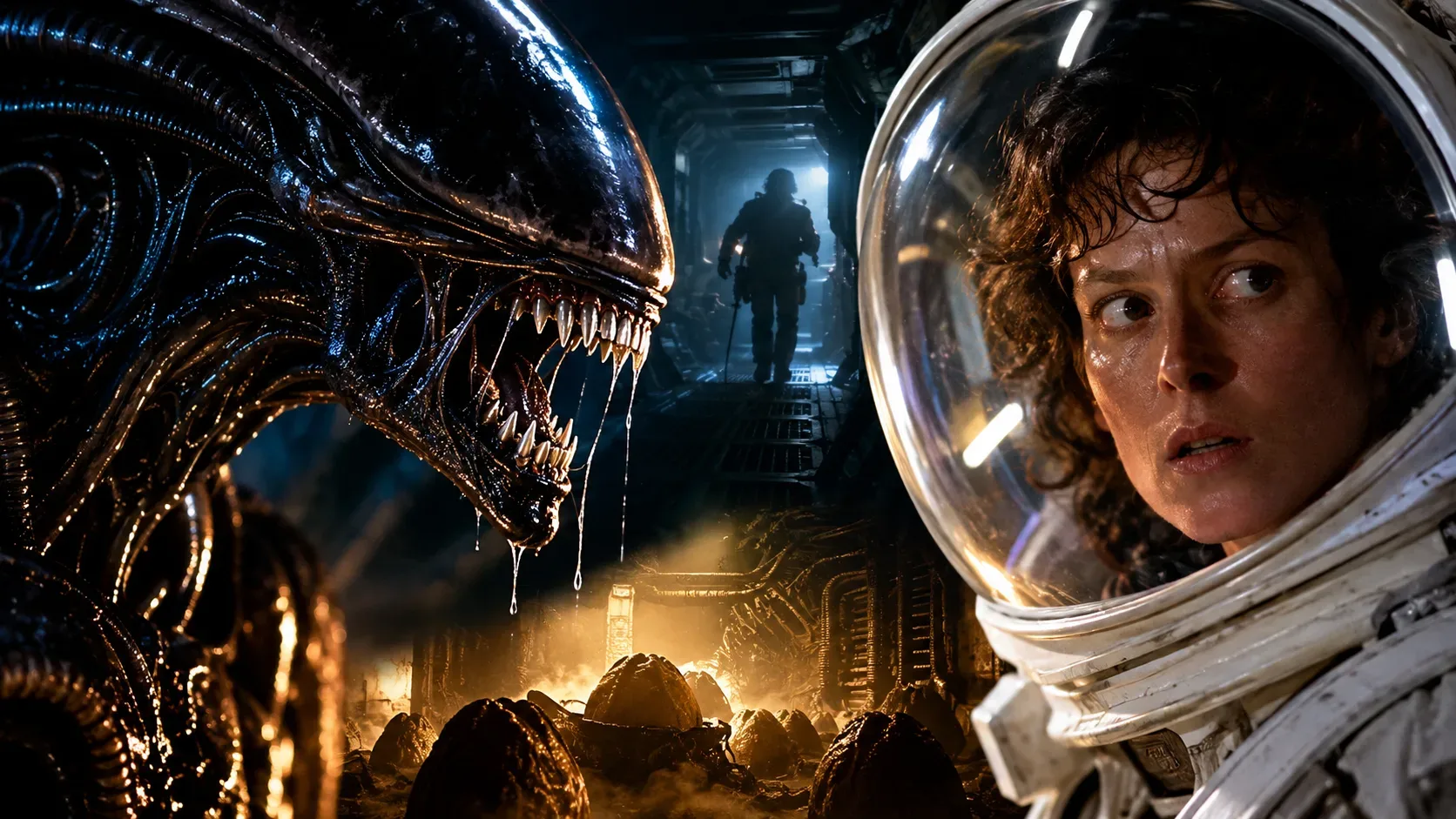
The most significant difference between the two cuts of Alien (1979) is the scene in which Ripley finds Dallas and Brett trapped in cocoons aboard the Nostromo. Missing from the theatrical release, this sequence was restored for the 2003 Director’s Cut. The revision also expands certain confrontations and glimpses of the alien, while shortening or removing material from the original film. Surprisingly, the result runs about one minute shorter.
The label Director’s Cut can be misleading: Ridley Scott helped shape the 2003 edit, but identified the 1979 theatrical release as his preferred version. That distinction matters when choosing which cut to watch first.
Spoiler warning: this comparison discusses deaths, late-film events, and details about the creature.
Alien theatrical cut vs. 2003 Director’s Cut: at a glance
| Aspect | Theatrical version (1979) | Director’s Cut (2003) |
|---|---|---|
| Approximate runtime | 117 minutes | 116 minutes, roughly one minute shorter |
| Editing | More room for pauses, dialogue, and gradually building tension | Some passages shortened and previously unseen scenes inserted |
| Dallas and Brett in cocoons | Sequence absent | Ripley finds both men in an area overtaken by the creature |
| Lambert and Ripley | The physical confrontation is absent | Lambert slaps Ripley after their quarantine dispute |
| Attack on Brett | The creature is revealed more sparingly | Additional shots show the alien among chains and Parker’s reaction |
| Dallas and the ship’s computer | His exchange about his chances of survival remains | That exchange has been removed |
Runtimes are rounded because they may differ slightly by presentation and home-video release. AVP Galaxy’s scene comparison and DVD Talk’s contemporary reviews document the changes.
What does the 2003 cut add?
The unidentified transmission: a bridge sequence shows the Nostromo crew listening to the signal from the spacecraft discovered on the planet. The dialogue gives more room to their reactions and to the information being considered before the investigation.
Tension after Kane returns: Lambert confronts and slaps Ripley because Ripley tried to keep the returning crew outside in accordance with quarantine protocol. Dallas challenges Ripley as well. The added material makes explicit a conflict that the 1979 edit handles more briefly.
Brett’s attack: additional angles show the creature hanging near chains before it strikes. Ripley and Parker then enter the area, and Parker notices Brett’s blood overhead. These additions are short, but they change how much of the monster viewers can see.
There is also a brief shot of Kane holding a gun while examining the eggs and a variation on the alien watching Jones the cat. Not every deleted scene available in DVD or Blu-ray supplements was incorporated into the 2003 edit.
What was removed or shortened?
The 2003 edit removes the moment when Dallas asks the MOTHER computer how to destroy the alien and what his own chances are. In the theatrical cut, the machine’s unhelpful response reinforces the captain’s isolation before he enters the air ducts.
Conversations among Ripley, Ash, and Dallas are also missing or reduced: an exchange about interpreting the signal and the conversation in which Ripley questions Dallas about Ash, a recent addition to the crew. Other transitions are trimmed, including part of Ripley’s activity at a console, alongside changes to the final escape.
That is why comparing the versions requires more than counting restored scenes. The edits change when information is revealed and how long the viewer waits between scares. The original allows more space for pauses and conversations; the 2003 alternative reveals certain details earlier and speeds up other passages.
What does the Dallas and Brett cocoon scene actually show?
Near the climax of the Director’s Cut, Ripley discovers Dallas immobilized by organic material inside the ship and Brett at a more advanced stage of transformation. Still conscious, Dallas asks her to kill him. Ripley uses her flamethrower. The moment links both disappearances to the creature’s ability to alter its victims.
This idea is commonly called eggmorphing: the edit suggests that Brett is turning into something resembling an egg. It is a disturbing visual implication, not a full scientific explanation of the alien’s reproductive cycle. On its own, it also does not establish that every entry in the franchise follows exactly the same mechanism.
The placement matters as well: Ripley makes the discovery while racing to abandon a ship about to be destroyed. Some interpretations see the sequence as deepening the body horror; other observers, as reflected in DVD Talk’s coverage, consider it an interruption to the urgency of the climax. These are assessments of the editing, not evidence that Ripley’s central fate has changed.
Why is the Director’s Cut shorter?
Fox was preparing the Alien Quadrilogy DVD collection when the idea of revisiting the first movie arose. Instead of reinstating every discarded sequence, Scott worked on an alternative assembly that restored certain moments and compressed others. AVP Galaxy reports that the finished cut is roughly a minute shorter than the original release.
Megan Denny’s DVD Talk review, published around the 2003 re-release, identifies the cocoon sequence, Lambert’s slap, and additional images of the alien among the visible differences, while noting that they do not radically transform the film. The more meaningful change is how the scenes redistribute suspense and explanation.
Which version does Ridley Scott prefer?
Ridley Scott expressed a preference for the 1979 theatrical version. His introduction included on home-video releases of the newer edit, as noted by DVD Talk, helps explain why: he already considered the original release the film he wanted to make. The 2003 assembly was offered as an alternative experience, not a definitive correction of some alleged mistake in the first release.
In this case, then, Director’s Cut is the marketed name for a second edit supervised by Scott. It does not automatically mean that the 2003 version is more complete, longer, or the only version endorsed by the filmmaker.
Which cut should you watch first?
For a first viewing, the 1979 theatrical cut best matches the director’s stated preference and preserves the build-up of suspense that introduced the movie to audiences. The Director’s Cut is particularly useful for a second viewing, when the viewer can compare how the creature, its victims, and Ripley’s escape are presented.
When selecting a disc or digital edition, look for a menu that explicitly identifies the Theatrical Version and Director’s Cut. AVP Galaxy’s release guide documents DVD, Blu-ray, and 4K editions offering both versions. A list of deleted scenes under extras does not mean those scenes are included in either completed cut.