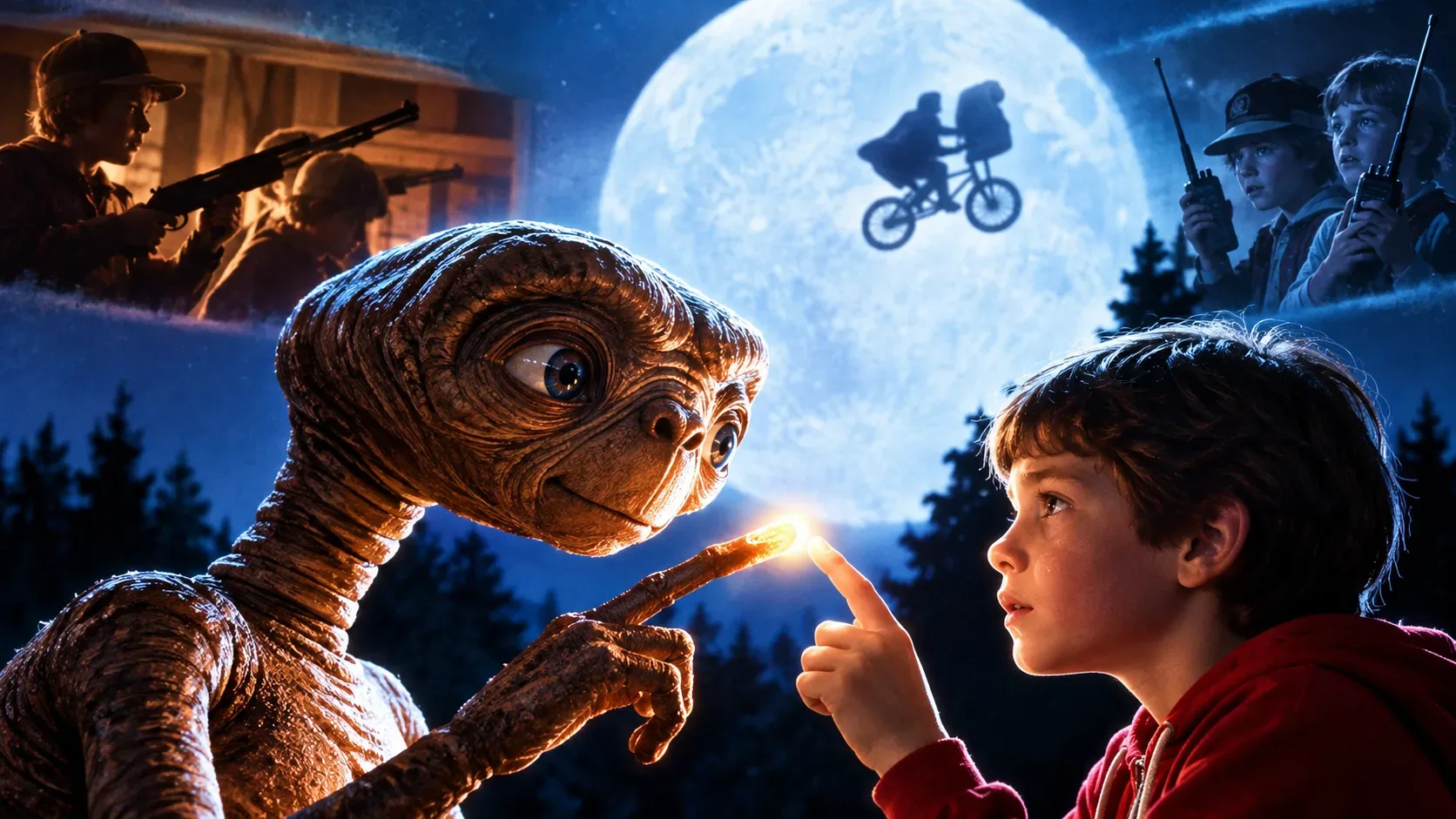
The 2002 edition of E.T. the Extra-Terrestrial is not the same cut audiences saw in 1982. For the film's 20th anniversary, Steven Spielberg digitally replaced firearms carried by agents and police officers with walkie-talkies during the children's escape, restored two previously shot passages, and altered visual effects, dialogue, and sound. In 2023, the director said removing the guns had been a mistake, arguing that films should preserve the marks of the eras in which they were made.
For anyone who wants to experience the film as it originally reached theaters, the 1982 theatrical cut is the point of reference. The 2002 anniversary edition is valuable as a record of Spielberg's attempt to revisit his own work, but the two versions are not simply the same movie with different picture restoration.
What changed between the 1982 and 2002 versions?
Production notes for the 20th-anniversary edition, available through Cinema.com, describe the restoration of the negative, the work performed by Industrial Light & Magic (ILM), and the scenes reinstated. Contemporary interviews with Spielberg and producer Kathleen Kennedy help distinguish story changes from technical improvements.
| Element | 1982 version | 2002 edition |
|---|---|---|
| Bicycle escape | Agents and police officers are shown carrying firearms. | In shots from the chase, guns are digitally replaced by walkie-talkies; parts of the editing involving the weapons also change. |
| Bathroom sequence | The encounter between Elliott and E.T. in the bathtub is absent from the original cut. | The previously filmed and discarded sequence is reinstated with digital-effects assistance. |
| Halloween | A shorter passage involves Elliott's mother, Mary, searching for him. | A passage showing Mary looking for her son is reinstated, extending the holiday sequence. |
| E.T.'s face and movements | The performance relies primarily on the animatronic puppets developed for the original production. | Digital work refines facial expressions, lip movements, and some actions; certain shots of E.T. running through the forest are rebuilt. |
| Backgrounds and bicycle flight | The photographic effects and animation reflect the original release. | The spacecraft, backgrounds, clouds, and wind receive adjustments; Elliott's costume cape gains digitally animated movement during the flight. |
| Dialogue and soundtrack | In the Halloween-costume line, Mary uses the English word terrorist. | The word becomes hippie, while the score and soundtrack receive a new multichannel presentation without rerecording John Williams's music. |
The Halloween dialogue in this comparison refers to the original theatrical release and the 2002 revision. Some home-video copies and broadcasts from other periods have their own audio differences, so it would be inaccurate to assume that every VHS release of E.T. contains exactly the same line.
Why did Spielberg alter the film?
The revisions pursued two separate goals. The first was to restore and refine existing material. The animatronic creature designed by Carlo Rambaldi had limited certain actions, especially in the bathtub scene. The production notes describe adjustments to facial performances and the reconstruction of movements that had not worked as the director intended. ILM also restored deteriorated elements of the original film materials.
That work extended well beyond the best-known gun replacement. In a March 2002 report, the Los Angeles Times said ILM effects supervisor Bill George had overseen revisions to more than 140 shots. In a June interview with WIRED, Spielberg estimated that around 55 shots specifically featuring E.T. had received digital enhancements. These figures describe different portions of the work, rather than one inconsistent overall count.
The second goal was to reduce the presence of firearms around children. Spielberg explained at the time that he had long been uncomfortable with the image of authorities pointing guns during the escape. The anniversary production notes connect his changed perspective to becoming a father and document that the idea of removing the guns predated the rerelease. Kathleen Kennedy also advanced an argument about making the scene more plausible. Those were the filmmakers' stated reasons in 2002, not the director's final position.
When did he change his mind, and why did he call it a mistake?
His shift was already on the record before 2023. In an interview published by Ain't It Cool News on June 3, 2011, Spielberg said he would stop making digital corrections to his movies and explicitly advised audiences to watch the original 1982 edition of E.T.. In his view, technical imperfections also preserve evidence of when a film was made.
On April 25, 2023, at the TIME100 Summit, he went further: he described replacing the guns as a mistake and argued that older works should not be revised to fit present-day sensibilities. His admission of regret at that event was specifically about removing the guns, although he also voiced a broader belief in respecting film archives.
This resolves the apparent contradiction. In 2002, Spielberg defended the change because he felt the shot was inappropriate for children; by 2011 and 2023, he placed greater value on preserving the movie as a product of its own time. His 2002 explanation should not be treated as though it already represented his views in 2023.
Which version should you watch, and how can you identify it?
Choose 1982 for a first viewing or for a return to the theatrical edit that established the movie. That choice also follows Spielberg's public advice in 2011. The 2002 cut is worth exploring if you want to compare editing decisions, recovered footage, and the limits of digital revision.
According to contemporary coverage from Sound & Vision, the anniversary DVDs released in the United States in October 2002 included both cuts in the editions described. By contrast, Universal's May 2012 announcement specified that its 30th-anniversary Blu-ray contained the restored 1982 theatrical movie. Universal also announced a 40th-anniversary edition in 2022 on 4K Ultra HD, Blu-ray, and digital; that anniversary label should not automatically be mistaken for the expanded 2002 edit.
When choosing a copy, check the description of the main feature for wording such as theatrical version, original 1982 version, or 20th Anniversary Edition. The word “anniversary” on its own does not identify the cut. Runtime listings in apps can also be unreliable clues because playback speed, credits, and catalog metadata may differ. The historical releases discussed here are not evidence of present-day availability on Brazilian streaming services.
The history of E.T. is unusually revealing because Spielberg documented both positions himself. First he used technology to bring the film closer to his wishes in 2002; later he decided that preserving the 1982 cut mattered more than modernizing its details.
Sources and references
- Cinema.com: production notes for the 20th-anniversary edition
- WIRED: Lisa Kennedy's 2002 interview with Spielberg
- Los Angeles Times: Michael Mallory's 2002 report on visual effects
- Los Angeles Times: Mark Caro's 2001 report on the announced changes
- Ain't It Cool News: June 3, 2011 interview with Spielberg
- TIME: Spielberg at the April 25, 2023 TIME100 Summit
- Universal Studios Home Entertainment: 2012 Blu-ray press release
- Universal Pictures Home Entertainment: 2022 40th-anniversary edition announcement
- Sound & Vision: October 2002 DVD release coverage