Spoiler warning: this recap reveals the full story and ending of First Blood (1982), including comparisons with the original novel. The film is known in Brazil as Rambo: Programado para Matar.
Rambo surrenders because Colonel Samuel Trautman stops the confrontation, reaches him emotionally, and persuades him to lower his weapon. After seriously injuring Sheriff Will Teasle, the veteran finally speaks about the pain he has carried since Vietnam. He survives and leaves the police station in handcuffs. That is the ending of director Ted Kotcheff's first film, First Blood, not the ending of David Morrell's novel, in which Rambo dies.
Starring Sylvester Stallone, the story follows a former soldier who sets out to visit an old comrade and instead finds himself pursued by the police in a small town. The manhunt expands to include the National Guard, but its underlying conflict remains the collision between a traumatized veteran and authorities who respond to him with hostility.
How does Rambo's story begin?
John Rambo travels through the Pacific Northwest to find Delmar Barry, a man who served alongside him in Vietnam. When he reaches Barry's address, he learns that his friend has died of cancer. The news deepens his isolation: the connections that tied him to his former military unit are disappearing.
Rambo continues to Hope, a mountain town where he wants something to eat. Sheriff Will Teasle (Brian Dennehy) sees him as an unwanted drifter and drives him beyond the town limits. When Rambo turns back, Teasle arrests him. An ordinary encounter becomes an open conflict.
At the police station, officers led by the aggressive Galt mistreat their prisoner. Rambo is struck, blasted with a high-pressure stream of water, and threatened with a straight razor while being prepared for a shave. The abuse revives memories of torture endured as a prisoner of war. He fights back, overpowers the officers, retrieves his knife, and escapes on a motorcycle.
From the mountain escape to Galt's death
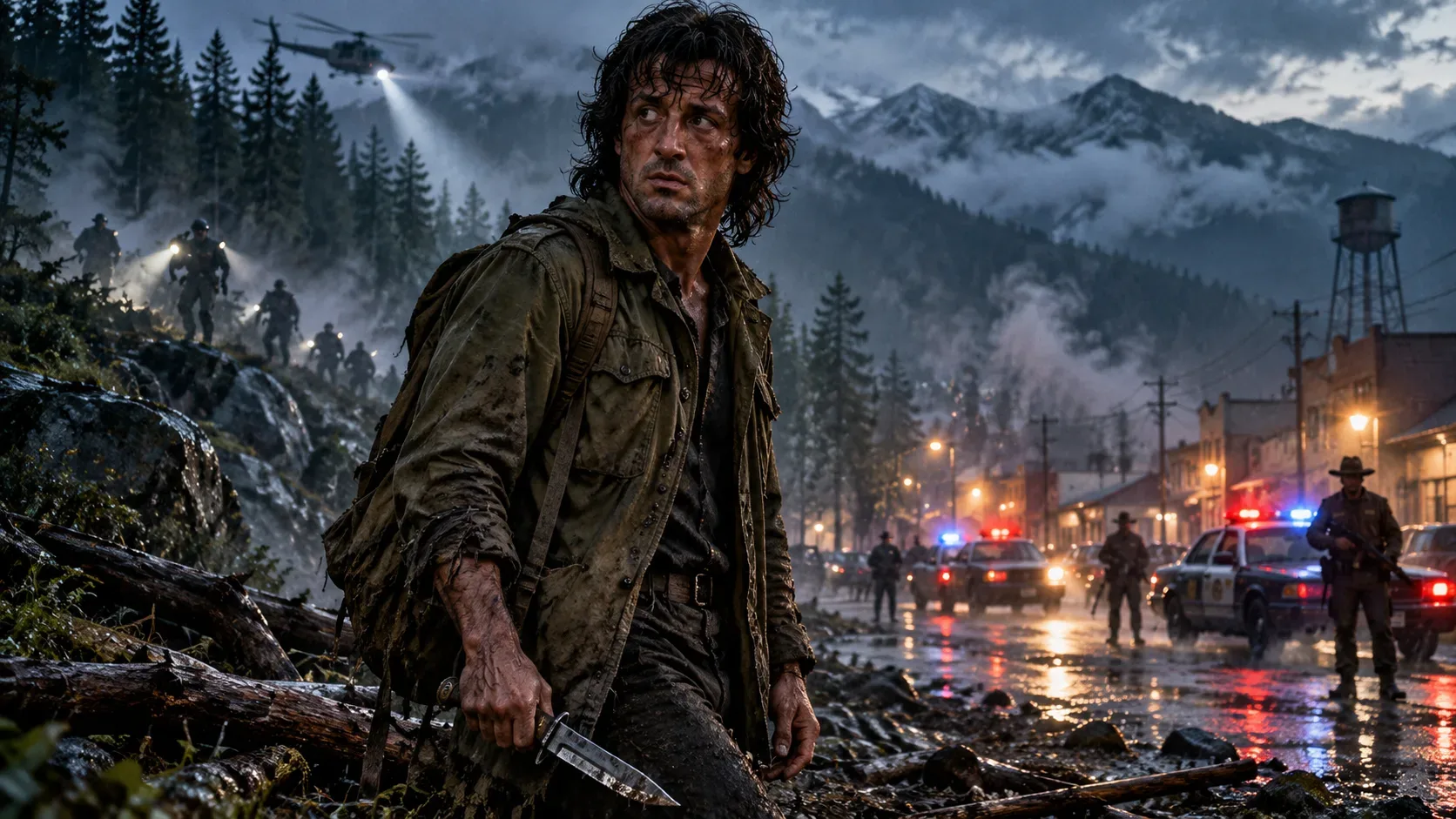
Teasle chases the motorcycle along muddy roads but loses control of his car. Rambo abandons the bike and continues on foot through the forest, using the terrain to evade capture. During the search, he becomes trapped on a rocky cliff. Galt starts firing at him from a helicopter despite Teasle's attempts to stop the shooting.
Wounded and struggling to survive, Rambo throws a rock at the helicopter. The aircraft lurches, and Galt falls to his death. The death is not presented as a deliberate execution by Rambo: it happens as he responds to incoming gunfire. Shortly afterward, he tries to surrender and explain what happened, but other officers open fire, forcing him to flee again.
Galt's death changes the sheriff's approach. Teasle becomes determined to capture Rambo even after learning that the fugitive is a decorated former Special Forces soldier. Meanwhile, Rambo sets improvised traps, injures his pursuers, and eventually holds a knife to Teasle's throat. He warns the sheriff to end the hunt, spares his life, and vanishes into the trees.
Why does the manhunt spiral out of control?
Colonel Samuel Trautman (Richard Crenna), Rambo's former commanding officer, arrives to try to resolve the crisis. He knows the soldier's training and advises Teasle to back off and wait for a chance to take Rambo into custody without further deaths. The sheriff refuses. The National Guard joins an operation that now involves far more men than the lone fugitive.
Speaking over the radio, Rambo insists that the police were the ones who drew first blood. The phrase that gives the original work its title, First Blood, expresses how he sees the hunt: he believes he is responding to the initial violence, even though his own actions also deepen the disaster. The statement helps explain the character, but it does not make everything he does an act of self-defense.
Tracked down in the mountains, Rambo shelters inside a mine. National Guardsmen fire at the entrance and use a rocket launcher, believing they have killed him. He survives the collapse and finds his way out through flooded tunnels, passing rats along the way. Once free, he seizes a military truck carrying an M60 machine gun and heads back into town.
How does First Blood (1982) end?
Back in Hope, Rambo causes a series of explosions and disruptions to approach the police station: he sets the truck ablaze at a gas station, shoots electrical equipment, and destroys a gun store. The town falls into chaos. Teasle takes an elevated position near the station to confront him.
They exchange gunfire. Rambo hits the sheriff, who falls through a skylight and is badly injured. Finding Teasle inside the building, Rambo has the opportunity to kill him. Trautman arrives at that moment and prevents the confrontation from ending in another death.
The colonel tries to make Rambo understand that the operation is over, but the veteran cannot treat his experiences like a mission that can simply be switched off. He describes how hard it has been to return to civilian life, the rejection he feels in his own country, and the comrades he has lost. Recalling the brutal death of his friend Danforth in Vietnam breaks through the emotional defenses that have kept him going.
Rambo breaks down in tears, stops threatening Teasle, and accepts Trautman's intervention. In the final sequence, Teasle is taken away for medical treatment while Rambo leaves in handcuffs, accompanied by the colonel. Both men survive the ending released in 1982.
Why does Rambo surrender to Trautman rather than Teasle?
The explanation combines events on screen with an interpretation of the conflict. In the action described, Trautman is the person who can approach Rambo without resorting to violence. He once commanded him, recognizes what combat has done to the veteran, and listens when Rambo finally speaks. Teasle, by contrast, has led the pursuit and remains willing to fight him.
Rambo's emotional collapse matters, too. Memories of torture, the loss of his military comrades, and his sense that he has no place in civilian society help explain how an arrest for an apparently minor reason becomes a private war. The film depicts traumatic effects of military experience; there is no need to assign the character a formal clinical diagnosis to recognize them.
Rambo does not surrender because Teasle defeats him in combat. He has already wounded the sheriff and could continue firing. He gives up when his conversation with Trautman breaks the cycle of threat and retaliation that has driven the story. One interpretation is that, in this moment, he finds someone willing to recognize him as a person rather than merely an enemy.
Is Teasle the villain, or is he part of the tragedy as well?
Teasle starts the conflict by expelling Rambo from town and intensifies it by insisting on the manhunt. Galt's death strengthens his determination. This does not erase Rambo's violent choices, but it shows that the escalation depends on decisions on both sides and on the authorities' failure to halt the crisis.
The outcome is especially bitter: Teasle survives but is carried away wounded; Rambo survives but ends up in custody. The town's name, Hope, also suggests a possible symbolic reading, rather than an explanation spoken by the characters. The film ends the chase without presenting Rambo's emotional recovery as a completed process.
What changes between the 1982 movie and the 1972 novel?
David Morrell's First Blood, published in 1972, inspired the film, but its ending and distribution of perspectives are different. The author explains those changes on his own website and explicitly distinguishes the novel's continuity from that of the films.
| Aspect | 1982 film | 1972 novel |
|---|---|---|
| Setting | A town in the Pacific Northwest, surrounded by forests and mountains. | The conflict takes place in rural Kentucky. |
| Point of view | Follows Rambo primarily and gives less space to Teasle's personal experience. | Alternates between Rambo's and Teasle's perspectives, giving them comparable weight. |
| Teasle's background | His military past does not play the same central role. | The sheriff is a decorated Korean War veteran, a counterpart to the Vietnam veteran. |
| Violence | Rambo wounds his pursuers; Galt dies after falling from a helicopter. | The book depicts a deadlier, more brutal confrontation. |
| Ending | Teasle and Rambo survive; Rambo surrenders to Trautman. | Rambo kills Teasle; Colonel Trautman then shoots Rambo dead with a shotgun. |
Morrell interprets Rambo's death in the novel as an allegory: Trautman stands for the military system that shaped the soldier and ultimately destroys its own creation. This is the author's stated interpretation of the book, not a scene from the released film.
Was the alternate ending in which Rambo dies actually filmed?
Yes. In addition to the literary ending, the filmmakers shot a discarded conclusion in which Rambo takes his own life. It is not the same scene as the novel: in the book, Trautman kills him. Director Ted Kotcheff described the filming of Rambo's death and the decision to use the other version after a negative test-screening response in an interview with AlloCiné. Morrell also recounts the change.
These are therefore three different outcomes that must not be confused: in the 1982 theatrical film, Rambo lives and is arrested; in the 1972 novel, Trautman kills him; in the filmed but rejected alternate ending, Rambo dies by suicide. The first movie ends with the protagonist's surrender and survival. The events of Rambo: First Blood Part II belong to a separate story.
Sources and references
- American Film Institute (AFI): film record, production history, and detailed synopsis of First Blood (1982)
- David Morrell: interview and explanation of the differences between the book and film
- David Morrell: official page for the First Blood novel
- AlloCiné: interview with Ted Kotcheff about the alternate ending