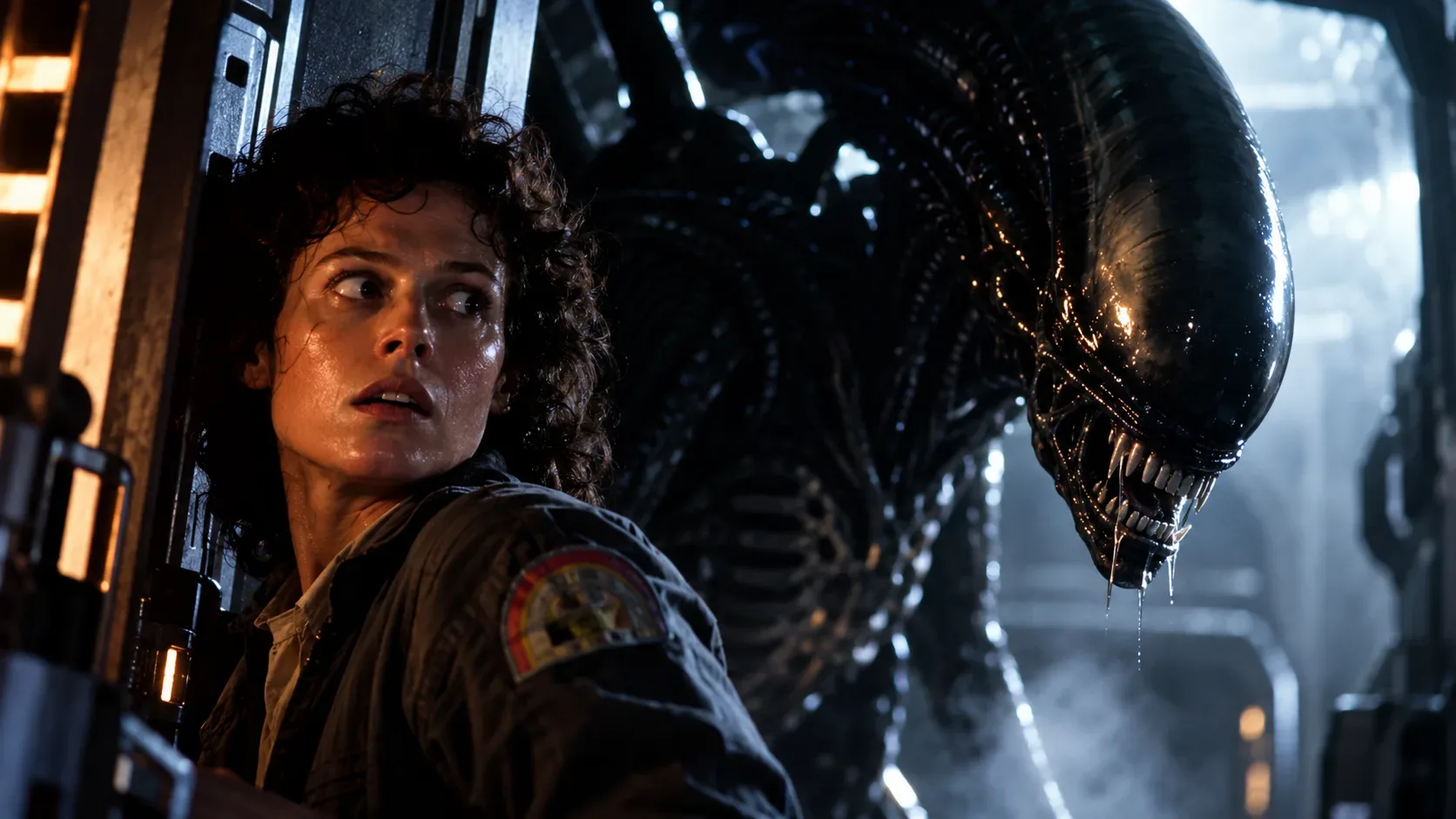
Spoiler warning: the following article reveals the entire story and ending of Alien (1979).
At the end of Alien, Ellen Ripley is the only human member of the Nostromo crew to survive. She escapes with Jones the cat shortly before the ship explodes, only to discover that the alien has stowed away on the escape shuttle. Ripley manages to force it into space and enters hypersleep. An earlier revelation also changes how the events make sense: Ash was carrying out a secret company order that valued the organism above the lives of its employees.
This recap follows the original theatrical version released in 1979 and directed by Ridley Scott. It is reconstructed from the American Film Institute's detailed synopsis, studio documentation and identified analyses. One significant scene added to the alternative 2003 edit is discussed separately so that it is not mistaken for part of the original cut.
Why does the Nostromo leave its course?
The Nostromo is a commercial towing spacecraft carrying a huge mineral-ore shipment back to Earth. Its seven crew members are in hypersleep when the ship's computer, Mother, wakes them. A transmission from an unknown source on a remote world has triggered a course change.
Captain Dallas is instructed to investigate the signal. Parker and Brett, who handle ship maintenance, question the assignment: they were not hired for a rescue operation. Science officer Ash explains that company rules require the investigation of possible signs of intelligent life. The crew proceeds to the surface, where a difficult landing damages the Nostromo.
While Parker and Brett work on repairs, Dallas, Kane and Lambert cross the hostile landscape and find an abandoned alien spacecraft. Inside lies the fossilized body of a gigantic being, apparently dead after sustaining a wound in its chest. In another chamber, Kane discovers a vast number of egg-like objects. One opens and an organism leaps onto his face. Back aboard the Nostromo, Ripley recognizes a detail that changes the mission's meaning: the transmission appears to be a warning, not a call for help.
How does the alien enter the ship and emerge from Kane?
Dallas and Lambert bring the unconscious Kane back. Ripley, enforcing quarantine procedure, refuses to open the hatch while contamination remains possible. Ash overrides her decision and lets them inside. That security breach brings the organism aboard.
In the medical bay, the crew tries to remove the creature attached to Kane's face. When injured, it releases a corrosive fluid that burns through sections of the deck, showing why an attack inside the Nostromo could endanger the ship itself. Later, the parasite detaches and dies. Kane wakes, apparently recovered, and the crew resumes its journey.
The relief does not last. During a meal, Kane convulses and a small creature bursts through his chest, killing him in front of his colleagues. The organism that attached itself to his face had left a developing life form inside his body. The crew loses Kane and now has a predator loose on board. The film depicts these stages without offering a complete scientific explanation of the creature's life cycle.
What happens to Brett and Dallas?
The survivors improvise tracking equipment and tools to catch or repel the intruder. During the search, they mistake movement by Jones the cat for a possible sign of the creature. Brett goes looking for the animal and is attacked by an alien that has grown dramatically larger. His body disappears from his crewmates' reach.
Dallas tries to drive the monster through the ventilation shafts toward an exit, carrying a flamethrower while the others track its movements. The creature ambushes him and radio contact ceases. In the theatrical cut, Dallas disappears without the same explicit resolution shown in Kane's death. With the captain gone, Ripley takes command.
What were Ash and the company hiding?
Ripley consults Mother for information that Ash has not been providing. She uncovers Special Order 937: retrieving the alien organism for analysis takes priority, while the crew's safety is secondary. The discovery makes clear that the company did not treat the diversion as merely a rescue mission. A corporate interest in the specimen stood behind the official assignment.
When Ripley confronts Ash, he tries to kill her. Parker and Lambert intervene, damage the science officer and discover that he is an artificial person, not a human crewmate. They briefly reactivate his head to question him, but hear only his admiration for the organism's survival abilities, not a way to defeat it. The android is then shut down and his remains destroyed.
This explains Ash's behavior since Kane's return: he permitted the quarantine breach and safeguarded the chance to transport the specimen. The interpretation that the company intended to exploit it as a biological weapon is supported by the film's context and an analysis published by the BFI. However, the species' origin, who made the eggs and the full extent of the company's advance knowledge are not conclusively answered in the 1979 film.
Who survives aboard the Nostromo?
| Character | What happens in the 1979 film |
|---|---|
| Kane (John Hurt) | Dies when a creature bursts from his chest during a meal. |
| Brett (Harry Dean Stanton) | Is attacked by the adult alien while searching for Jones. |
| Dallas (Tom Skerritt) | Disappears after an attack in the air shafts; no recovered body is shown in the original cut. |
| Ash (Ian Holm) | Is revealed as an android and destroyed after attacking Ripley. |
| Lambert (Veronica Cartwright) | Is killed by the creature during preparations to escape. |
| Parker (Yaphet Kotto) | Also dies in the attack during preparations to escape. |
| Ellen Ripley (Sigourney Weaver) | Escapes on the shuttle as the sole human survivor; Jones also survives. |
Ending explained: how does Ripley defeat the alien?
After Ash is disabled, the three remaining humans, Ripley, Parker and Lambert, decide to abandon the Nostromo and destroy it so the intruder cannot remain aboard. While Parker and Lambert gather the supplies needed for the shuttle, the creature attacks and kills them. Ripley finds her colleagues dead and is left alone apart from Jones.
Ripley activates the Nostromo's self-destruct system and rushes toward the escape shuttle, known as the Narcissus. The alien briefly blocks her route and forces her to retreat. She attempts to cancel the countdown, but Mother's point of no return has already passed. Ripley retrieves Jones and finally launches before the main ship explodes.
The escape is not over. As she prepares for hypersleep, Ripley realizes that the alien is hiding inside the Narcissus. She puts on a spacesuit, opens the hatch to expose the creature to space, uses a harpoon gun to force it outward and fires the shuttle's engines to prevent it from remaining near the exit. The ending shows the intruder expelled and Ripley back in control of the craft.
Ripley then records a report on the loss of the Nostromo and its crew, settles Jones and enters hypersleep. The film ends with her survival but does not depict her eventual rescue on Earth. Her victory comes through practical decisions, persistence and the use of her surroundings, not a sudden revelation of an easy weakness in the monster.
What does the ending tell us about the signal and the real threat?
The signal from the beginning takes on new significance after Special Order 937 is uncovered. Ripley had identified the message as a warning, while the company prioritized securing the organism. The sequence of decisions puts the workers at risk before the creature even enters their ship. Ash helps turn a dangerous discovery into a retrieval mission.
There are two different threats. The alien acts as a predatory organism; the company knowingly makes decisions that expose employees to danger. This contrast is an interpretation of the story supported by the BFI's analysis, not an additional revelation about the species' biology or intentions. The film preserves the mystery of what exactly happened aboard the extraterrestrial vessel found by the crew.
What changes between the 1979 theatrical cut and the 2003 Director's Cut?
The main recap here concerns the original theatrical release. The alternate version titled Director's Cut, released in 2003, adds shots while also removing or shortening others, so it is not simply an extended edition. A comparison published by specialist site AvP Galaxy documents, for example, changes to the presentation of the signal, character moments and the pace of the escape.
The most important narrative difference is the cocoon scene. In the 2003 edit, Ripley finds Dallas trapped in an organic structure, still able to ask her to kill him; Brett appears at a different stage of transformation. Ripley uses her flamethrower there. This discovery is not part of the original 1979 theatrical cut. The scene suggests a transformation process connected to alien reproduction, but it does not mean that every detail of the creature's biology is fully explained by the first film.
Both cuts retain the central chain of events: Kane brings the organism aboard the Nostromo, Ash follows the secret mission, the others are eliminated, and Ripley escapes with Jones after ejecting the intruder from the shuttle. Anyone trying to understand the version released in 1979 should not insert the cocoon scene into that original chronology.