Spoiler warning: the following text reveals major events and the ending of the 1951 film.
In The Day the Earth Stood Still (1951), Klaatu comes to Earth to warn that human violence could lead to the planet’s destruction if that aggression spreads into space. His demonstration of power lasts 30 minutes, but the decisive warning arrives at the end: civilizations on other worlds have entrusted robots such as Gort with preventing aggression that could threaten peace between planets.
Robert Wise’s film, starring Michael Rennie as Klaatu and Patricia Neal as Helen Benson, turns an extraterrestrial visit into a clash of suspicion, diplomacy, and fear. This explanation covers only the original 1951 production, not the version released in 2008.
How Klaatu’s story begins
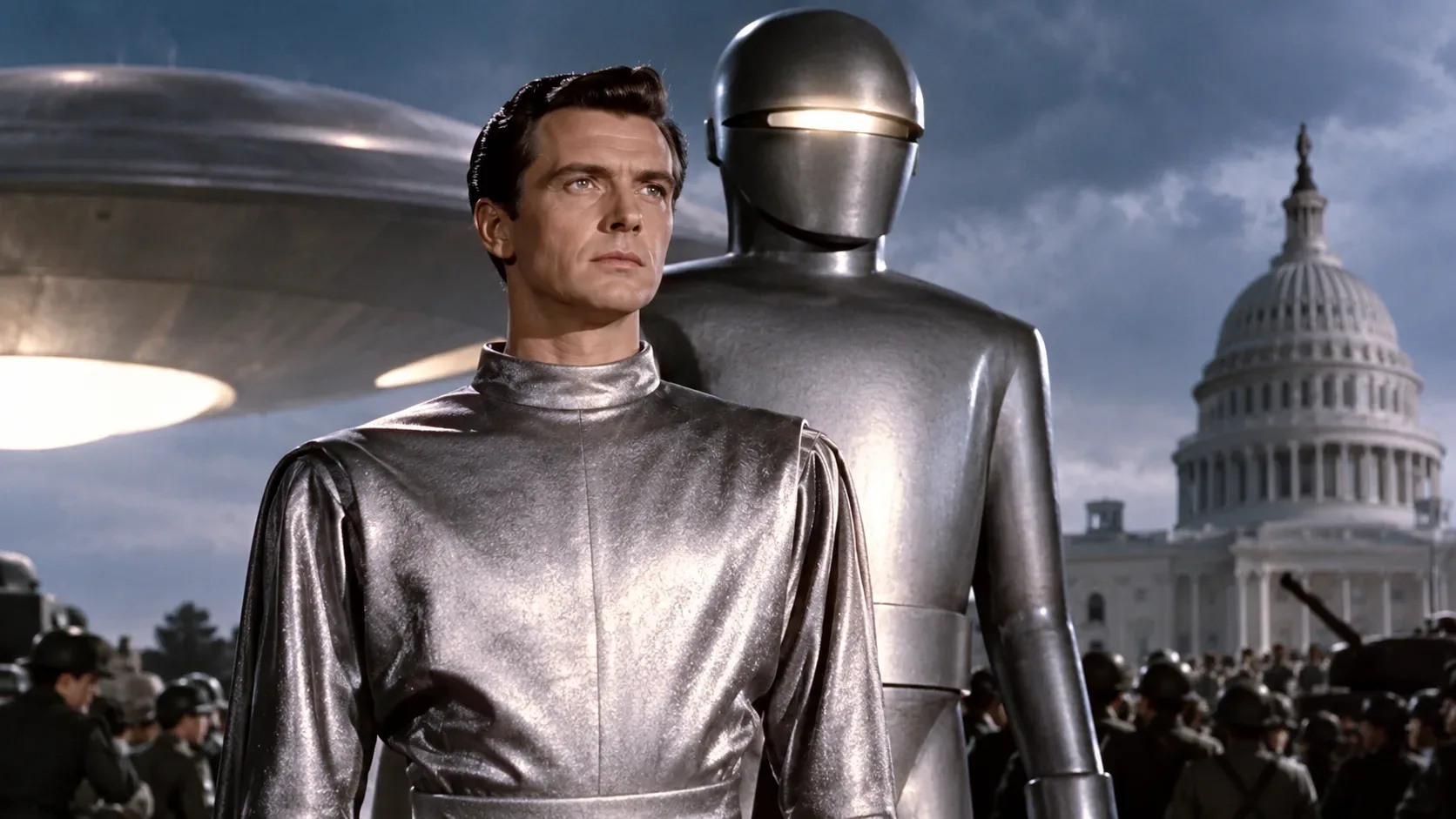
A disc-shaped spacecraft lands in Washington, D.C., before soldiers and onlookers. Its visitor emerges saying he has come in peace, but a soldier shoots him as he opens a small device. The object is not a weapon: it is a scientific gift intended for the president of the United States.
Gort, the imposing robot accompanying Klaatu, responds by destroying weapons with an energy beam. Klaatu orders him to stop, and the military takes the wounded visitor to a hospital. His extraordinarily swift recovery suggests that humanity is facing a civilization with vastly superior technology.
Klaatu asks for a meeting with the leaders of every nation to deliver an urgent message. Political disagreements prevent them from agreeing to gather. Realizing that official channels will not allow him to address everyone, he escapes to learn about the society he has been sent to warn.
The Carpenter disguise and the meetings with Helen, Bobby, and Barnhardt
Calling himself Carpenter, Klaatu takes a room in a boarding house and meets Helen Benson, her son Bobby, and Tom Stevens, who is romantically involved with Helen. His friendship with Bobby helps the visitor see that Earth cannot be defined solely by the hostility of his arrival.
While touring Washington, Bobby shows his new friend places connected with American history and mentions scientist Jacob Barnhardt. Klaatu seeks out the professor and displays his knowledge by completing an equation on his blackboard. Their meeting provides a route around the diplomatic deadlock.
Klaatu tells Barnhardt that Earth’s atomic technology and humanity’s first steps toward space concern other planets, especially because of human aggression. The scientist agrees to assemble researchers and other influential figures to hear the message, but suggests that a peaceful demonstration of power will make the warning impossible to dismiss.
Why does the Earth stand still for 30 minutes?
For half an hour, Klaatu halts the operation of electrical equipment around the world. Machines, activities, and transport that depend on that power stop; essential services where lives would be endangered, such as hospitals, are spared. His goal is neither to kill people nor to begin an invasion, but to prove that his technology exceeds humanity’s ability to resist.
The shutdown gives the title its meaning and fulfills Barnhardt’s suggestion: people experience a small sample of the power that could be used against them. By telling Helen that he caused the phenomenon, Klaatu gains an ally. He tries persuasion before invoking the far more serious threat he came to deliver.
Tom’s betrayal and the words spoken to Gort
Tom becomes suspicious of Carpenter’s real identity and sees an opportunity for fame in handing him over to the authorities. Helen rejects that choice and tries to take Klaatu to Barnhardt’s gathering, but soldiers intercept them along the way.
Before they are stopped, Klaatu instructs Helen to tell Gort “Klaatu barada nikto” if anything happens to him. Klaatu is shot and killed. The danger now extends beyond the pursuit of the visitor, since the robot may respond to his death with devastating force.
Helen reaches the spacecraft and speaks the words. Gort halts his reaction, brings her inside the saucer, and retrieves Klaatu’s body. Using the craft’s technology, he revives him. Klaatu himself explains, however, that he does not know how long this recovery will last. The film never supplies a literal translation of the three words; within the story, they operate as an emergency command.
Ending explained: what exactly is Klaatu’s warning?
Appearing before the assembled scientists, Klaatu explains that an organization of planets created immensely powerful robots to prevent aggression between worlds. These machines, including Gort, were granted the authority to act against violence and maintain collective security. The visitor is therefore not asking Earth’s governments to hand control of the planet to him personally.
The condition is harsher: as long as human violence remains confined to Earth, other worlds do not intend to intervene in its local disputes. But if humanity carries its destructive capabilities into space and threatens other civilizations, the machines may destroy Earth. Klaatu presents a choice between peaceful coexistence and annihilation, without claiming that the planet is already doomed.
Klaatu leaves with Gort, and the decision remains open. There is no later scene showing world leaders signing an agreement, giving up weapons, or suffering an attack. The ending is an ultimatum, not a completed destruction. Nor does it mean Klaatu demands an end to all scientific research or every use of atomic energy: the central danger is the aggressive use of such capabilities.
His speech can be read as a call for international cooperation amid the Cold War’s nuclear anxieties. Yet it contains a deliberate tension: the peace Klaatu describes depends on robots given immense punitive power. Rather than portraying Gort as a harmless protector, the movie confronts viewers with the uncomfortable cost of that arrangement.
What Gort represents and how to identify the 1951 version
Gort is both Klaatu’s bodyguard and a concrete example of the interplanetary security force. His role explains why the phrase entrusted to Helen matters so much. Without that command, the messenger’s death could set off a catastrophe, even though the original mission was peaceful contact.
The original opened in New York on September 18, 1951, and reached its 75th anniversary in 2026. Its story reflects the political tensions, weapons, and technology of its era. The 2008 The Day the Earth Stood Still, directed by Scott Derrickson and starring Keanu Reeves, is a different adaptation that places an environmental crisis at its center. Its events and ending should not be used to explain Michael Rennie’s final warning.
Sources and references
- AFI Catalog: historical record and detailed plot synopsis for the 1951 film
- Turner Classic Movies: original film, cast, and clips
- D23: historical context for the 20th Century Fox classic
- Humanities journal: scholarly discussion of atomic energy in the film
- Disney+ Brazil: listing for the 2008 film adaptation