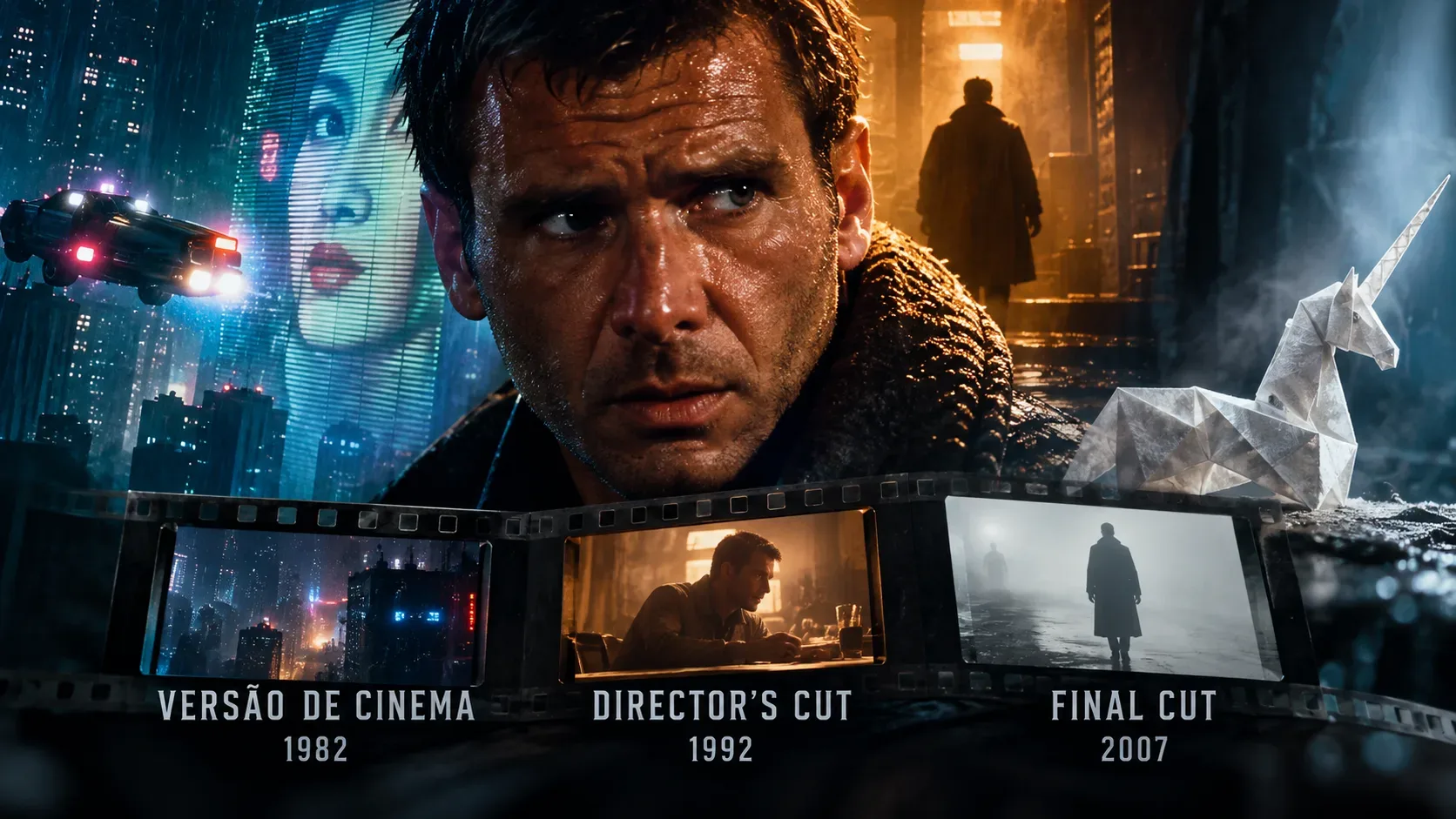
For viewers who want to see Blade Runner (1982) in the version Ridley Scott was able to finish under his own control, the clearest choice is The Final Cut (2007). The 1982 U.S. theatrical release has explanatory narration from Rick Deckard; the 1992 Director's Cut removes it and restores the unicorn imagery; The Final Cut keeps those decisions while revisiting the editing, picture and sound.
All three cuts tell essentially the same story, but they lead viewers toward different conclusions and questions. This comparison uses the 1982 U.S. theatrical cut as its starting point. An international cut also appeared that year, with more explicit violence; it should not be confused with the Director's Cut.
Spoiler warning: the following comparison reveals the ending of Blade Runner (1982), including what happens to Deckard and Rachael and the role of the unicorn.
What changes between the three versions?
| Feature | U.S. theatrical (1982) | Director's Cut (1992) | Final Cut (2007) |
|---|---|---|---|
| Deckard's narration | Present, with voice-over explanations delivered by Harrison Ford. | Removed. | Still absent. |
| Ending | Deckard and Rachael escape; an epilogue shows open landscapes. | Ends as their escape reaches the elevator, without the epilogue. | Keeps the elevator ending. |
| Unicorn | Gaff's origami appears, but Deckard's unicorn reverie does not. | Restores the brief unicorn reverie. | Retains the reverie in a more complete version. |
| Picture and sound | Original theatrical-release presentation. | A recut with technical limitations Scott still found unsatisfactory. | Audiovisual restoration and corrections to effects and continuity. |
| Violence and editing | Certain violent moments were toned down for the U.S. release. | Its main changes involve narration, the ending and the unicorn. | Also restores more intense moments from other cuts and adjusts footage. |
Why does the theatrical version have narration and a different ending?
Following test screenings, those overseeing the 1982 release added Deckard's first-person narration and a more hopeful ending. The voice-over explains thoughts and events in the language of film noir. Meanwhile, the landscape sequence after Deckard and Rachael escape offers a less unsettling view of their possible future.
In the 1992 Director's Cut, the narration disappears and the story ends as the elevator doors close. That leaves more room for audiences to interpret Deckard's silence and the danger still surrounding the escape. The BFI describes the changes made for the 1982 release as a response to the production's concerns about how the film would be received.
Does the unicorn change how we interpret Deckard?
Yes, chiefly because it connects two images: Deckard's reverie of a unicorn and the origami unicorn left by Gaff. The origami was already part of the theatrical ending, but without the reverie the connection between the images was less explicit.
In a 2007 interview with WIRED, Scott explained his intention: if Gaff knows about an image Deckard would keep only in his thoughts, that may suggest access to implanted memories or experiences. For the director, this clue supports the idea that Deckard is also a replicant.
That is Scott's stated interpretation, not a consensus among the people who made the film. The BFI documents Harrison Ford's disagreement and his view that Deckard was human. It is therefore more accurate to say that the 1992 and 2007 cuts strengthen the director's reading than to claim a line of dialogue explicitly settles the question.
Did Ridley Scott personally make the 1992 Director's Cut?
The title might suggest so, but the history is more complicated. After an old workprint began screening as though it were the director's cut, Warner assembled the edition released in 1992 using Scott's guidance. According to Turner Classic Movies' history of the film, he was not able to oversee that recut as closely as he wanted.
Scott himself told WIRED that the 1992 cut had corrected major narrative decisions, but he was still dissatisfied with its technical presentation. That difference in involvement and finish helps explain why another major version followed in 2007.
What does the 2007 Final Cut restore or fix?
The Final Cut does not replace the plot with a different story. With more direct control from Scott, it presents a fuller version of the unicorn reverie, adjusts scene pacing, restores material from other edits, and revises picture and sound. Some moments of violence previously found in international editions also appear in this cut.
Some interventions are easiest to notice in the details. Scott told WIRED about digitally removing the cables used to suspend flying vehicles. The magazine's coverage of The Final Cut release also describes refinements to shots and the recovery of footage missing from the 1992 version. This is restoration and re-editing, not a sequel or an entirely new movie.
Which version of Blade Runner should you watch?
First viewing: choose The Final Cut (2007) if you want the finished conception championed by Ridley Scott. It combines the narrative choices of the later cuts with a more extensive technical overhaul.
Historical interest: watch the 1982 U.S. theatrical cut to understand how the film first reached that audience, complete with narration and its more optimistic ending. The 1992 Director's Cut is useful as an intermediate step. The 1982 international cut and earlier workprints explain why some lists contain more than three versions.
Whichever cut you choose, these are not three incompatible stories. The most important difference is how much the editing explains to the viewer and which clues it offers about Deckard's identity.