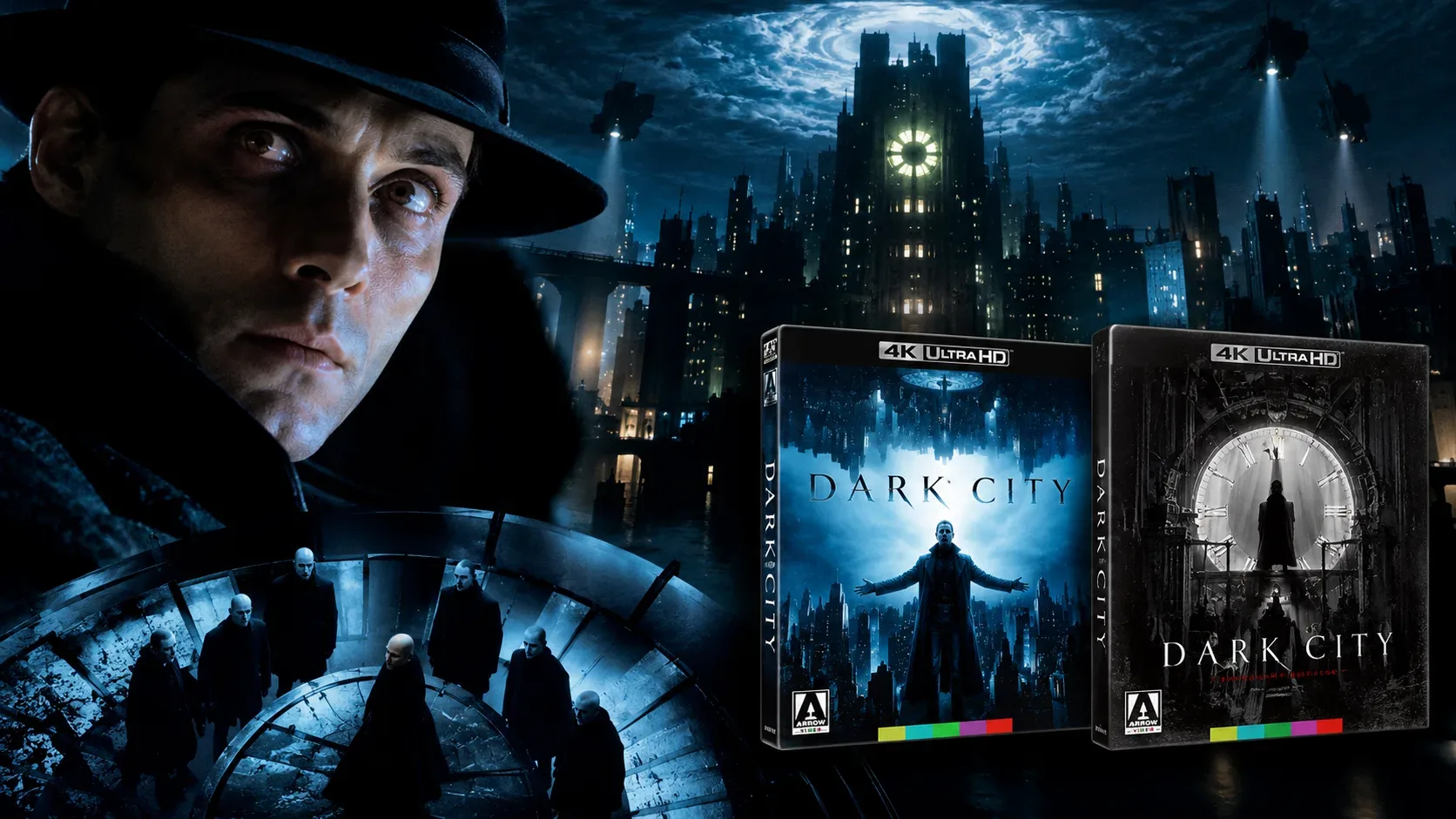
In Alex Proyas’s Dark City (1998), the Director’s Cut removes the explanatory voiceover heard at the start of the theatrical version, letting viewers discover the film’s world alongside its protagonist. That is not the only change: the 2008 edit restores material and gives the story a more measured rhythm. To watch both cuts in 4K, you need Arrow Video’s two-disc Limited Edition 4K UHD. The regular one-disc 4K UHD Special Edition contains only the Director’s Cut.
Spoiler-free: this comparison describes what the edits do, without revealing the mystery’s answers or the film’s ending. In Brazil, the film is also known as Cidade das Sombras.
Why does the Director’s Cut remove the opening narration?
The version released theatrically in 1998 opens with a voiceover from Dr. Schreber, played by Kiefer Sutherland, giving audiences information about how the film’s world works before John Murdoch, played by Rufus Sewell, can understand it himself. This creates a more guided introduction. In the director’s edit, that explanation is gone: clues instead arrive through actions, dialogue and imagery, in step with the protagonist’s investigation.
Speaking to ScreenAnarchy in 2008, Proyas linked the added narration to test-screening reactions and attempts to make the story easier to follow. In a further interview published by Sci-Fi Bulletin in 2025, he explained that he wrote the voiceover as a concession amid requested changes. The crucial difference is not a new answer to the plot: it is when viewers receive certain information.
What else changed in the 2008 edit?
Proyas described the Director’s Cut as having a more reflective pace, restored scenes, dialogue and small extensions to familiar passages. A 2008 DVD Talk review also identifies the relocation of a sequence that the theatrical version moved forward into the opening. Together, these adjustments change the order of discovery and the atmosphere without requiring the film to tell a different story.
Arrow’s US listing for the limited 4K release specifies 111 minutes for the Director’s Cut and 100 minutes for the theatrical cut. These are runtimes stated for that commercial release; numbers in other listings or formats may differ. Proyas also noted in 2025 that the 2008 cut was closer to his original vision, although it did not recover every piece of footage lost during editing.
Arrow 4K: Limited Edition or regular Special Edition?
The two official Arrow listings consulted refer to specific products on its US storefront. Both describe a new 4K restoration from the original 35mm camera negatives, approved by cinematographer Dariusz Wolski, with Dolby Vision and HDR10 compatibility. The key difference is what is actually on the discs:
| Arrow edition | 4K UHD discs | Included cuts | How to tell |
|---|---|---|---|
| Limited Edition 4K UHD | 2 | Director’s Cut and theatrical cut | Disc 1 contains the director’s edit and disc 2 the theatrical edit; a collector’s book and physical extras are included. |
| Regular 4K UHD Special Edition | 1 | Director’s Cut only | The listing specifies a UHD presentation of the director’s edit and does not include the theatrical cut as an option. |
Do not mistake 4K UHD for a 1080p Blu-ray edition, or assume the phrase 4K restoration means both cuts are included. A package bearing the 4K label may still contain just one version. Extras also vary: the limited edition distributes additional features across both discs, while the regular edition lists supplements tied to the Director’s Cut.
Which cut should you watch first, and what should you check before buying?
For a first viewing without information revealed in advance, the Director’s Cut fits the sense of mystery Proyas wanted to protect. The theatrical version still matters if you want to see what audiences encountered in 1998 or compare how narration and sequence order shape the experience. If you want to make that comparison in UHD, look specifically for the two-disc Limited Edition 4K UHD.
Before buying, verify the seller’s description for the full edition name, disc count, included cuts, UHD versus Blu-ray format, and subtitle languages. Both 4K listings consulted specify English subtitles for deaf and hard-of-hearing viewers; they do not establish the availability of Portuguese subtitles. These are Arrow listings for particular commercial products, not proof of availability, import options or streaming catalogues in Brazil. Other editions require their own cut-by-cut verification.