Spoiler warning: This article reveals events from episodes 4 through 9 of Andor Season 2.
Ghorman suffered two massacres because Tarkin's violence against unarmed demonstrators in the Empire's early years was followed by a separate Imperial operation designed to turn local resistance into a pretext for taking control of the planet. The second tragedy takes place in 2 BBY, in Andor Season 2 episode 8, and leads directly to Mon Mothma's public denunciation in episode 9.
The events are connected by the same square in Palmo and the Empire's attempts to control the story. In the first massacre, a demonstration was crushed when Tarkin's ship landed. In the second, the Imperial Security Bureau (ISB) manipulates rising tensions to enable the extraction of kalkite, a mineral needed for the Death Star project. The timeline below distinguishes the series' account from Imperial propaganda.
The first massacre: Tarkin and Palmo's memory
In 'Ever Been to Ghorman?', the fourth episode of Season 2, local leader Carro Rylanz recalls Tarkin killing 500 peaceful, unarmed Ghormans in the capital's square 16 years earlier. Because this part of the series is set in 3 BBY, his account places the earlier massacre around 19 BBY. The death toll is Carro's figure for the Tarkin incident, not an official count for the second attack.
Official Star Wars coverage explains that Tarkin's cruiser did not postpone its landing for the protest. Years of trauma became concentrated in the Monument to the Fallen. Hotel worker Thela, whose father died when he was a child, gives that memory a human dimension. Construction of an Imperial armory near the memorial raises tensions: residents see an occupation prepared to repeat history.
How the Empire prepared the second massacre
Ghorman's strategic value reaches far beyond the suppression of dissent. According to the official Star Wars Databank, Orson Krennic needed kalkite to coat the Death Star's reactor lenses and stabilize its energy output. The aggressive mining required to obtain it could destabilize the planet's core. The Empire needed to suppress the population and manufacture a political justification for its occupation.
Krennic places Dedra Meero in charge. She fuels hostility toward the Ghormans, uses Syril Karn to infiltrate the Ghorman Front, and allows the resistance enough successes to attract attention and be branded a threat. Syril participates without knowing the mining objective. The residents' protests are real, but the conditions in which those protests will be violently put down are deliberately engineered by the ISB.
In episodes 4 to 6, set in 3 BBY, Cassian arrives disguised as a fashion designer to assess the rebel cell led by Carro and Enza Rylanz. Vel Sartha and Cinta Kaz also become involved in its operations; Cinta dies during a mission that goes wrong. Ghorman's escalating crisis unfolds alongside Mon Mothma's still-cautious political efforts in the Senate.
A timeline of the two massacres and the episodes
| Time | What happens | Why it matters |
|---|---|---|
| Around 19 BBY | Tarkin lands despite a demonstration in Palmo Square; Carro attributes 500 deaths to the incident. | Residents preserve the victims' memory in a monument. |
| 3 BBY (episodes 4 to 6) | Imperial occupation intensifies; Syril infiltrates the Ghorman Front while Cassian investigates the cell. | Krennic's secret plans intersect with both peaceful and armed local resistance. |
| 2 BBY (episodes 7 and 8) | The crackdown is prepared, and a demonstration in the square ends in a massacre. | The violence provides the Empire with the crisis it intended to create. |
| 2 BBY (episode 9) | Mon Mothma denounces Palpatine in the Senate and escapes with Cassian's help. | The clandestine opposition gains a publicly defiant leader. |
What Imperial propaganda says versus what happens
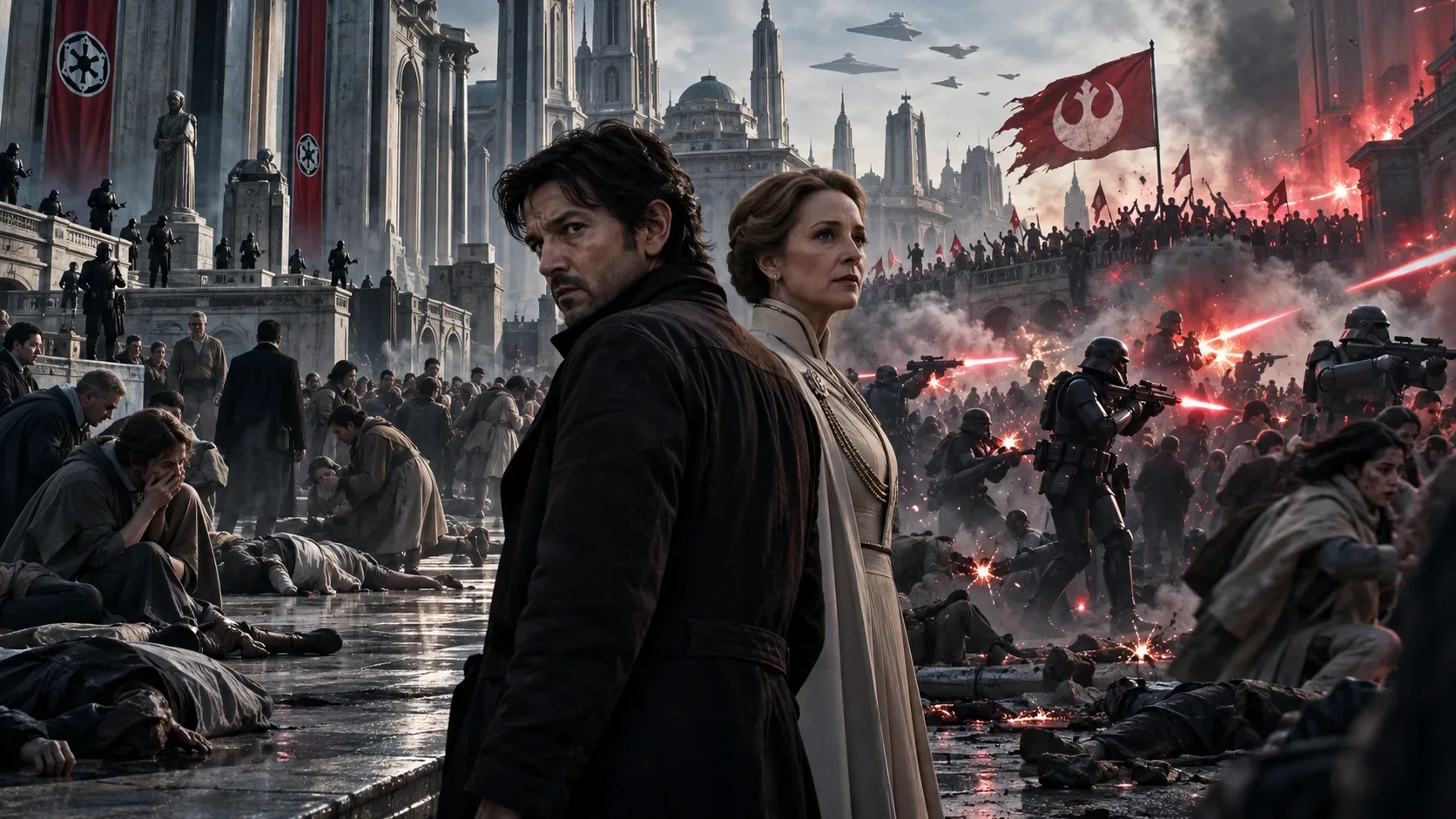
In 'Who Are You?', episode 8, Imperial troops and KX droids surround demonstrators in Palmo. According to the official Star Wars recap, the decisive blaster shot comes from the Imperials themselves: one of their own is sacrificed to make it appear that the crowd started the violence. The crackdown spreads across the square. Cassian fights Syril, who discovers Dedra has used him; Carro kills Syril while preventing him from killing Cassian.
Pro-Imperial reports portray the crisis as a Ghorman uprising and cast Imperial personnel as victims. The story itself documents something else: the occupying power provokes the confrontation, prepares an armed response, and needs the residents weakened so it can exploit the planet. That does not mean every local group rejects all forms of confrontation; it means the incident used to justify the massacre was manufactured. The official sources consulted do not provide a definitive death toll for the second attack.
Why Mon Mothma breaks with the Empire, and what changes for the Rebellion
In 'Welcome to the Rebellion', episode 9, Mon Mothma abandons the caution that previously shaped her public role. She calls what happened on Ghorman 'unprovoked genocide', disputes the Imperial account, and names Emperor Palpatine as responsible. That description is the character's accusation within the story, not an independent legal determination or statistic made by this article.
Her speech ends any realistic prospect of remaining a tolerated opponent inside Imperial institutions. The effort to extract her from Coruscant is compromised by double agents; Cassian takes over the rescue and gets her beyond the Empire's immediate reach. The senator moves from covert backer and parliamentary critic to the public face of the resistance.
The Rebellion's transformation is political and organizational. Rebel networks, Luthen's operations, and the base on Yavin 4 existed already. Ghorman makes the split between open condemnation and the struggle against the regime impossible to maintain: the cause gains a recognized voice openly breaking with the Senate. Lucasfilm's official account frames this as the Rebellion's public birth, not the galaxy's first act of resistance.
Why do some accounts describe only one massacre?
Tony Gilroy told StarWars.com about a tension between earlier Star Wars continuities: in Legends, the Tarkin incident occupied the historical position many readers associated with the Ghorman Massacre. Andor retains that event as the Tarkin Massacre and separately depicts the repression in 2 BBY. These are therefore not contradictory descriptions of a single scene. In the continuity portrayed by the show, they are two events linked by the Empire's use of fear and propaganda.
Gilroy described the crisis as a campaign of provocation and misinformation directed at a community with its own strong identity. In an official interview, actor Genevieve O'Reilly connected Mon's speech to the violence inflicted on Ghorman's people. These attributed comments illuminate the creative intentions, while the sequence of events is grounded in the episode guides and recaps.
Sources and references
- StarWars.com: official recap of episodes 4 to 6
- StarWars.com: official recap of episodes 7 to 9
- StarWars.com: Orson Krennic official Databank entry
- StarWars.com: Dedra Meero official Databank entry
- StarWars.com: interview with creator Tony Gilroy
- StarWars.com: interview with Genevieve O'Reilly
- Doux Reviews: episode 4 review and Carro Rylanz's account
- The Ringer: Ben Lindbergh's analysis of episodes 7 to 9