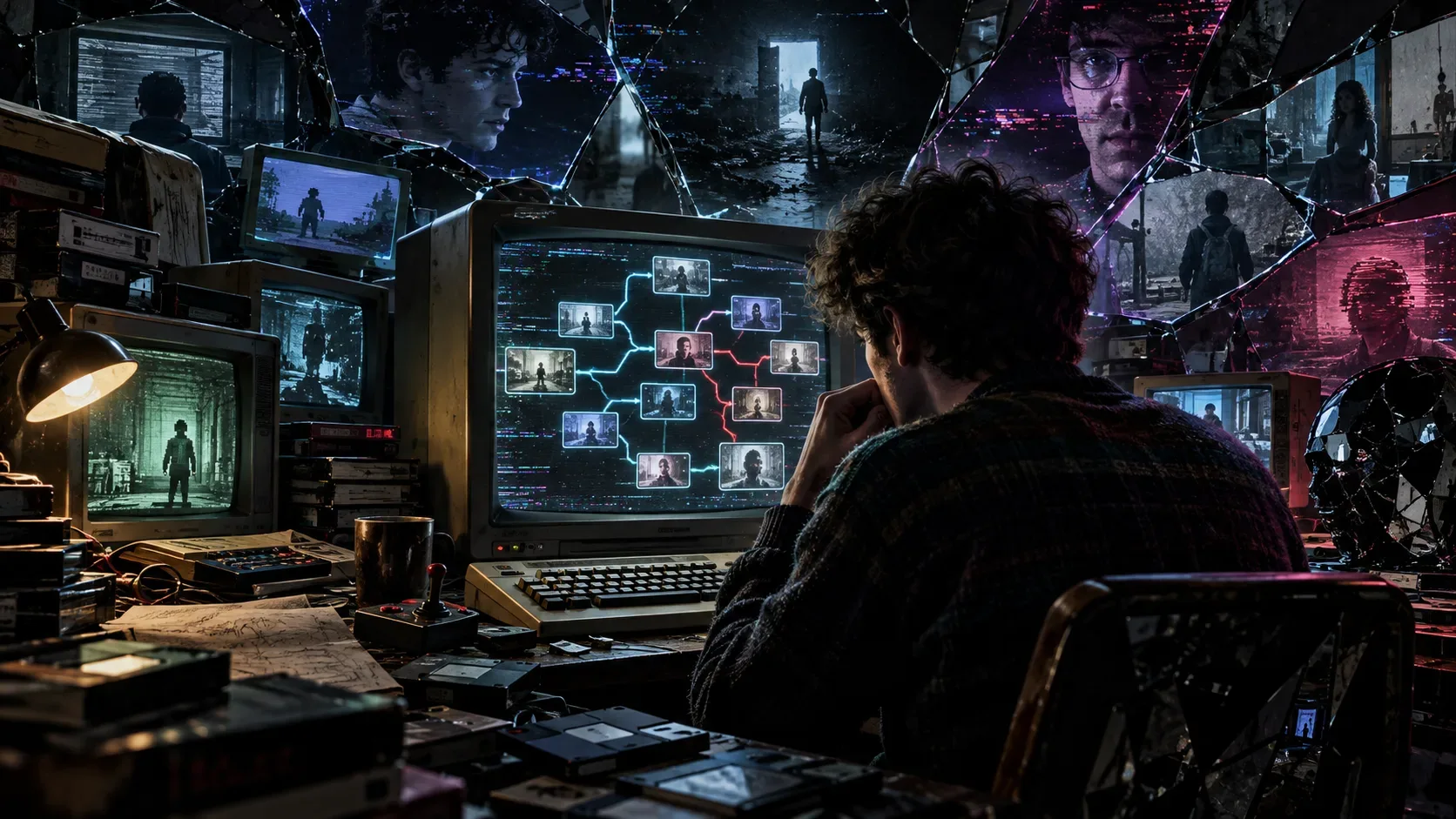
The connection between Plaything and Bandersnatch is confirmed: Colin Ritman, Mohan Thakur, and the fictional game company Tuckersoft return in the fourth episode of Black Mirror Season 7. That does not make any one ending of the 2018 interactive film the sole canon ending. Charlie Brooker told Entertainment Weekly that its different outcomes remain equally valid, even though the later story features a living Colin.
Spoiler warning: the following sections reveal Bandersnatch branching paths and events from Plaything.
What the connection actually establishes
Bandersnatch follows Stefan Butler (Fionn Whitehead) in 1984 as he tries to adapt a choose-your-own-adventure book into a video game. The viewer’s decisions change events and outcomes, including the fates of Stefan and Colin, the programmer played by Will Poulter. Those choices are integral to the work itself rather than clues pointing toward a single ending awaiting confirmation.
In Plaything, game journalist Cameron Walker’s memories (Lewis Gribben as the younger Cameron, Peter Capaldi as the older one) take us back to 1994. Cameron visits Tuckersoft, meets Mohan Thakur (Asim Chaudhry), and sees Colin’s secret project: Thronglets, digital life-forms presented as a game. The sequence establishes that Colin is alive and working at the company in this version of events, ten years after 1984.
The link extends beyond familiar faces. Netflix’s official coverage identifies references to Bandersnatch games and objects in Colin’s office, including the book itself and drawings by his daughter Pearl. These are documented connections through setting and character. On their own, they cannot tell us which decisions a viewer made in the interactive film.
Colin can die in Bandersnatch: what changes?
On some Bandersnatch paths, Stefan follows Colin to the balcony sequence, where a choice determines which of the two jumps. Other decisions affect the development of the game, character encounters, and Stefan’s fate. GamesRadar+’s ending guide and WIRED’s reporting on how the interactive story was made help distinguish branching paths from a mandatory linear continuation.
| Question | Bandersnatch (1984) | Plaything (1994 flashbacks) |
|---|---|---|
| Story format | Interactive film with branching paths and different endings. | Linear episode following Cameron’s story. |
| Colin Ritman | His fate varies with choices, including the balcony sequence. | Cameron meets him while he is working at Tuckersoft. |
| What is established | Multiple outcomes belong to the original experience. | A later version of the characters exists; no single mandatory route is identified. |
It is reasonable to read Plaything as continuing a route in which Colin remains available to create Thronglets. That is an interpretation consistent with the episode, not an officially designated sequence of choices. Nor is there confirmation that Plaything retroactively rewrites the paths on which Colin has a different fate.
What Charlie Brooker said about canon
In an Entertainment Weekly interview published on April 11, 2025, Brooker recognized Plaything as canon while saying he regarded every Bandersnatch ending as equally valid. He invoked the show’s parallel realities to explain that position. Canon status therefore establishes that the newer story belongs to the universe, not that alternative stories have been discarded.
In a discussion released by Netflix Tudum, the creator also explained that Plaything was not conceived as a direct Bandersnatch sequel. He wanted Cameron to meet a brilliant programmer and chose to bring back Colin and Mohan. Brooker framed the episode as a different story sharing elements with the film; Jessica Rhoades noted that David Slade directed both.
Where certainty ends and interpretation begins
What is confirmed is the return of the characters and Tuckersoft, the 1994 setting of Cameron’s encounter, and Brooker’s stated intention to preserve the validity of the interactive endings. What remains unresolved is the precise map connecting one particular 1984 set of choices to Cameron’s story. None of the sources consulted provides that map or selects a winning ending.
Even Plaything ends with uncertainty: the signal transmitted by the Thronglets appears to reach the world, but the episode does not conclusively settle humanity’s fate. Netflix Tudum attributes this deliberate ambiguity to Brooker. Black Mirror thus connects the two works without turning a story of possibilities into a closed chronology.