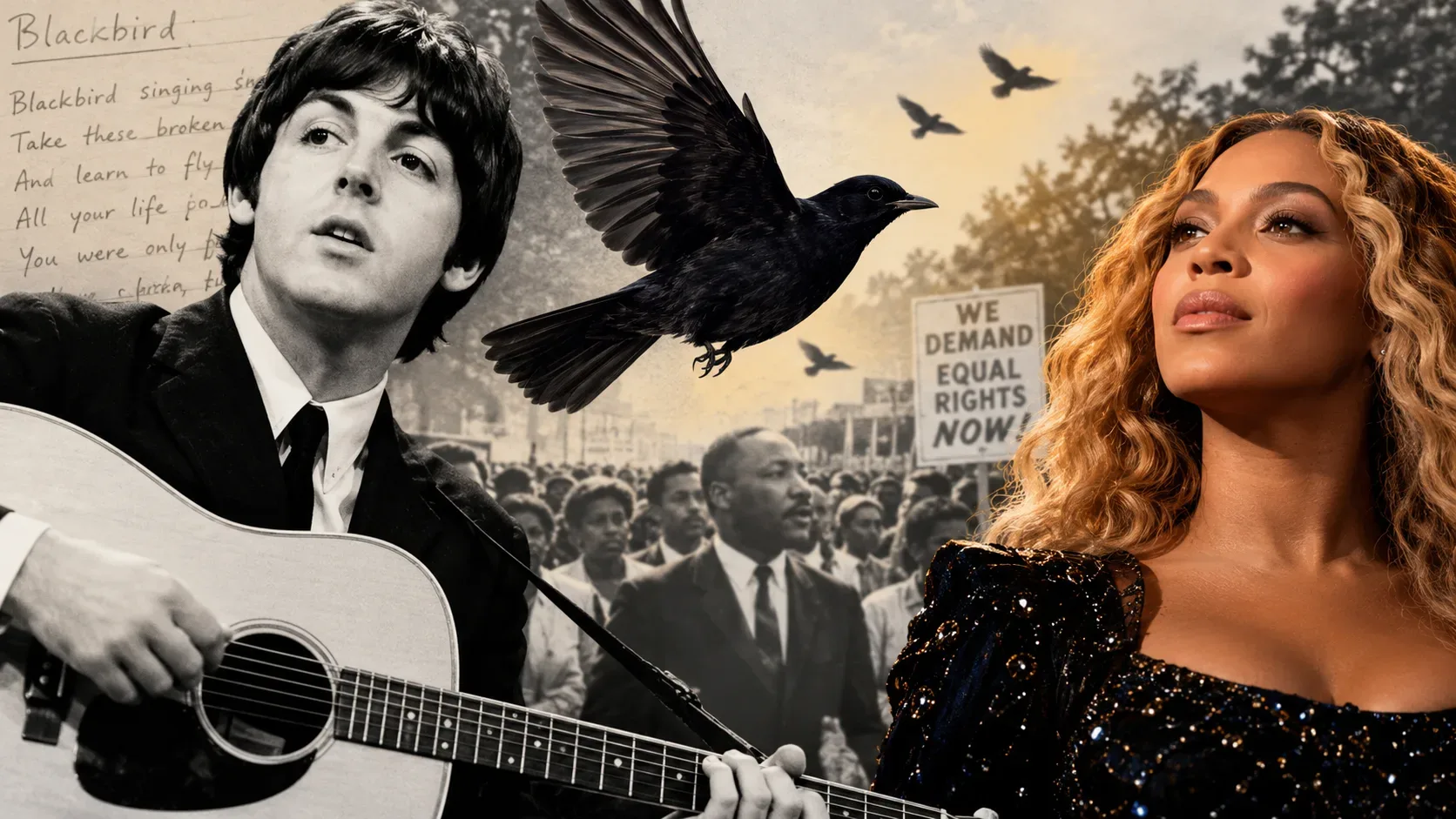
Paul McCartney says he wrote "Blackbird" with the US civil rights struggle in mind, particularly the discrimination faced by Black girls and young women. Beyoncé covered it as "BLACKBIIRD" on Cowboy Carter (2024), featuring four Black women working in country music. The connection between the recordings is supported by the song’s history and the album’s context, but the sources reviewed do not contain a statement from Beyoncé identifying one specific reason for choosing this particular track.
That distinction matters. McCartney has explained what he hoped to communicate in 1968. Some of the cultural meaning of the 2024 recording, by contrast, comes from interpreting the finished collaboration and the wider artistic project Beyoncé described.
What McCartney said about the origins of Blackbird
The Beatles’ official song page places "Blackbird" on the 1968 double album The Beatles, widely known as the White Album. It was recorded on June 11, 1968, and released on November 22 of that year. Although the songwriting credit reads Lennon-McCartney, the official page identifies Paul McCartney as the person who wrote the song.
In a video interview with GQ published in September 2018, McCartney explained that he had been thinking about reports of racial conflict in Alabama, Mississippi and especially Little Rock. He wanted to write something that might offer hope to people experiencing that discrimination.
He also explained the central metaphor: in British colloquial English, bird can mean a girl. McCartney said he had a young Black girl seeking freedom in mind. The civil rights connection is therefore not merely an interpretation invented by later listeners; the songwriter described it himself. That does not rule out other personal readings of the song.
Why Little Rock matters to the story
The historical episode McCartney referenced concerns nine Black students who confronted segregation when they sought to attend Central High School in Little Rock, Arkansas, in 1957. According to the US National Park Service, they entered the school on September 25 that year under federal troop escort, facing the opposition of white segregationists.
The dates must remain distinct: the school desegregation crisis took place in 1957, whereas "Blackbird" was recorded and released in 1968. McCartney has described the impact of reports and images of racial discrimination on him. The image of spreading one’s wings and finding freedom fits that account, without requiring every line to be treated as a literal reference to an individual historical event.
How Beyoncé reinterpreted the song on Cowboy Carter
Beyoncé released Cowboy Carter on March 29, 2024. Its second track, "BLACKBIIRD", brings her voice together with Tanner Adell, Tiera Kennedy, Brittney Spencer and Reyna Roberts, four Black women active in country music. The doubled "i" marks the album’s spelling, but the underlying composition is still the Beatles’ "Blackbird".
The Recording Academy reports that Beyoncé’s recording uses elements of the Beatles’ original instrumental master, including McCartney’s acoustic guitar and foot-tapping sounds. The new interpretation adds a collective of Black women’s voices to a recording whose message of hope the composer has discussed. Its change in vocal perspective is therefore important; it does not establish a different origin story for the lyrics.
The four collaborators’ presence is verifiable. Interpreting their inclusion as a response to the marginalization of Black women in country music is a cultural reading supported by the casting and by the album’s context, rather than a statement that should be attributed to Beyoncé as a direct quote. Tanner Adell discussed the personal significance of participating in the recording in an interview with the Recording Academy.
Why Blackbiird fits Beyoncé’s wider project
Before Cowboy Carter arrived, Beyoncé said the album grew from an experience in which she did not feel welcome. She said that experience prompted her to investigate country music’s history and its rich musical heritage more deeply. In that statement, she did not identify a single specific reason for selecting "Blackbird".
This helps explain why the song belongs within the album: a composition McCartney links to the experiences of Black girls reappears in a project concerned with musical boundaries and with highlighting Black voices in country. That connection is an interpretation of the artistic choices as a whole, supported by the Recording Academy’s analysis. It must not be confused either with McCartney’s original intent or with an undocumented personal explanation of Beyoncé’s decision.
How Paul McCartney responded to Beyoncé’s cover
On April 4, 2024, McCartney posted a positive response on his official website. He said Beyoncé’s version reinforced the civil rights message that had inspired "Blackbird" and described speaking with her over FaceTime. According to him, she thanked him for writing the song and allowing her to reinterpret it.
The composer’s response directly links the two recordings, without erasing what distinguishes them. In 1968, McCartney sought to express solidarity with people facing racial discrimination from afar. In 2024, Beyoncé brought together Black women in country music to reinterpret that composition. The historical connection is documented; the additional artistic meanings audiences may find in the new recording remain open to analysis.
Sources and references
- The Beatles: official Blackbird song page
- GQ: Paul McCartney explains the song’s origins (2018)
- National Park Service: the 1957 Little Rock school desegregation
- Recording Academy: Cowboy Carter track list and guest artists
- Recording Academy: Cowboy Carter’s musical and cultural approach
- Recording Academy: Beyoncé’s statement about her relationship with country music
- Recording Academy: Tanner Adell interview about Blackbiird
- Paul McCartney: statement on Blackbiird, April 4, 2024