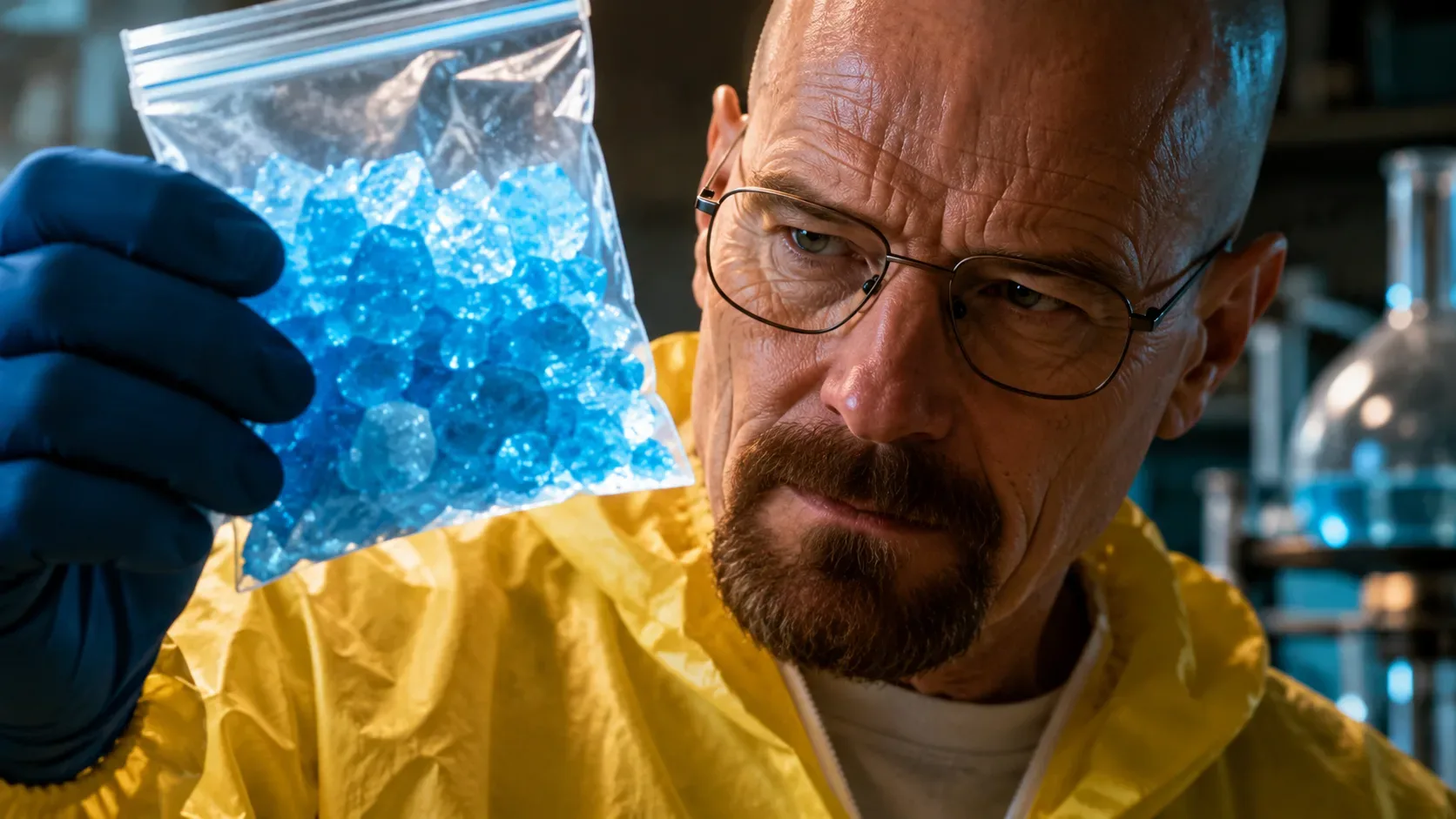
Yes, within the story of Breaking Bad, Walter White's methamphetamine is presented as exceptionally pure. But its blue color is not evidence of that quality. Outside fiction, blue is not a marker of greater purity. The shade became famous because the show's team wanted Heisenberg's product to be instantly recognizable.
Minor spoiler warning: this article refers to dialogue from episodes in seasons 4 and 5 without revealing their endings.
Where does Walter White's 99.1% purity figure come from?
In Say My Name (season 5, episode 7), Walter claims his product reaches 99.1% purity, while a rival's reaches only about 70%. That is how the character argues that his merchandise is superior. The percentage belongs to the show's fictional world; it is not a figure established by the crystals' appearance.
The contrast appears earlier in Box Cutter (season 4, episode 1): Gale Boetticher considers a sample of roughly 99% purity better than the 96% product he says he can make himself. The chemist also acknowledges that he cannot explain why the sample is blue. In other words, the story itself separates assessing purity from explaining the color.
Why is Heisenberg's meth blue?
In an interview published by AMC in 2013, creator Vince Gilligan explained that the writers wanted Walt's product to have a distinctive visual feature. They chose blue because it looked clean and was easy to recognize, not because it signaled any extraordinary chemical property.
Gilligan said he consulted chemist Donna Nelson, the production's science adviser. According to the creator, she warned that introducing color into a material could actually suggest adulteration and reduce its purity. The show kept the blue as an artistic liberty.
What does the science say about the color?
In an interview with Scientific American, Nelson said that highly pure crystals, like those she knew from her laboratory experience, would be colorless, and that the pronounced blue of Breaking Bad was not realistic. PBS NewsHour also documented her work advising the series on science.
The central distinction is straightforward: appearance is not a purity test. Color may be related to the presence of other substances, but looking at blue material cannot establish its composition or assign a reliable percentage. In Breaking Bad, 99.1% is part of the narrative; blue serves as Heisenberg's visual signature.