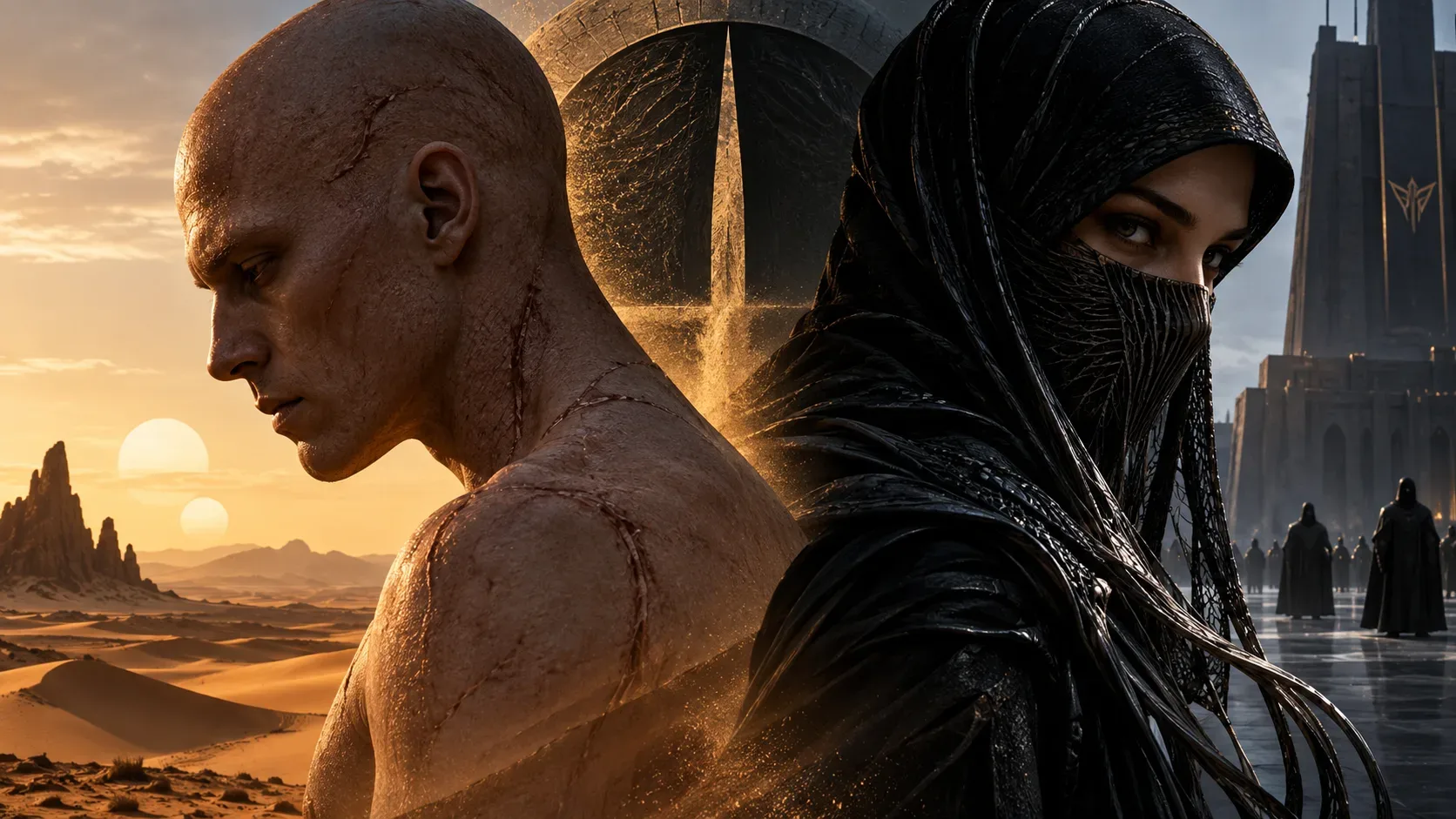
In Dune: Part Three, a ghola is a person biologically recreated from someone who has died, whereas a Face Dancer is a being able to alter their own appearance to impersonate other people. The distinction goes beyond looks: a ghola raises questions about whether a past identity can return; a Face Dancer can adopt identities as a means of infiltration. The movie’s official materials identify Hayt as a ghola of Duncan Idaho and Scytale as a Face Dancer. Both are associated with the Bene Tleilax, but they do not possess the same defining ability.
This explanation uses the novels to clarify the concepts while separating Warner Bros.’ confirmed descriptions from what cannot yet be established about the finished film, scheduled for December 2026. It does not reveal the ending of Dune Messiah or the upcoming film.
Ghola: a new life made from someone who has died
In Dune lore, the Bene Tleilax possess techniques for biological recreation. A ghola is not a living person who simply changes faces: it is produced from the biological material of someone who died. That distinction matters for Duncan Idaho, who died protecting Paul Atreides and Lady Jessica in the first movie but returns under the name Hayt in the third.
Memory is the difficult part. Having a body associated with Duncan does not, by itself, prove that Hayt thinks, remembers or makes decisions exactly as the original Duncan did. The official character description itself highlights identity, memory and loyalty as central questions. A later novel, The Winds of Dune by Brian Herbert and Kevin J. Anderson, also addresses the gap between Hayt’s appearance and his memories. That offers context from the wider book series, not a guarantee that the movie will resolve these issues in the same way.
Face Dancer: the ability to pass as someone else
A Face Dancer works on a different principle: the transformation of their own body’s appearance. Rather than biologically recreating a dead person, this being can assume another person’s features and mislead those watching. Shapeshifting makes visible identity unreliable and creates an obvious advantage for espionage and manipulation.
Scytale is the example introduced for Dune: Part Three. Warner Bros. describes Scytale as a Face Dancer linked to the Bene Tleilax; Variety, reporting on the trailer unveiled in July 2026, identifies Robert Pattinson’s character as a shapeshifter opposing Emperor Paul. That official identification does not establish which disguises or transformations will appear in the final cut.
Ghola versus Face Dancer: the key distinctions
| Question | Ghola | Face Dancer |
|---|---|---|
| How does it work? | Biological recreation using material from a deceased person. | Changing their own appearance to imitate other people. |
| What is the main uncertainty? | Continuity of identity, memory and loyalty. | Who is behind the appearance being shown. |
| Example in Part Three | Hayt, connected to the deceased Duncan Idaho. | Scytale, associated with shapeshifting. |
| What should not be assumed? | That all the original person’s memories return automatically. | That imitating someone’s appearance resurrects them. |
The shared element is their association with the Bene Tleilax and with the manipulation of bodies and identities. But not every being created by Tleilaxu methods is a Face Dancer, and wearing someone’s face is not the same as bringing that person back.
What do Hayt and Scytale mean for Paul’s story?
The official synopsis places the third film almost two decades after Paul seized the imperial throne. Against that backdrop of conspiracies, Hayt represents the return of a face with personal significance to the Atreides. Scytale introduces a different problem: trusting identities during a political struggle in which appearances can be manipulated.
Promotional materials and trailer coverage associate Jason Momoa with Hayt and Robert Pattinson with Scytale. The film’s central question here is not whether they share one power, but how two distinct Bene Tleilax capabilities might affect the relationships and choices surrounding Paul. The characters’ eventual actions, any recovery of memories and the specific use of disguises fall outside this spoiler-conscious pre-release explanation.
What is confirmed, and what remains unknown?
Confirmed in the materials reviewed: Hayt is officially described as Duncan Idaho’s ghola; Scytale is officially described as a Face Dancer; both are associated with the Bene Tleilax. The distributor lists a North American theatrical release of December 18, 2026, with international rollout beginning December 16. These dates alone do not establish the exact release day in every country.
Not yet demonstrated by the promotional material: precisely how the techniques function on screen, the range of disguises shown, the film’s treatment of Hayt’s memories or the resolution of their conflicts. Frank Herbert’s Dune Messiah provides the literary source of this storyline, but it should not be treated as an advance, verified account of Denis Villeneuve’s final edit.
Sources and references
- Warner Bros. and Legendary Pictures: official site and Hayt and Scytale character descriptions
- Variety: July 2026 trailer report and character information
- Penguin Random House: authorized edition of Frank Herbert’s Dune Messiah
- Macmillan: The Winds of Dune, a later novel by Brian Herbert and Kevin J. Anderson, with an excerpt about Hayt