“Enjoy the Silence” began as a slow, spare Martin Gore composition, but it acquired its familiar pulse when Alan Wilder and Flood argued for a faster arrangement built around a beat and bass line. That was only part of the change: Flood asked for a guitar phrase, Gore came up with the riff, and Dave Gahan recorded the lead vocal. Accounts from the people involved, read alongside the official credits, reveal how the ballad became the 1990 single.
The early sketch and Martin Gore's resistance
In a March 2017 interview with Entertainment Weekly, Gahan described the song's first presentation as an unfinished sketch, with piano, a very slow pace and only a couple of verses. His recollection supports its origins as a ballad, but it does not allow any particular demo recording to be reconstructed note for note.
According to Gahan, Wilder and Flood imagined a beat for the material and asked the others to leave the studio while they developed the idea. He recalled a two-day interval before they returned. In an analysis published on 11 September 2025, MusicRadar writer Roland Schmidt likewise credits Wilder and Flood with pushing up the tempo. His article recounts Gore's initial reluctance: Gore associated the subject of silence with serenity, which at first seemed at odds with a dance rhythm.
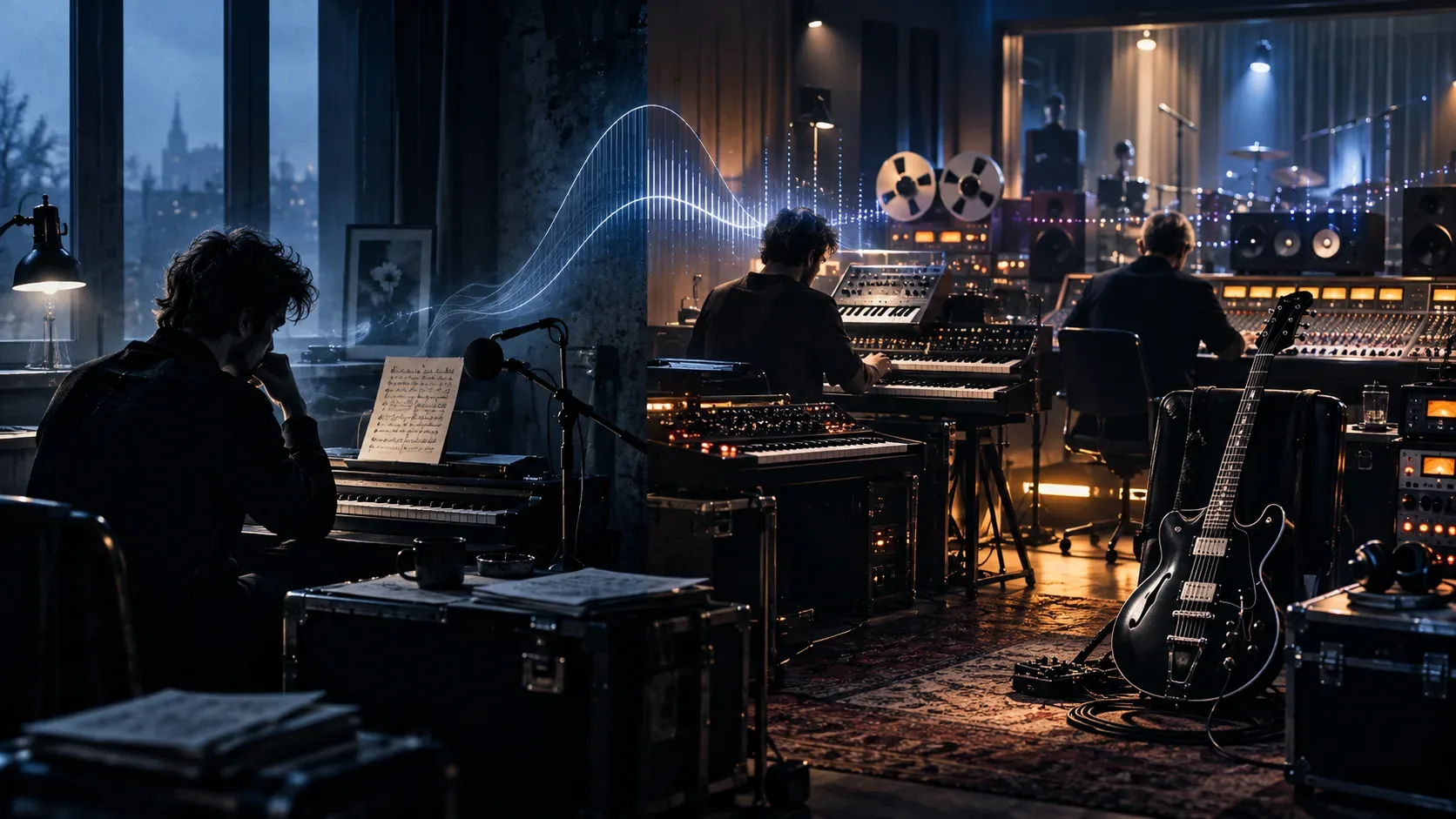
The disagreement matters because the change went beyond adding instruments to a completed arrangement. It altered the way the composition was supported: a rhythmic foundation now carried the melody and created room for other defining elements.
How the arrangement developed: who did what
- Songwriting and starting point: Martin Gore wrote the song and brought the early material to the group. Depeche Mode's official archive confirms Gore as the songwriter.
- A new direction: Wilder and Flood advocated a faster tempo and developed the rhythmic backing. This was a contribution to the arrangement and construction of the recording, not a transfer of songwriting credit.
- Guitar riff: Gahan remembers Flood asking Gore for a guitar line after the new foundation had taken shape. Gore's motif became one of the recording's most identifiable features.
- Lead vocal: Gahan was brought in to sing over the reworked arrangement. He recalls that the process was quick and that later attempts to add more did not necessarily improve the track.
- Record production and mix: the official archive credits Depeche Mode and Flood with producing the album and single versions, and Daniel Miller and Flood with mixing those versions. That is not the same as crediting Wilder with every mixing decision or assigning the main mix to remix producers.
Why the recording feels expansive while remaining simple
The decisive change was not just speed. In Schmidt's MusicRadar analysis, the recording retains a relatively straightforward structure while introducing its ideas in stages: the riff returns with additional synthesizer timbres, and layers of synth choir, percussion and small countermelodies enlarge the texture. The writer describes drum sounds associated with the 808 and 909 machines, while the pulsing bass helps hold the arrangement together.
That is a published analysis of the recording, not a claim to have inspected the session's multitrack tapes or equipment. It nevertheless explains the production choice: repetition brings motion, the guitar establishes a melodic signature, and the synthesizers add depth without erasing the lyrics' restrained mood.
Gahan recalls that the song came together in a matter of days and that the group eventually recognized the advantage of not overloading it. His recollection is not a complete technical timetable for the making of Violator, but it helps explain why an apparently economical arrangement was allowed to stand.
Credits: Flood, Wilder, Daniel Miller and François Kevorkian had different roles
This is where the documents separate stages that are often blended together. Wilder features prominently in accounts of the arrangement's transformation alongside Flood. Yet the official credits list Depeche Mode and Flood as producers and Daniel Miller and Flood as mixers for the album and single versions. A group production credit does not erase Wilder's input, but neither does it justify assigning him the entire production or main mix individually.
The same archive credits François Kevorkian with alternative mixes including Bass Line, Hands and Feet and Ecstatic Dub. Seeing his name attached to an “Enjoy the Silence” release therefore does not mean he mixed the core album recording. The archive also identifies Harmonium, also called the Quiet Version, as mixed by Depeche Mode and engineered by Steve Lyon.
Is the Harmonium version identical to the original demo?
The official discography establishes that Enjoy the Silence (Harmonium) appeared among the single's 1990 configurations, including a limited UK 12-inch edition. It offers a documented reference point for the contrast between an intimate presentation and the electronic production. But the commercial listing does not, by itself, establish that its audio is identical to the original demonstration recording Gore brought to the studio. No comparison listening to a specific original demo recording was undertaken for this article.
The single was released in the United Kingdom on 5 February 1990, according to the official archive, and Violator followed in the UK on 19 March 1990. The transformation recounted in the interviews took place before those releases; catalogue dates should not be mistaken for exact dates of studio decisions.
The most accurate attribution is therefore collaborative and role-specific: Gore wrote the song and created the riff; Wilder and Flood drove the change in tempo and backing; Gahan performed the lead vocal; Depeche Mode and Flood received the production credit; Daniel Miller and Flood mixed the principal versions. The strength of “Enjoy the Silence” lies in that combination, not in the notion that one person single-handedly turned a ballad into a hit.
Sources and references
- Depeche Mode Archives: official recording and mixing credits for Enjoy The Silence
- Depeche Mode Archives: single discography and versions
- Depeche Mode Archives: Violator album editions
- MusicRadar, Roland Schmidt (11 September 2025): musical analysis of Enjoy the Silence
- Entertainment Weekly (23 March 2017): Dave Gahan interview