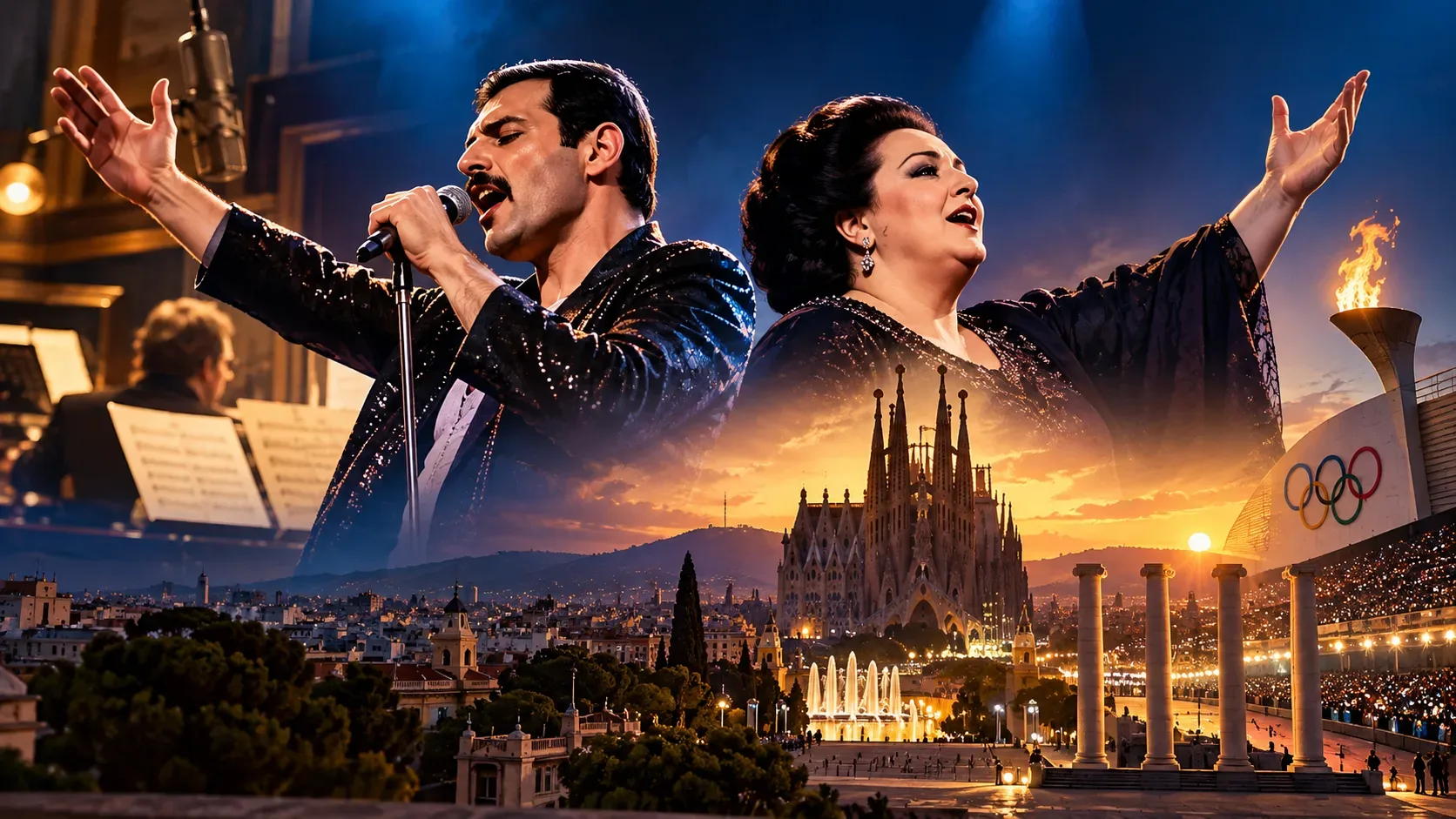
“Barcelona” was created before the 1992 Olympic Games. Freddie Mercury and soprano Montserrat Caballé began collaborating in 1987, released the song that year and expanded their partnership into an album issued in 1988. Only later did the track become inseparable from the Barcelona Games. The project grew out of Mercury's admiration for the singer and their shared interest in bringing different vocal traditions together, not out of an appearance at the Olympic ceremony.
There is a crucial difference between the album's history and popular memories of the Games: the two artists appeared together at events in 1987 and 1988, but they did not sing together at the 1992 Olympic opening ceremony. Mercury died on November 24, 1991. A recording of “Barcelona” was used during the opening broadcast, while Caballé took part in other sections of the ceremony.
How Freddie Mercury met Montserrat Caballé
In a July 1986 interview with the Spanish television program Informe Semanal, Mercury discussed his love of opera, especially Caballé's voice. According to his official archive, manager Jim Beach and promoter Pino Sagliocco helped arrange a meeting. It took place on March 24, 1987, at the Ritz Hotel in Barcelona, with composer and arranger Mike Moran and other members of Mercury's team in attendance.
What Mercury brought was not a finished version of the future anthem. It was a recording of Exercises in Free Love, a piece he had developed with Moran. The musicians tried out ideas at the piano with Caballé. A few days later, she performed the piece as an encore at London's Covent Garden. According to the same official account, Caballé subsequently asked Mercury to write a song about her hometown. That artistic request provided the starting point for “Barcelona”.
This also puts the Olympic connection into perspective: Barcelona had already been selected in October 1986 to host the 1992 Games. The event gave the city an important symbolic horizon, but the song and the album developed their own musical identity years before the opening ceremony.
How the recording brought rock and opera together
Mercury and Mike Moran are credited with writing “Barcelona”. The song combined the Queen frontman's rock and pop background with Caballé's operatic technique, using keyboard arrangements, programming and instruments with an orchestral sound. David Richards also took part in producing the album. Mercury's official archive says recording work ran from 1987 through July 1988, with sessions at Townhouse Studios in London and Mountain Studios in Switzerland.
The soprano's schedule required careful preparation. Richards recalled that Mercury rehearsed and tested not only his own vocal lines but also those intended for Caballé, singing her parts in a high falsetto before she arrived at the studio. Instrumental layers were assembled and reviewed step by step. The aim was not simply to place an operatic voice over a completed rock track: the arrangement was built around the interaction between the two performers.
The initial idea grew. Mercury had expected to record a single song, but Caballé suggested making an entire album together. As a result, Barcelona refers both to the 1987 single and to the larger project released in 1988. Other tracks, including The Golden Boy and How Can I Go On, continued that conversation between styles.
Barcelona from 1987 to 1992: a timeline
| When | What happened | Why it matters |
|---|---|---|
| July 1986 | Mercury publicly expresses his admiration for Caballé on Spanish television. | The connection begins before the recording sessions. |
| March 1987 | The artists meet in Barcelona and try out musical ideas. | The creative partnership takes shape. |
| April and May 1987 | “Barcelona” is recorded in April, and the duo present it at the Ibiza '92 event at Ku club in May. | The song already exists five years before the Games. |
| Late 1987 | The single enters the UK chart and reaches No. 8. | It has its own release and reception ahead of 1992. |
| October 8 and 10, 1988 | The pair appear at Barcelona's La Nit festival on October 8; the album is issued on October 10, having reached the Spanish market earlier. | The album enters the public spotlight during pre-Olympic celebrations. |
| November 24, 1991 | Mercury dies before the Games take place. | The proposed joint opening-ceremony appearance cannot happen. |
| July and August 1992 | A recording of “Barcelona” features at the Olympic opening, and the reissued single returns to the UK chart, reaching No. 2 in August. | The song's connection with the Games becomes firmly established. |
What happened at the Ibiza and La Nit appearances?
One of the partnership's first public appearances came at Ibiza's Ku club in May 1987, during the Ibiza '92 audiovisual project. A report published by El País that month says the performance was recorded using playback. That distinction matters: the artists' presence before an audience is documented, but it should not be described as an entirely live vocal duet when the event formed part of a recorded production.
On October 8, 1988, the pair shared a stage again at La Nit, staged in Barcelona as part of the Cultural Olympiad and the Olympic flag's arrival. RTVE records playback presentations of “Barcelona”, “The Golden Boy” and “How Can I Go On”, with Mike Moran at the piano. Contemporary newspaper reporting also confirms their appearance. It is this pre-Olympic performance, not a scene from July 1992, that often circulates in clips associated with the song's history.
Why did Barcelona become a symbol of the 1992 Games?
The song directly celebrated the host city, featured two internationally renowned performers and had already been showcased at cultural events connected to the Olympic preparations. RTVE describes “Barcelona” as an anthem of the Games. That does not make it the event's only significant musical work: “Amigos para siempre” (Amics per sempre), for example, was also part of Barcelona 1992's musical identity.
Mercury's official archive refers to plans for him and Caballé to sing at the opening ceremony. Those plans never materialized. At the July 25, 1992, opening, the recording of “Barcelona” accompanied images of the city at the start of the broadcast. Caballé took part in the ceremony, but did not perform that song there as a duet with Mercury. A Maldita.es fact-check, based on the ceremony's recording, confirms the distinction and warns against misleadingly labelled older footage.
The song also enjoyed two separate periods of chart success. The original reached No. 8 in the United Kingdom in 1987, while the 1992 reissue reached No. 2, according to the Official Charts Company. Those are British chart positions, not results for Brazil or a single worldwide ranking.
A musical legacy that began well before the Games
The sequence tells the story: Mercury and Caballé met first, then came the song and the album, and finally the Olympic recognition. The composition became a lasting musical memory of the Games because it already expressed an ambition associated with the host city: presenting a local identity to an international audience. Its reputation has endured, but that should not obscure the studio work begun in 1987 or turn the 1992 ceremony into a joint concert that never took place.
Sources and references
- Official Freddie Mercury archive: Barcelona
- RTVE: The Barcelona 1992 Olympic Games
- El País (1987): Caballé and Mercury at Ibiza 92
- El País (1988): La Nit at the Cultural Olympiad
- Official Charts: original 1987 Barcelona single
- Official Charts: the 1992 Barcelona reissue
- Maldita.es: fact-check on the Olympic opening ceremony