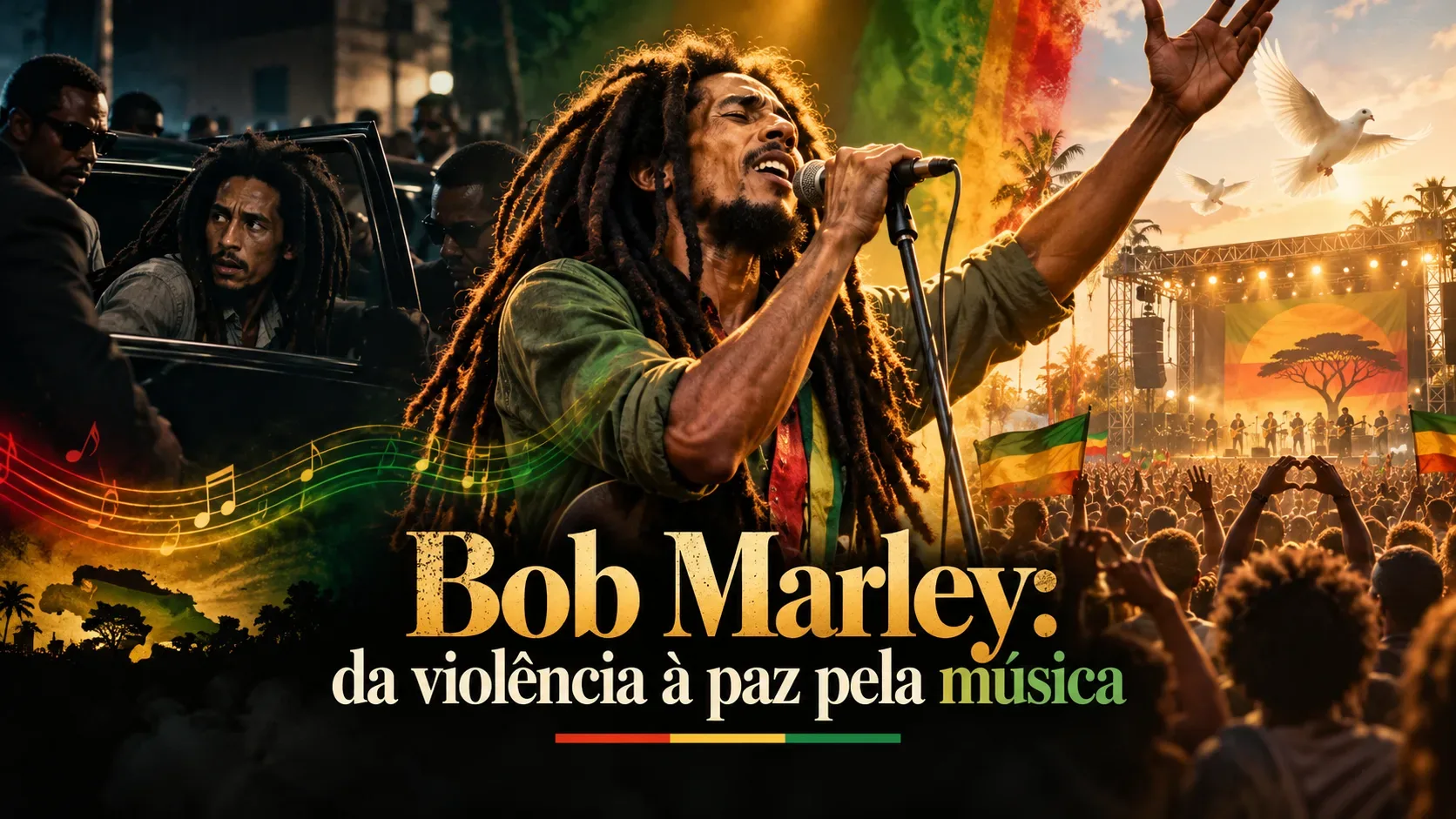
Bob Marley survived a shooting at his home in Kingston on December 3, 1976, and performed at Smile Jamaica two days later. On April 22, 1978, after a period abroad, he headlined a different event: the One Love Peace Concert, remembered for bringing two rival political leaders together onstage. The concerts were distinct moments connected by an effort to confront Jamaica's violence through music.
The image of Marley lifting the joined hands of Michael Manley and Edward Seaga became a worldwide symbol of reconciliation. It did not mean the concert ended the conflict. To understand why the gesture mattered, it helps to follow the events between those two performances.
A divided Jamaica and a singer with a political voice
During the 1970s, rivalry between Michael Manley's People's National Party (PNP) and the Jamaica Labour Party (JLP), associated with Edward Seaga, reached into Kingston's neighborhoods and was accompanied by violence. Marley's international audience was growing with the Wailers, but his songs remained rooted in Jamaican communities, Rastafarian beliefs, and subjects such as inequality, resistance, and freedom.
Albums including Burnin' (1973) and Rastaman Vibration (1976) already reflected that blend. 'Get Up, Stand Up' called for the defense of rights; for 'War', released in 1976, Marley adapted ideas from a 1963 speech by Ethiopian emperor Haile Selassie. That history helps explain why his appearance on a stage could carry political weight without his music simply becoming propaganda for one party.
The 1976 shooting and his decision to play Smile Jamaica
Smile Jamaica was scheduled for December 5, 1976, in Kingston as a free concert carrying a message of peace. With elections approaching and the country polarized, its timing was sensitive. On the night of December 3, gunmen attacked Marley's home while he and his team were rehearsing.
Marley was wounded; Rita Marley was also hit and received medical care; manager Don Taylor was seriously injured. All three survived. The attack is well documented, but the sources consulted do not establish who ordered it. Suspicions and competing accounts of responsibility should not be presented as proven facts.
Despite the shooting, Marley took the stage on December 5 and performed 'War', among other songs. Smile Jamaica took place in 1976, before his temporary departure from the island. It was not the 1978 concert, nor was it the occasion when Manley and Seaga appeared together onstage.
Exodus, Kaya and the months away from Jamaica
After Smile Jamaica, Marley spent a short time in the Bahamas before moving to London. There he recorded Exodus, released in 1977, and much of Kaya, released in 1978. His time away from Jamaica coincided with one of the best-known periods of his recording career.
Exodus featured songs including 'Jamming', 'Three Little Birds', and a new recording of 'One Love/People Get Ready'. Its title and lyrics engage with displacement, faith, solidarity, and change. Kaya explored a different mood through tracks such as 'Is This Love' and 'Satisfy My Soul', alongside darker pieces including 'Running Away' and 'Time Will Tell'. Together, these albums help connect the trauma of 1976 to his public return in 1978, without reducing all of Marley's music to the attack.
One Love Peace Concert: what happened on April 22, 1978
The One Love Peace Concert took place at Kingston's National Stadium on April 22, 1978. It grew out of efforts to bring rival groups closer together. Historical accounts identify Claudie Massop and Bucky Marshall, associated with opposing political camps, among the figures behind the initiative. Promoter Tommy Cowan also helped organize the event, which brought together a wide range of reggae performers.
Peter Tosh, Marley's former Wailers bandmate, used his set to criticize injustice and the political leaders in attendance. His intervention highlighted an important distinction: calling for peace did not mean setting aside inequality or police violence. The event made space for appeals to unity and direct political criticism.
During 'Jamming', Marley called Prime Minister Michael Manley of the PNP and opposition leader Edward Seaga of the JLP onto the stage. He joined their hands and raised them before the audience, turning a brief act into the night's defining image. The festival was called the One Love Peace Concert, but the song associated with this particular moment was 'Jamming', not 'One Love'.
Did the handshake put an end to violence?
No. The onstage meeting was a symbolic display of unity, not an agreement capable of immediately resolving disputes among parties, armed groups, and communities. Political violence continued in Jamaica in the following years, as historical accounts of the event make clear.
That does not make the gesture meaningless. Marley used reggae's public visibility to ask political opponents to acknowledge each other before their country. The moment's historical significance lies in that moral and cultural pressure; its limitation is that a concert alone cannot change the conditions sustaining a conflict.
Songs that help explain this journey
Listening to each track in its own context, rather than treating them as the soundtrack of a single concert, reveals different sides of Marley's message.
- War (1976): Released on Rastaman Vibration, it challenges racism and inequality and was part of the Smile Jamaica set.
- Exodus (1977): Blending spirituality and displacement, it lent its name to the album recorded during Marley's stay in London.
- Jamming (1977): This was the song being played as Manley and Seaga joined hands onstage in 1978.
- One Love/People Get Ready (1977): Revisiting an earlier Wailers song, it became an enduring expression of Marley's message of unity.
- Ambush in the Night (1979): From Survival, it revisits experiences of violence and persecution associated with the shooting.
- Redemption Song (1980): On Uprising, it turns the discussion toward freedom, memory, and emancipation.
Timeline: from Smile Jamaica to international recognition
| Date | Event |
|---|---|
| Dec. 3, 1976 | Gunmen attack Marley's Kingston home; Marley, Rita Marley, and Don Taylor are injured. |
| Dec. 5, 1976 | Marley performs at Smile Jamaica despite the shooting. |
| 1977 | Exodus is released after recording sessions in London; it includes 'Jamming' and 'One Love/People Get Ready'. |
| Apr. 22, 1978 | At the One Love Peace Concert, Marley brings Manley and Seaga together during 'Jamming'. |
| 1979 and 1980 | Survival and Uprising develop Marley's reflections on justice and freedom. |
| 1994 | Bob Marley is inducted into the Rock & Roll Hall of Fame. |
| 2001 | He posthumously receives the Recording Academy's Lifetime Achievement Award. |
The legacy of a call for peace, not a finished peace
Marley continued to connect music with justice. Survival (1979) included 'Ambush in the Night', linked by his official biography to the assassination attempt, and 'Africa Unite', a call for African solidarity. On Uprising (1980), 'Redemption Song' offered another way to reflect on emancipation. Marley died on May 11, 1981, but his songs continued to circulate through performances, tributes, and cultural movements.
Posthumous honors include his induction into the Rock & Roll Hall of Fame in 1994 and the Recording Academy's Lifetime Achievement Award in 2001. The clearest way to remember the two concerts is still to distinguish them: Smile Jamaica was Marley's immediate response to the attack in 1976; the One Love Peace Concert was a public attempt at reconciliation in 1978. Both show the reach of his music without erasing the complexity of Jamaican history.