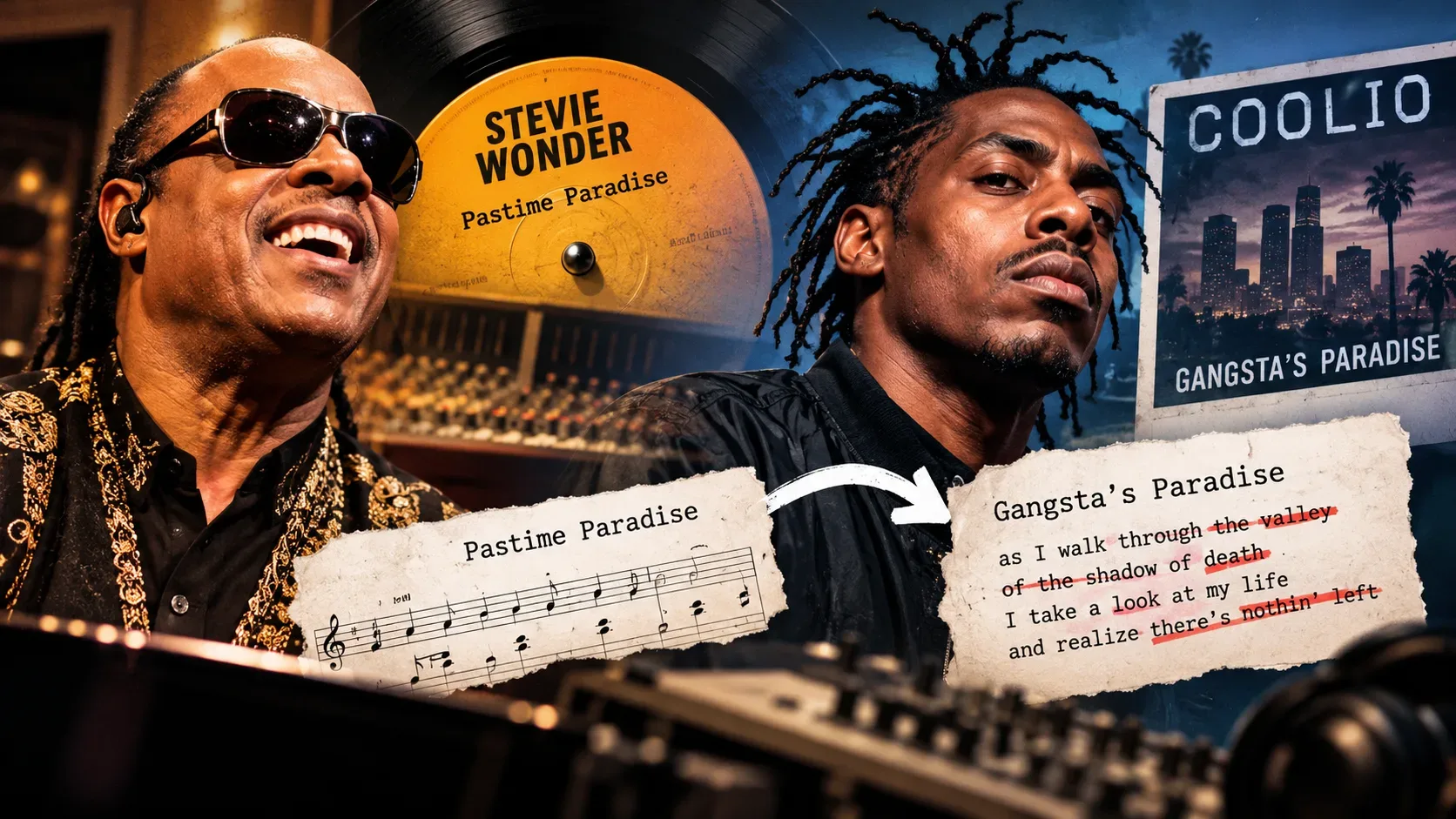
Stevie Wonder made permission to use material from “Pastime Paradise” in Coolio and L.V.’s “Gangsta’s Paradise” conditional on removing profanity and references to violence. Producer Doug Rasheed described that requirement to ABC Audio in 2025 and in accounts of the recording sessions. Coolio revised parts of the lyrics, and the song was released in 1995. The consulted sources do not publish the agreement itself, so they cannot establish every rewritten line or the precise financial split.
How Stevie Wonder’s song became the foundation of the beat
The starting point was “Pastime Paradise”, Stevie Wonder’s 1976 recording from Songs in the Key of Life. Rasheed recalls that he and manager Paul Stewart used to challenge each other to find the best samples in their record collections. When he pulled out Wonder’s record, he selected a passage of synthesized strings and percussion, chopped and looped it, and added instruments to create a new arrangement.
In her Classic Tracks feature for Mixonline, Sarah Jones describes Rasheed building up the drums, keyboards and bass while singer L.V., born Larry Sanders, handled the vocal harmonies. Singing along to the familiar melody, L.V. changed “Pastime Paradise” into “Gangsta’s Paradise” in the chorus. Coolio heard the backing track when its key parts were already in place and wrote the rap verses. Rather than simply replaying Wonder’s recording in full, the musicians had built a distinct song around recognizable material from it.
The initial refusal and the lyric rewrite
Rasheed told ABC Audio that Stewart initially relayed the refusal without an immediate explanation. After further efforts to reach Wonder’s representatives, the condition came back: the profanity and violent content had to go. Rasheed’s account for Vevo Footnotes, reproduced by Rap Industry in 2025, likewise describes a delay in obtaining approval and says Coolio had to rewrite a few lines.
That requirement does not mean Wonder ordered every reference to crime or violence removed. The released song still addresses street life, fear of death and the consequences facing its narrator. The reported change concerned explicit language and particular violent references, not the abandonment of the song’s central subject.
Nor do the accounts provide a verifiable transcript of the original draft. A line-by-line comparison between the rejected version and the commercial release is therefore not possible, and no particular line can responsibly be identified as the definitive cause of the refusal. In the Vevo account, Rasheed himself said he no longer remembered the discarded passages.
One clearance, three different creative roles
The story is commonly described as sample clearance, but several distinct rights and contributions are involved. A sample takes part of an existing recording. A composition consists of music and lyrics, whereas production concerns the work of constructing and finishing a recording. The U.S. Copyright Office explains that a musical work and a sound recording are separate protected works, often with separately administered rights.
AllMusic lists Artis Ivey Jr. (Coolio), Doug Rasheed, Larry Sanders (L.V.) and Stevie Wonder as songwriters of “Gangsta’s Paradise”. The studio accounts credit Rasheed with producing the recording. Wonder’s songwriting credit recognizes the use of his earlier work; it does not mean he produced Coolio’s sessions or joined the group to record the new track.
The interviews establish that clearance was sought and eventually granted, but they do not reproduce the legal agreements. Claims about publishing shares, royalty percentages or ownership of the master should not be presented as verified contract terms on that basis.
What changed beyond the words
Mixonline documents a separate production process, unrelated to Wonder’s lyrical condition: Rasheed combined early house-recorded vocals with studio performances to make the choir sound larger. He also revised the mix for radio, replacing drum elements and adding synthesized string accents. Engineer Kevin Davis worked on the mix.
Those production choices helped give the released song its identity, but they should not automatically be described as demands made by Wonder. Rasheed believes the lyric revisions improved the record and helped it reach a wider audience. That is the producer’s retrospective assessment, not a measured finding establishing how much of its commercial success came from the changes.
“Gangsta’s Paradise” became closely associated with the film Dangerous Minds and was a major hit in 1995. The clearance story explains a notable aspect of its final recording: despite its dark subject matter, the released lyrics avoid the profanity Wonder objected to. The evidentiary limit remains important: the type of revision is documented, but the complete earlier draft and the contract terms are not.