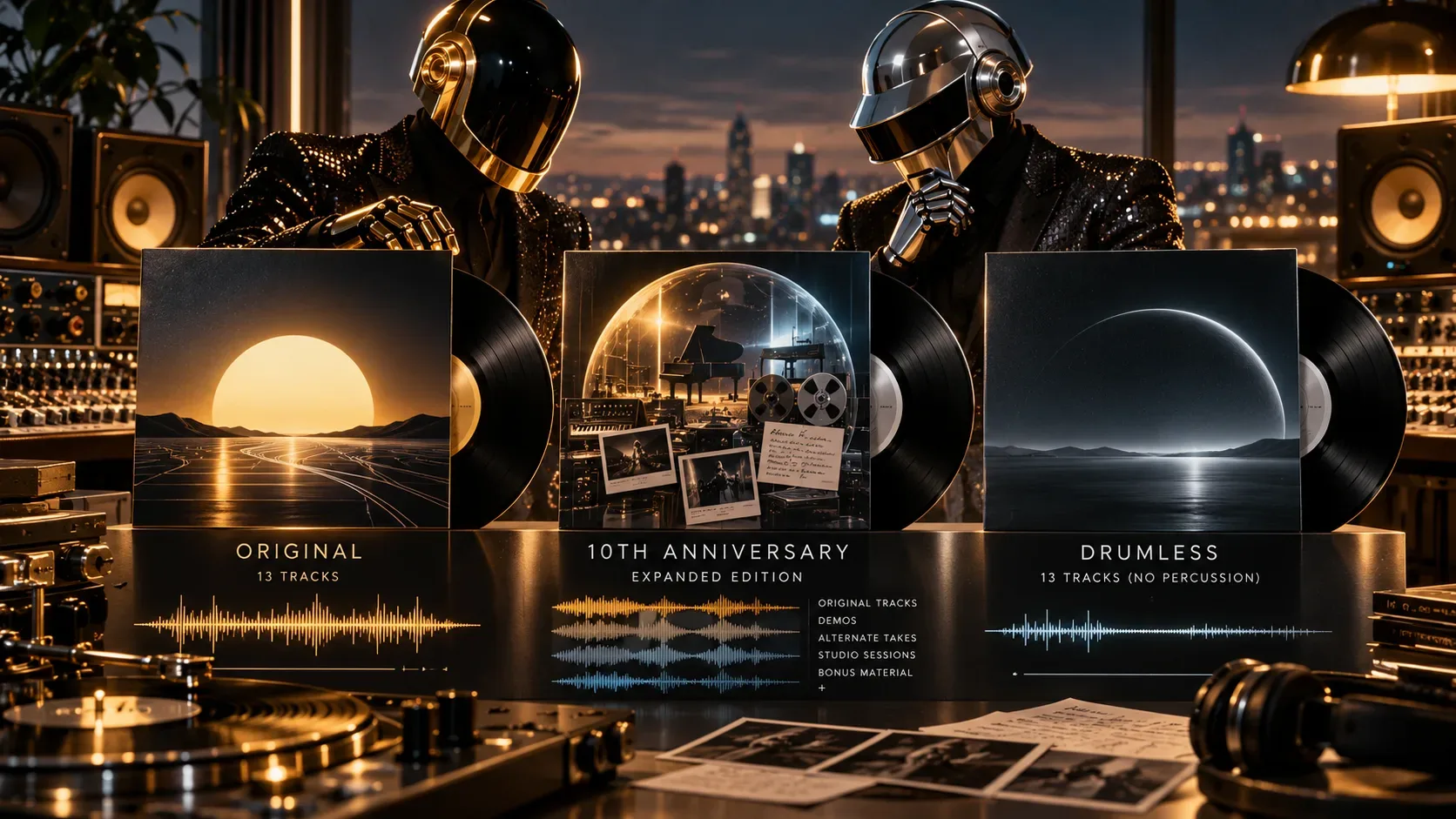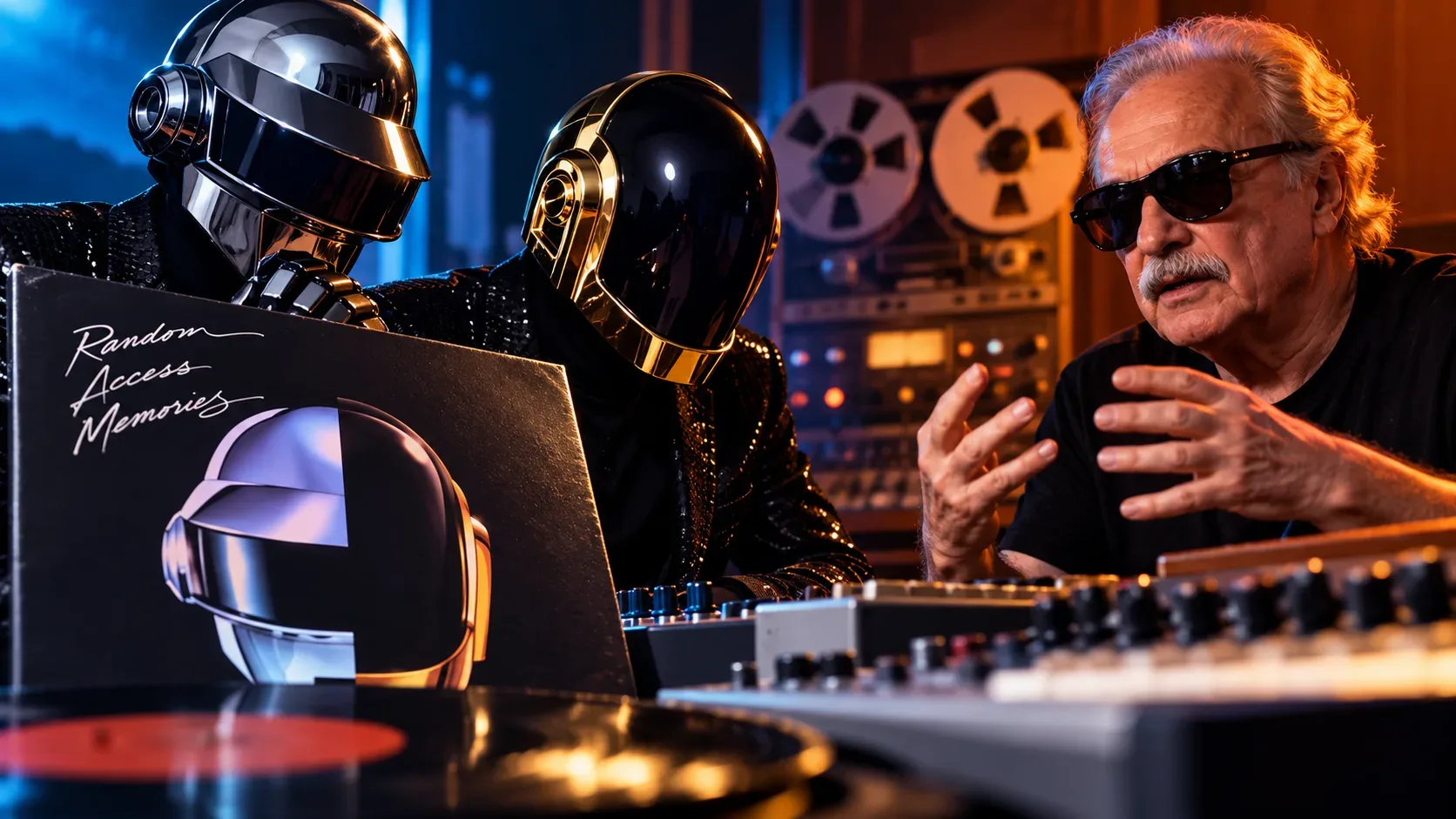
Daft Punk turned a Giorgio Moroder interview into “Giorgio by Moroder” by editing a lengthy account of the Italian producer’s life and weaving it into their own instrumental composition. The song is the third track on Random Access Memories (2013) and runs for 9 minutes and 4 seconds. Moroder contributed his voice and his story, but he did not play the synthesizers heard on the recording. The musician himself made that distinction in interviews around the album’s release.
Thomas Bangalter and Guy-Manuel de Homem-Christo approached the feature as a kind of audio documentary. The result moves between spoken memory and music rather than following the usual format of a guest singer.
From an audio documentary idea to an interview in Paris
In a track-by-track discussion published by Exclaim! in April 2013, the duo described Moroder as a touchstone whose career crossed styles and eras. Their aim was to capture his journey from his youth and early performances to his exploration of synthesizers. The publication noted that the remarks had been translated from French, so their wording is best paraphrased rather than presented as a verbatim quotation.
As Moroder later told FACT and Exclaim!, the invitation was straightforward: visit the studio in Paris and tell the story of his career. Bangalter guided the conversation and asked for further details. The recording lasted roughly three hours. Moroder expected that short sections might be cut up or processed, but he was not given a precise account of the arrangement the duo planned to build.
Why were there three microphones in the studio?
Moroder told The Independent that the studio contained three microphones associated with different eras of recording technology. The idea was to follow the chronology of his account: the sound of older equipment for memories of his youth, another microphone for the 1970s, and a more modern one for the future. The choice became an example of Daft Punk’s attention to detail.
That does not mean every listener can identify which microphone was used in each passage. Moroder himself asked who would notice the difference and was told Bangalter would know. His account establishes the intention behind the approach, not proof that all three microphones are audibly distinguishable in the final mix.
How the story became a nine-minute track
Recording the voice was only one part of the process. In an interview published by Guitar World, bassist James Genus described instrumental sessions held in Los Angeles in May 2012. He and other musicians performed and improvised from the mood and harmonic guidance supplied by the duo. Daft Punk subsequently assembled sections of those performances into the composition. The sources document both strands of the project, but do not establish the precise order of every vocal and instrumental take.
On the released recording, the autobiographical narration rides over a rhythmic foundation before making room for increasingly expansive instrumental passages. Credits published by Qobuz identify Moroder on vocals, Daft Punk on synthesizers and keyboards, James Genus and Nathan East on bass, John “JR” Robinson and Omar Hakim on drums, Paul Jackson Jr. on guitar, and Chris Caswell on keyboards, among other contributors. Those players help explain why the piece develops into more than an interview laid over electronic backing.
Bangalter told Pitchfork that he vocalized a complicated drum-and-bass idea to Hakim for the second half of the track. The drummer performed it with a richness that surprised the producer. This is a specific account of the arrangement taking shape, not evidence that Moroder attended that instrumental session.
Did Moroder compose or perform the music?
Speaking to Stephen Carlick of Exclaim! on May 15, 2013, Moroder said he had not been involved in shaping the instrumental music and that his recorded contribution was spoken narration. He did not even know exactly how the material would be used: when he asked an engineer about the song’s progress, he was not given a preview.
There is an important distinction between a studio performance and a songwriting credit. Moroder’s official website lists Thomas Bangalter, Guy-Manuel de Homem-Christo and Giorgio Moroder as songwriters, while crediting the duo as producers. It is therefore accurate to say that Moroder has a songwriting credit, but not to infer that he programmed the synthesizers or directed the arrangement.
Why tell Moroder’s story through music?
The narration recounts his search for new musical possibilities and his discovery of synthesizers, a technology associated with his recordings with Donna Summer, including “I Feel Love”. By placing those memories inside a composition that moves from spoken narrative into an extended instrumental sequence, Daft Punk created a musical tribute with a story arc. This is an interpretation of the finished work’s structure, not an additional intention attributed to the Italian producer.
In their 2013 track-by-track discussion, the duo portrayed Moroder as an example of the freedom to cross genres. Moroder, meanwhile, told FACT that he first heard the finished song in April 2013, shortly before the album appeared, and was moved both by the story it told and the way the music told it. The documented process thus runs from an interview recorded without revealing an instrumental plan to Moroder through to a track produced and assembled by Daft Punk.
Sources and references
- Giorgio Moroder official website: track credits
- Exclaim!: Stephen Carlick interview, May 15, 2013
- FACT: Carl Loben interview, Nov. 12, 2013
- The Independent: Marcus Barnes interview, May 16, 2013
- Guitar World: James Genus account, Oct. 6, 2023
- Pitchfork: Ryan Dombal interview outtakes, May 15, 2013
- Qobuz: Random Access Memories credits and duration
- Exclaim!: Daft Punk track-by-track, Apr. 19, 2013
- NPR: Jennifer Ludden interview with Moroder, Dec. 29, 2013