Spoiler warning: the following article reveals the entire ending of the 2025 film KPop Demon Hunters.
At the end of KPop Demon Hunters, Jinu sacrifices himself to save Rumi and gives her his own soul. At the same time, Rumi abandons the belief that she must erase her demonic side. Together with Mira and Zoey, she confronts Gwi-Ma, frees the fans from his influence, and helps restore the Honmoon through music. The barrier remains important, but Rumi no longer pursues the dream of turning it into a solution that would erase every difference.
The ending of the Netflix animated film, produced in partnership with Sony Pictures Animation, brings together three conflicts that had been unfolding in parallel: the battle for the fans, the shame that binds Rumi and Jinu to their pasts, and the purpose of the barrier between humans and demons. The sequence below draws on Netflix's official guides and an independent analysis of the ending.
From Rumi's secret to the final battle: what happens, in order
- The Golden Honmoon plan. HUNTR/X believe their voices and bond with their audience can strengthen the shield against demons until it turns gold. Rumi also hopes this will remove the marks inherited from her demon father. That is the character's expectation, not a guaranteed outcome.
- The arrival of the Saja Boys. Jinu proposes a musical strategy to Gwi-Ma: win over HUNTR/X's fans. As support for the hunters fades, the Honmoon becomes more vulnerable, allowing the demon king to move closer to human souls.
- Rumi's marks are exposed. During a sabotaged performance, demons disguise themselves as Mira and Zoey and provoke Rumi onstage. Her origins are exposed; her bandmates discover her marks, and the trio's trust breaks down. The sabotage is tied to Jinu's submission to Gwi-Ma, despite his growing closeness to Rumi.
- The fans are endangered. With the barrier weakened, the performance of “Your Idol” extends demonic control over the audience. Meanwhile, Rumi stops treating her identity as something that must remain hidden and challenges the fear-based upbringing she received from Celine.
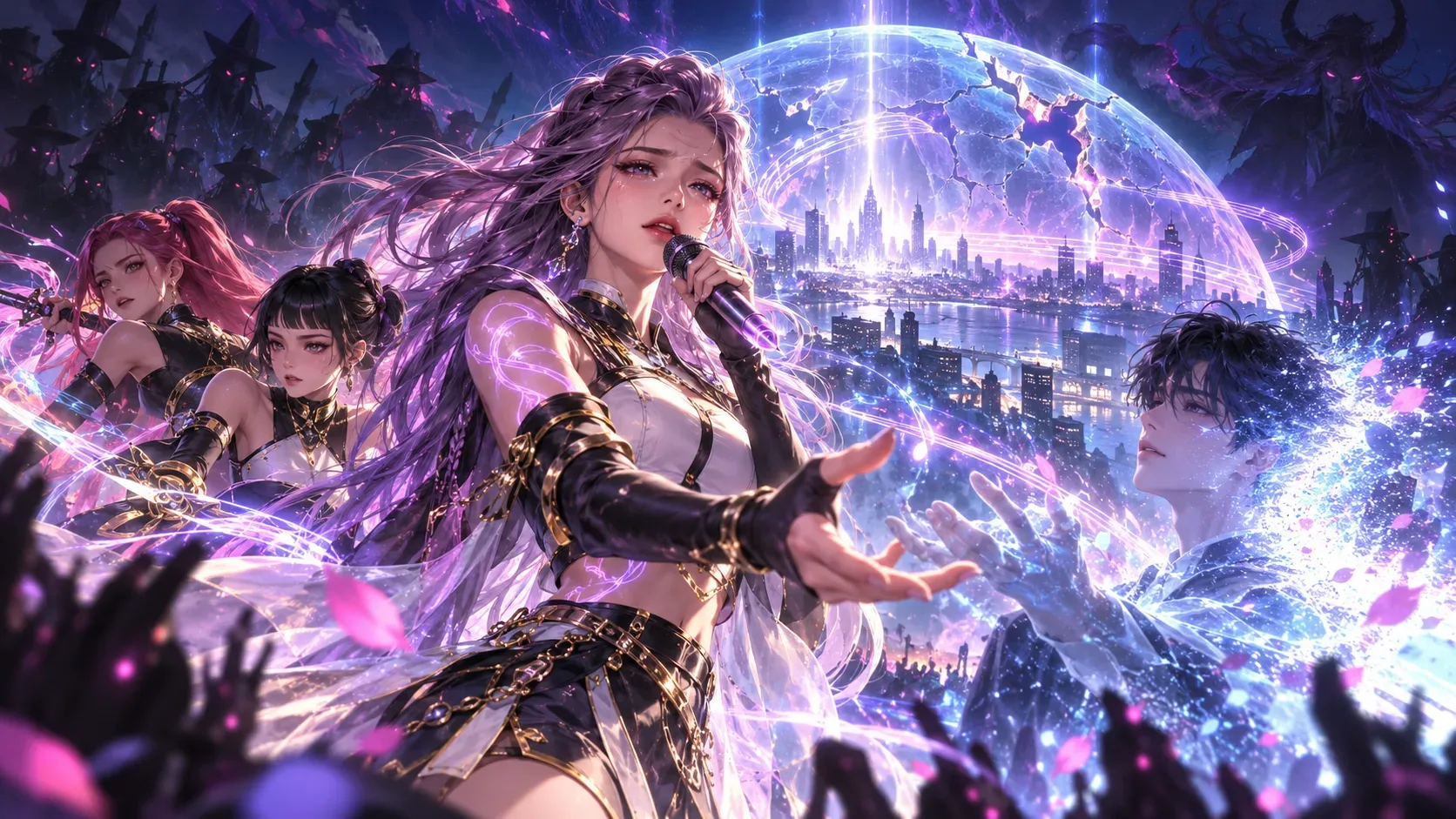
- The turn through music. Rumi begins “What It Sounds Like.” The song awakens people under demonic influence and restores the collective power the Saja Boys had tried to hijack. Mira and Zoey return to fight beside their friend.
- Jinu makes his choice. During the fight against Gwi-Ma, he intercepts an attack aimed at Rumi. Having broken free of the shame that kept him submissive, he gives the singer his soul. The film presents this as a sacrifice and a farewell, not as a resurrection.
- Gwi-Ma's defeat and a new balance. Reunited, HUNTR/X defeat the threat, save the audience, and bring back the Honmoon's protection. Rumi still has her marks, but no longer hides them.
Does Jinu die? What happens to his soul?
Jinu's on-screen fate is a sacrifice. Centuries earlier, when he was human, he traded his soul for fame and fortune, leaving his mother and sister behind. Gwi-Ma exploits that guilt to control him. His connection with Rumi offers another possibility: facing his mistakes without continuing to obey shame. That does not undo his betrayal when her secret is exposed.
At the climax, the change becomes more than a promise. Jinu saves Rumi and transfers his recovered soul to her, and Netflix's official character profile says his soul powers her sword. His last appearance is tied to the sacrifice. The film does not show Jinu coming back to life or establish a future return on its own. Any theory that he might reappear remains speculation until a specific story development or announcement confirms it.
Was the Honmoon destroyed, rebuilt, or finally turned gold?
The Honmoon is the musical protection that keeps demons from invading the human world. The hunters initially aim to make it a permanent golden seal. The Saja Boys attack the system by redirecting the fans' affection, part of what gives HUNTR/X their strength. That is why a battle of songs has a direct impact on the city's safety.
The official explanations use different wording. Discussing the final song, executive music producer Ian Eisendrath describes Rumi's choice as destroying the old Honmoon and the belief that humans and demons must automatically be enemies. Netflix's official Rumi and Jinu profiles, meanwhile, describe the Honmoon as sealed or conjured at the end. These readings can coexist when we distinguish the version of the barrier Rumi rejects from the protection the trio restores. The ending does not confirm that every demon has vanished forever, nor does it require us to claim that the original golden plan came true exactly as envisioned.
Why do Rumi's marks remain visible?
Because the marks are part of who Rumi is, and the solution she finds does not depend on removing them. The daughter of a demon hunter and a demon, she grew up believing she had to hide her ancestry to deserve her place as HUNTR/X's leader. The fear even affects her voice, her main means of fighting and expressing herself.
“What It Sounds Like” marks the opposite choice: singing without pretending to have a flawless identity. When Mira and Zoey accept her again, Rumi stops seeing her marks as a sentence. It is an established part of the ending that the marks remain and she no longer conceals them. The idea that a renewed Honmoon symbolizes protection compatible with difference is a thematic interpretation, not a magical rule whose every detail is spelled out by the film.
How the three songs shape the ending
| Song | What it does in the story | Connection to the Honmoon |
|---|---|---|
| “Golden” | Introduces HUNTR/X's goal and Rumi's private wish to remove her marks. | Establishes the ideal of a permanent Golden Honmoon. |
| “Your Idol” | The Saja Boys use their show to subject the audience to Gwi-Ma's power. | Shows how turning fans away can weaken the shield. |
| “What It Sounds Like” | Rumi embraces her identity; her teammates and the audience join the fight. | Helps defeat Gwi-Ma and restore protection grounded in acceptance. |
According to Eisendrath, the final song also calls people to reclaim their own voices. This helps explain why defeating Gwi-Ma takes more than swords or choreography: the villain relies on isolation, shame, and control, while HUNTR/X rebuild their relationship with the people listening.
What does the ending confirm, and what remains open?
- Confirmed by the story and official material: Jinu sacrifices himself; HUNTR/X overcome the threat in the final confrontation, protect the fans, and restore the Honmoon; Rumi keeps her marks without hiding them.
- Explanation attributed to the creative team: Ian Eisendrath links the Honmoon's transformation to a rejection of a rigid division between humans and demons. This is the producer's explanation of the song and Rumi's arc.
- Not confirmed: Jinu's survival or resurrection, the permanent disappearance of all demons, and the plot of the sequel.
Could the confirmed sequel bring Jinu back?
Netflix confirmed a sequel on March 12, 2026, with Maggie Kang and Chris Appelhans returning to direct. The announcement anticipates the return of Rumi, Mira, and Zoey, but does not reveal a storyline that reverses Jinu's sacrifice. The follow-up is a confirmed project; his return is not an announced fact.
The first film's closing moments keep the focus on the three friends. Rather than take the three-month vacation they had planned, they choose to spend time with their fans. The detail fits the main resolution: having rebuilt their trust and reclaimed their voices, the trio return to the stage without Rumi having to erase any part of herself.
Sources and references
- Netflix Tudum: the Honmoon's lore and official ending explanation
- Netflix Tudum: Jinu's character profile and fate
- Netflix Tudum: Rumi's journey and marks
- Netflix Tudum: Ian Eisendrath on the songs and climax
- The Review Geek: independent analysis of the final events
- Netflix Tudum: sequel announcement dated March 12, 2026