Spoiler warning: this article reveals the ending of Harry Potter and the Philosopher's Stone (the 2001 film) and compares scenes with the first novel.
The person trying to steal the Philosopher's Stone was Professor Quirrell, acting for Voldemort, not Severus Snape. Harry, Ron and Hermione's investigation points to the Potions teacher because several clues seem to implicate him. The final confrontation reveals instead that Snape was protecting Harry and trying to prevent the theft. The twist also explains how the Mirror of Erised and Harry's mother's sacrifice thwart the plan.
Why did Harry suspect Snape?
The suspicion grows from genuine events interpreted the wrong way. After Hagrid removes a package from vault 713 at Gringotts, someone attempts to break into that same vault. Harry and his friends later learn that the object hidden at Hogwarts is the Philosopher's Stone, associated with the alchemist Nicolas Flamel. It can produce the Elixir of Life, making it tempting to anyone seeking to restore Voldemort's strength and extend his life.
On Halloween, a troll appears at the school and Snape heads towards the forbidden third-floor corridor. His injured leg, sustained after getting too close to Fluffy, the three-headed dog guarding the trapdoor, seems to confirm that he is trying to reach the object. What Harry does not yet know is that Quirrell released the troll as a diversion.
During Harry's first Quidditch match, his broom begins moving dangerously. Hermione sees Snape muttering while staring at Harry and assumes he is casting a curse. She sets the teacher's robes on fire to interrupt him. The later revelation reverses the meaning of this scene: Quirrell was jinxing the broom, while Snape was casting a counter-curse to save Harry.
What did Quirrell want to do with the Stone?
Quirrell, the Defence Against the Dark Arts teacher, appears timid and easily frightened. Behind that harmless appearance, he is working for Voldemort. Before the main events at Hogwarts, he had already tried and failed to steal the Stone from Gringotts. At school, he released the troll and tried to knock Harry off his broom while Snape investigated his activities.
Voldemort has not yet regained a body of his own. Quirrell acts as a host for his weakened form and conceals the Dark wizard's face on the back of his head beneath a turban. The two roles matter: Quirrell carries out the theft; Voldemort stands to benefit and directs the scheme. They intend to exploit the Stone's powers to restore Voldemort's strength and prolong his existence.
How does Harry reach the final confrontation?
Convinced that the Stone is in danger and unable to persuade the teachers to act in time, Harry, Ron and Hermione go through the trapdoor. In the film, they pass Fluffy, Devil's Snare and the flying keys. The giant wizard chess game requires Ron to sacrifice himself as a piece so the others can continue. Hermione stays to help him, while Harry goes into the last chamber alone.
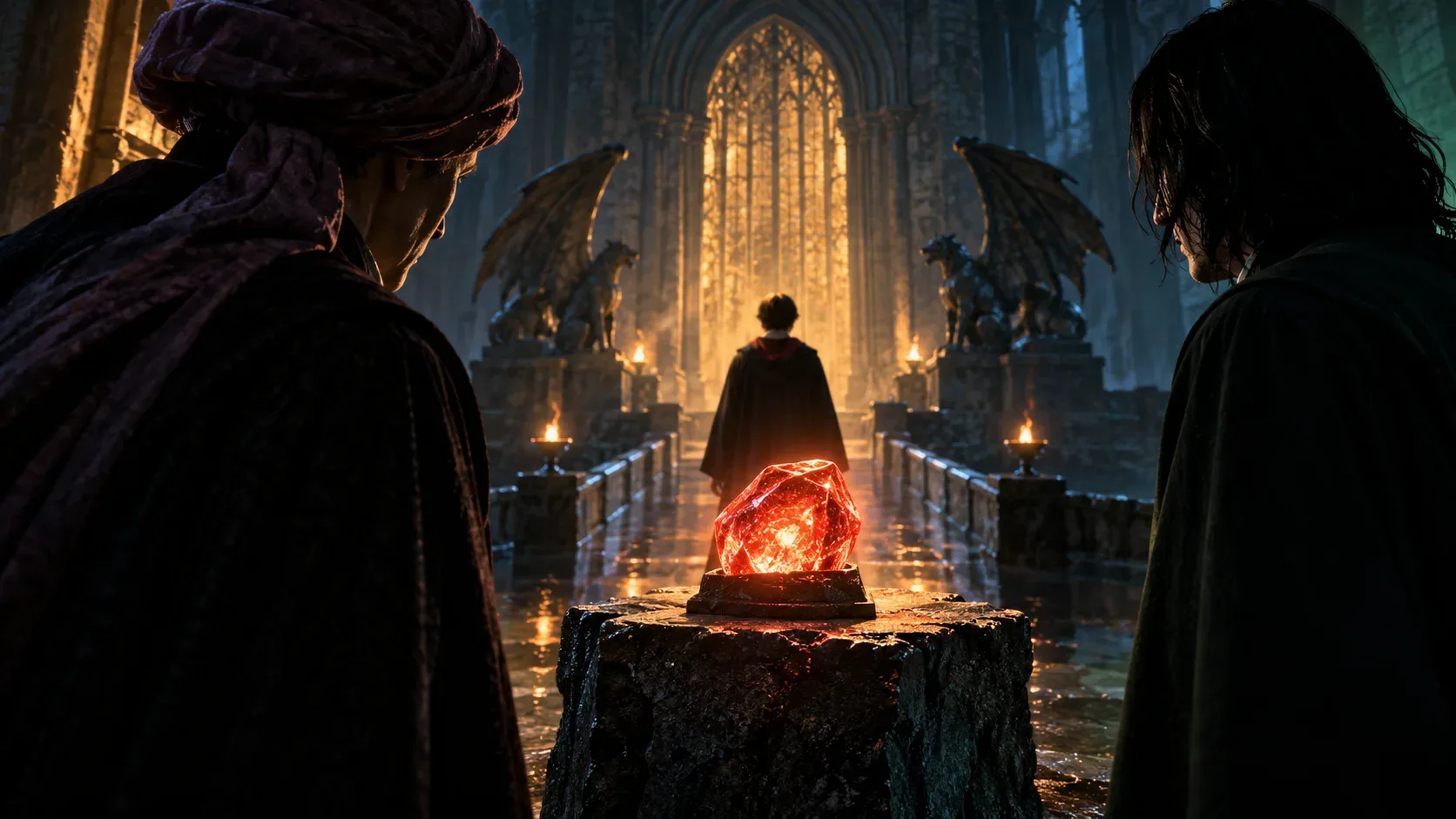
There he finds Quirrell, rather than Snape, standing before the Mirror of Erised. Dumbledore has arranged a crucial safeguard: only someone who wants to find the Stone but not use it can retrieve it from the mirror. Quirrell and Voldemort want to exploit it, so they cannot claim it. Harry only wants to keep it out of their hands. Looking into the reflection, he sees the Stone being slipped into his pocket and then discovers that it really is there. He tries to conceal what has happened.
Why does Harry's touch destroy Quirrell in the film?
When Harry refuses to hand over the Stone, Voldemort orders Quirrell to attack him. Physical contact with Harry injures the professor. In the film, Harry realizes what is happening and touches Quirrell's face, causing his body to disintegrate. Voldemort's spectral form escapes and passes through Harry, who loses consciousness. This ending does not mean that Voldemort has been destroyed for good.
In the hospital wing, Dumbledore explains the protection: Lily Potter sacrificed her life to save her son, leaving behind magic rooted in love that Voldemort cannot endure. Because Quirrell is hosting Voldemort, the contact harms him. Dumbledore also explains that the Stone will be destroyed with Nicolas Flamel's agreement, preventing another attempt to use it.
What changes between the film's ending and the book?
Both versions agree on who is behind the theft, how the mirror works and the protection left by Harry's mother. The 2001 adaptation streamlines the route to the revelation and makes Quirrell's death far more visible.
| Element | J.K. Rowling's novel | 2001 film |
|---|---|---|
| Final obstacles | Beyond the other defences, there is a room containing an already unconscious troll and a potions logic puzzle devised by Snape and solved by Hermione. | Both stages are omitted. The film moves from the chess game to Harry's meeting with Quirrell. |
| Effect of touch | Contact with Harry causes Quirrell pain and burns. | The effect is depicted as disintegration, and Harry deliberately touches the teacher's face. |
| Quirrell's fate | Harry faints before witnessing the death. The outcome is explained later, after Voldemort abandons Quirrell. | Harry sees Quirrell fall apart and Voldemort's form escape before losing consciousness. |
The distinction matters because the film shows the antagonist's physical defeat directly to the audience, whereas the novel leaves part of it outside Harry's awareness. In both versions, Snape was the wrong suspect in this particular plot. His hostility towards Harry makes the mystery plausible but does not prove that he took part in the theft.
Sources and references
- Official Harry Potter: rewatch of the 2001 film
- Official Harry Potter: Quirrell's reveal and suspicions about Snape
- Official Harry Potter: Snape's misunderstood actions
- Official Harry Potter: Quirrell, the troll and the theft plot
- Official Harry Potter: obstacles and the secret of the Mirror of Erised
- Official encyclopedia: properties of the Philosopher's Stone
- UOL Play: differences between the Harry Potter books and films