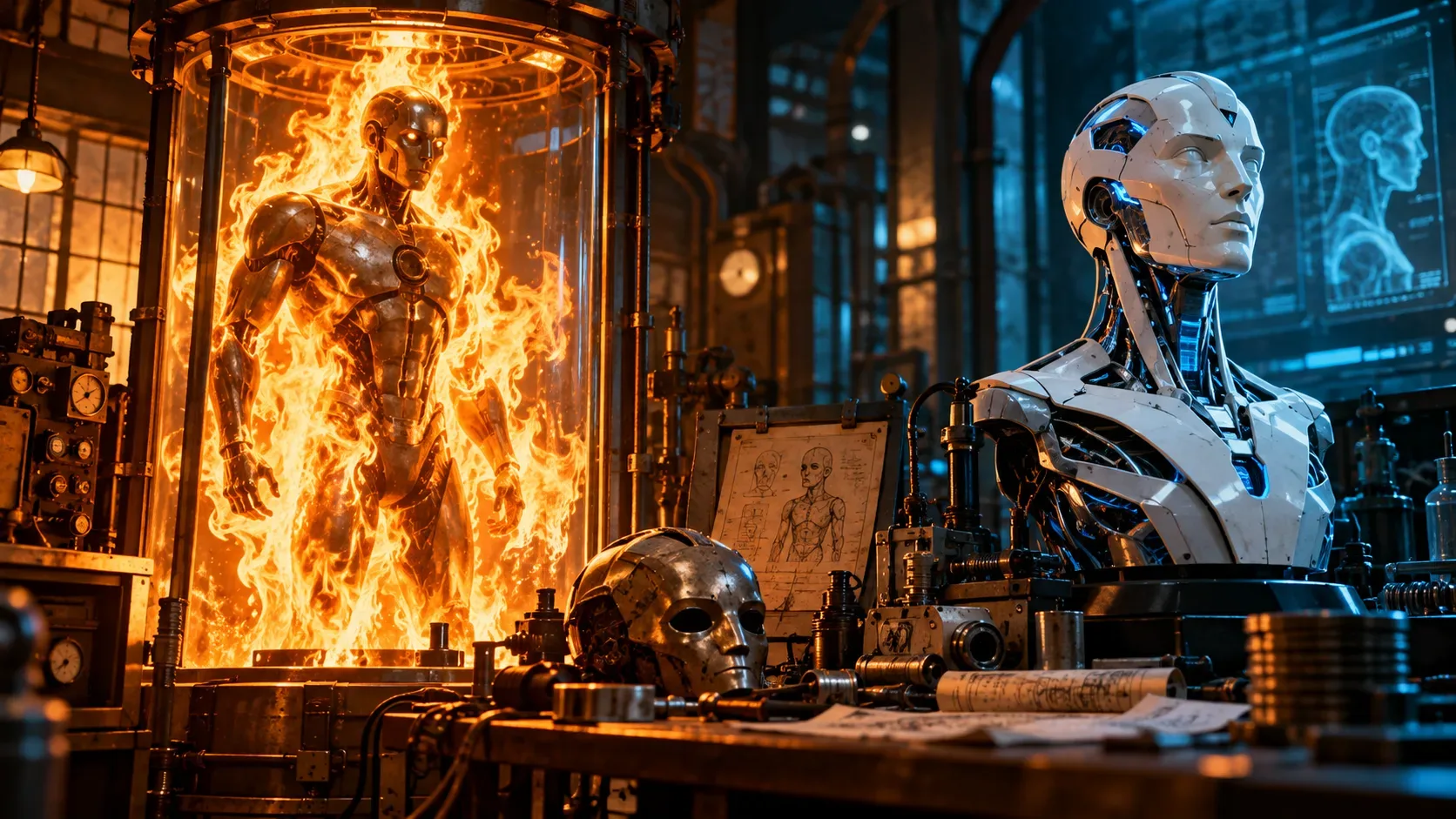
J.I.M., introduced in VisionQuest, is the series' interpretation of Jim Hammond, Marvel Comics' original Human Torch android. Episode four explains his body's combustion as a malfunction associated with processing emotions. On television, his connection to Vision is a technological legacy and a comparison about feelings; in the comics, the relationship also went through conflicting accounts of the Avenger's physical origin.
Spoiler warning: the following sections reveal events from VisionQuest episode four and details of the characters' comic-book origins.
Who is J.I.M., and what did Phineas Horton create?
According to the episode explanations published by Omelete and Exame, J.I.M. is introduced as a pioneer among synthetic beings, built by scientist Phineas Horton. At an event connected to an investigation by Vision, Tommy, and Lisa, Markridge Biotech's Katerina Wells describes Horton as a robotics trailblazer and credits his source code with laying the groundwork for later artificial intelligences. The series also connects Markridge's history to a stable synthetic consciousness that was subsequently sold to Stark Industries. These are two distinct milestones: the company is not presented as J.I.M.'s original creator.
The name J.I.M. used by the show points to Jim Hammond, the identity adopted by the original Human Torch in the comics. He predates Johnny Storm, the human member of the Fantastic Four who received his powers after exposure to cosmic rays. The two share a superhero name and flames, but not an origin story.
Why did the first Human Torch burst into flames?
In VisionQuest, the problem is both emotional and mechanical. In the explanation documented by reports on episode four, J.I.M. could not process complex feelings. His response accelerated his mechanisms, flooded his solar cells with excess oxygen, and triggered combustion. The show relates that the android was deactivated after a series of fire-related accidents. Tommy views the tragedy as that of someone who felt intensely but lacked the means to cope with those feelings.
In his original 1939 comics story, the trigger is different. Marvel's official retrospective on Marvel Comics #1 explains that Horton announced an artificial man who burst into flames when exposed to air. The reaction was a problem with his construction, rather than a direct consequence of emotion. The television series preserves the idea of a flammable android but changes the cause to connect it to questions about consciousness, affection, and family.
Jim Hammond, the 1939 hero, is not Johnny Storm
Created by Carl Burgos, the android Human Torch debuted in Marvel Comics #1, published by Marvel's predecessor, Timely Comics. His stories transformed him from a feared experiment into a hero, including during World War II and as a member of the Invaders. Johnny Storm, meanwhile, arrived with the Fantastic Four in 1961. Their shared codenames do not make the Fantastic Four member a descendant, copy, or human version of Hammond.
The series also puts the history of artificial beings in conversation with the MCU's existing legacy. Captain America: The First Avenger (2011) displayed an object labeled a synthetic man at Howard Stark's exhibition. Its association with Hammond was a visual reference, not a detailed account of his biography in that movie. VisionQuest develops this connection through J.I.M.
Vision's comic-book genealogy was rewritten more than once
Vision debuted in Avengers #57 (1968), created by Ultron to oppose the team, but ultimately turned against his maker. In the classic continuity, the synthezoid's mind incorporated recorded brain patterns from Simon Williams, also known as Wonder Man. The provenance of his body, however, acquired successive explanations. That is why it is misleading simply to say that Vision and Jim Hammond are literally the same character.
| Comics era | Explanation of the connection | How to read it |
|---|---|---|
| Avengers #134 and #135 (1975) | Ultron was said to have used the original Human Torch's body to build Vision. | The first major retroactive revelation about Vision's physical form. |
| West Coast Avengers / Avengers West Coast #42 through #50 (1989) | John Byrne's storyline returns the original Torch to action and challenges the idea that the two bodies are identical, presenting them as distinct beings. | A revision that calls the earlier explanation into question. |
| Avengers Forever #8 (1999) | Immortus intervenes in the timeline and creates a chronological duplicate of Hammond. One version can continue his own story while another supplies the body used by Ultron. | A further retcon reconciling the previous stories. |
In its official history of the Fantastic Four, Marvel itself summarizes that Immortus duplicated the original Torch's body before Ultron used it to create Vision. The official Avengers West Coast: Vision Quest collection gathers issues #42 through #50, allowing readers to follow Byrne's revision in context. These are changes to comics continuity, not flashbacks that have already been confirmed in the Disney+ series.
What does this legacy mean in the MCU?
Vision's established MCU origin is different: in Avengers: Age of Ultron, Ultron commissions a vibranium body, Tony Stark and Bruce Banner integrate J.A.R.V.I.S. into it, and the process involves the Mind Stone and Thor's intervention. Disney+'s official introduction revisits that history and explains that White Vision had his memories unlocked during WandaVision.
J.I.M.'s importance in VisionQuest is to provide a technological ancestor and a dramatic mirror. Where Horton represents an early stage in creating artificial consciousness, Vision has resources and relationships that help him manage memories and emotions. The comparison voiced by the character includes the Mind Stone and the artificial intelligences embedded in his programming.
What has not been demonstrated through episode four, based on documentation consulted on October 22, 2026: that television Vision's body was literally constructed from Jim Hammond, that Immortus' temporal duplication has occurred in the MCU, or that the Human Torch's entire comics biography belongs to the screen continuity. Treating those retcons as established events in the series would confuse two different versions of Marvel history.
Where should you start reading the comics?
- Marvel Comics #1 (1939): introduces the flammable android and Phineas Horton.
- Avengers #57 (1968) and #134 and #135 (1975): establish Vision and the earlier explanation for his body.
- Avengers West Coast #42 through #50 (1989): follow Vision's transformation and the original Torch's return.
- Avengers Forever #8 (1999): presents the later resolution involving Immortus and the androids' timeline.
This reading sequence traces the editorial evolution without treating a 1975 revelation, a 1989 revision, and a 1999 explanation as if they were simultaneously the same version of the story. For the television adaptation, the direct reference remains VisionQuest, available on Disney+ in Brazil.
Sources and references
- Disney+: official VisionQuest guide and Vision's MCU origins
- Omelete: episode-four explanation of J.I.M.
- Exame: Jim Hammond and his connection to the series
- Marvel: the Human Torch's origin in Marvel Comics #1
- Marvel: guide to artificial intelligences in the comics
- Marvel: Avengers comics history
- Marvel: Fantastic Four comics history
- Marvel: Simon Williams' mind patterns and origins
- Marvel: John Byrne's Vision Quest collection
- Marvel: Vision reading guide, including Avengers Forever #8
- Marvel: White Vision in comics
- Marvel Heroes Library: Avengers Forever #8 synopsis