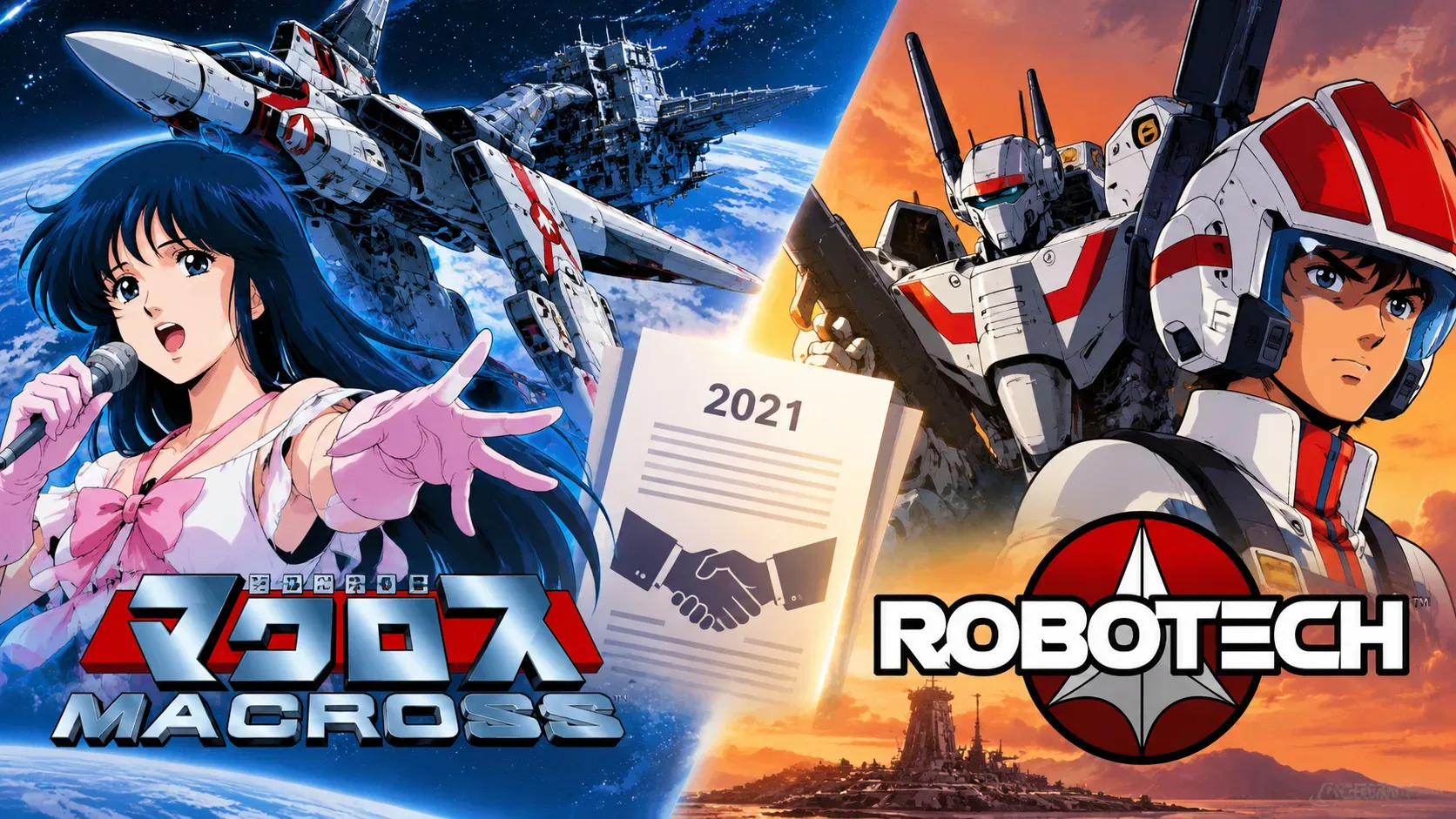
The agreement between Big West and Harmony Gold, signed on March 1, 2021, and announced on April 9, opened the door to international distribution of most Macross television sequels and films. At the same time, it affirmed specific Harmony Gold rights to Robotech. The deal eased a longstanding dispute, but it did not turn the two franchises into one story, clear every title without exception, or guarantee availability on Brazilian streaming services.
Why do Macross and Robotech tell different stories?
The Super Dimension Fortress Macross, first broadcast in Japan in 1982, combines space combat, transforming fighter aircraft, songs, and romantic conflict. Big West itself identifies music, Valkyries, and love triangles as defining features of the Japanese franchise.
Robotech, released in the United States in 1985 by Harmony Gold, instead reorganized animated material from three separate Japanese productions: The Super Dimension Fortress Macross, Super Dimension Cavalry Southern Cross, and Genesis Climber MOSPEADA. Under Carl Macek's creative direction, the episodes gained rewritten dialogue, interconnected characters, and a continuous plot spanning three sagas. The result was more than an English dub of Macross: it was an adaptation with its own continuity.
One change illustrates the scale of the rewriting. In an interview conducted in 2009 and republished in full by Time Extension in 2022, Macek explained that protoculture became an energy source in Robotech, taking on a role different from the concept used in Macross. This is an account from the adaptation's creator, not evidence that the two narratives share the same canon.
Which companies were involved in the rights dispute?
Big West, a Japanese company involved in developing and exploiting Macross, and Harmony Gold USA, responsible for licensing the Robotech franchise in its markets, had disagreed over international exploitation of the properties for roughly two decades. The 2021 announcement also names Studio Nue, associated with the creation of Macross, and Tatsunoko Production, which had granted Harmony Gold rights used in its adaptation.
The crucial distinction is that the rights were not treated as though a single company owned everything outright. The announcement recognized an opening for international distribution of much of the later Macross catalog, while preserving a Harmony Gold license involving specific elements used in Robotech.
What exactly did the 2021 agreement establish?
The public announcement describes a commercial understanding between the parties, with different effects for each property. It does not provide a complete list of countries, streaming services, or release dates.
| Subject | What the announcement confirms | What cannot be inferred |
|---|---|---|
| Macross sequels and films | International distribution was immediately permitted for most television sequels and films. | Clearance of every single work or automatic entry into every national catalog. |
| Robotech characters and mecha | Recognition of Harmony Gold's exclusive license from Tatsunoko to use 41 Macross characters and mecha in the Robotech television series and related merchandise outside Japan. | Transfer of the entire Macross franchise to Harmony Gold or an equivalent exclusive license inside Japan. |
| Projects after 2021 | A commitment to cooperate on international distribution of future projects from both franchises. | Confirmation of particular titles, platforms, or schedules. |
| Live-action Robotech film | Big West said it would not oppose a Japanese release of the then-planned film project. | That the film was completed, had a release date, or was automatically cleared for exhibition in every country. |
Why was the original series still a separate case?
A concrete example arrived on March 18, 2024. When the official Japanese Macross site announced Disney+ distribution plans, it identified the 1982 television series and the 1984 film Macross: Do You Remember Love? as Japan-only titles under that lineup. Other works, including Macross Plus, Macross 7, Macross F, and Macross Delta, were included in the international rollout plan.
That distinction shows why the word "most" matters in the 2021 agreement. Legal clearance makes distribution deals possible, but each title still depends on licensing, platform contracts, and territory. The 2024 announcement does not, by itself, prove current availability in Brazil; catalogs must be checked for the relevant region and date.
What does this mean for viewers?
Anyone seeking the original Japanese story should identify the appropriate Macross title and version. Anyone choosing Robotech is watching the 1985 American adaptation, which combines three shows into a rewritten narrative. Sharing animation, characters, or mecha does not make their timelines interchangeable.
The lasting effect of the 2021 deal is that the franchises can coexist commercially with fewer international barriers. It explains how additional Macross licensing became possible without eliminating Robotech. To find a legal way to watch, however, viewers still need to check the exact work, country, and current catalog.