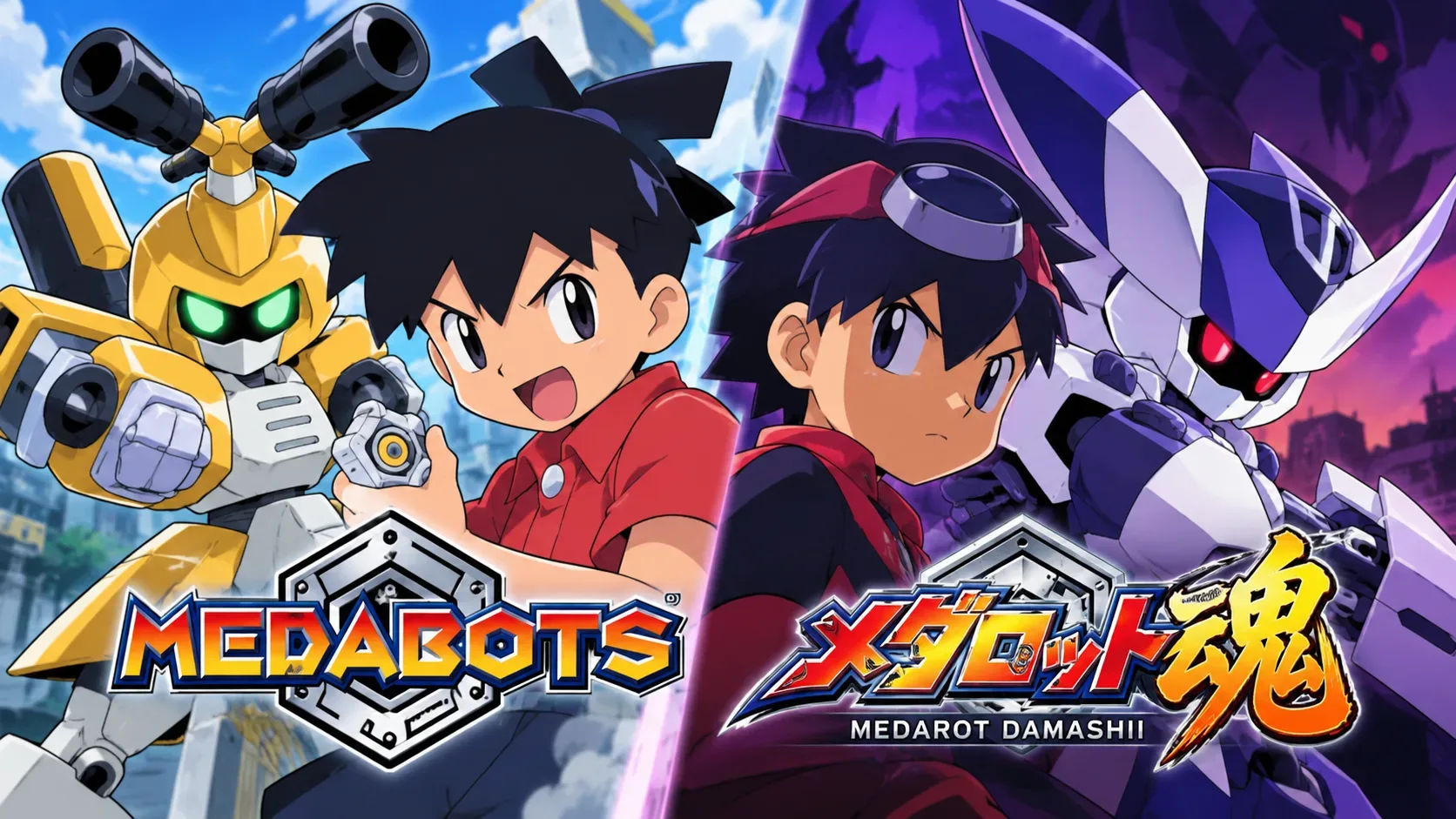
Medarot Damashii, released internationally as Medabots Spirits, is a sequel to the original Medabots anime, not a remake. Ikki and Metabee remain the leads, but the production team changes, some established supporting characters become less prominent, and the story turns toward the Death Medarots, machines designed to put winning above rules and the bond with their partners.
The key distinction is between two Japanese TV series and how international catalogs split them into seasons. ADK Emotions officially lists 52 episodes for the original and 39 for the sequel. That makes 91 episodes in total; it does not mean Japan produced a separate third series.
What is the correct viewing order?
Start with Medarot (also known as Medabots), which aired in Japan from July 2, 1999, to June 30, 2000. Then watch Medarot Damashii, broadcast from July 7, 2000, to March 30, 2001. The sequel began just one week after the original Japanese series ended.
Release order is the recommended order. There is no need to alternate episodes or watch an additional series between them. The franchise's official portal separately lists Medarot in 1999 and Medarot Damashii in 2000 on its timeline.
Original Medabots vs. Medarot Damashii: side-by-side
| Aspect | Original Medabots | Medarot Damashii |
|---|---|---|
| Identity | First Japanese series: Medarot / Medabots | Second Japanese series: Medarot Damashii / Medabots Spirits |
| Japanese broadcast | July 2, 1999 to June 30, 2000 | July 7, 2000 to March 30, 2001 |
| Episodes | 52 | 39 |
| Story focus | Ikki and Metabee, Robattles, growth and rivals | Ikki and Metabee face the Death Medarots |
| Characteristic conflict | Regular battles and threats such as the Roborobo Gang | Robots designed to win without respecting rules |
| Direction and series composition | Tensai Okamura; Ryota Yamaguchi | Shinji Arakawa; Yosuke Nakagawa |
| Animation | Bee Train | Trans Arts, with assistance from Production I.G |
How do the story and villains change?
In the original anime, Ikki learns to battle alongside Metabee, develops friendships and rivalries, and faces threats including the Roborobo Gang. The Japanese distributor's synopsis emphasizes the growth of the boy-and-robot partnership, while the franchise's world features tournaments and clashes with other Medafighters.
Damashii shifts the conflict to the Death Medarots (called Kilobots in the English localization). According to d Anime Store's synopsis, a company headed by Kokuryu creates these aggressive robots, which spread among children and threaten conventional Robattles. Ginkai is among the new characters featured in the sequel.
The contrast between friendship and power exercised without limits becomes more central. This is an interpretation of the official synopses, not a claim that all fights in the original were lighthearted or that Damashii removed humor and friendship. ADK also describes Metabee as having a new body in the sequel, another visible marker of a new phase.
Why does the sequel look and feel different?
Changes behind the scenes are documented. Tensai Okamura directed the first series, with series composition by Ryota Yamaguchi and animation by Bee Train. In the sequel, Shinji Arakawa became director, Yosuke Nakagawa handled series composition, and Trans Arts produced the animation with assistance from Production I.G.
These shifts help explain why the second show can feel different in staging and tone even though its leads are familiar. The staff did not change completely: Tokuyuki Matsutake remains credited for character design and Osamu Tezuka for music. The production records consulted do not explain every personnel decision, so blaming any specific broadcaster or studio policy would be speculation.
Which characters stay, and who becomes less prominent?
Ikki, Metabee and Arika appear in the cast records for both productions. The sequel also retains characters from Kikuhime's group, while highlighting Nae, Ginkai and Kokuryu. The focus changes, but the main protagonist does not.
Characters strongly associated with the original show, such as Koji and Karin, do not receive the same prominence in the main cast listings examined for Damashii. That difference helps explain the changed ensemble, but a condensed cast list alone cannot prove that a character never appears. Nor do these sources offer an official explanation for every omission.
Is it season two or season three?
It depends on the distributor's cataloging. As Japanese productions, there are two TV series: Medarot, with 52 episodes, and Medarot Damashii, with 39. However, the US JustWatch catalog lists Spirits as season 3, with 39 episodes. That label reflects packaging and indexing, not the existence of a third Japanese anime production.
When searching, try both Medarot Damashii and Medabots Spirits and check for the 39-episode run. The figures here refer to the Japanese broadcasts documented by ADK; international editions may use different season groupings or presentation orders.
Does Damashii reboot the story?
No. ADK explicitly calls it a sequel, and the central characters carry over. What changes is the narrative emphasis: the conflict structure most associated with the first run gives way to the Death Medarots, new opponents, and a sharper focus on power versus companionship.
To follow Ikki and Metabee's development and recognize returning elements, watch the original 52 episodes first. If you already know that story, you can move on to Damashii's 39 episodes, keeping in mind that the new team and supporting cast are part of what sets the sequel apart.
Sources and references
- ADK Emotions: official Medarot production record
- ADK Emotions: official Medarot Damashii production record
- Official Medarot portal: anime and game timeline
- d Anime Store: original series synopsis, cast and episodes
- d Anime Store: sequel synopsis, cast and episodes
- JustWatch United States: Spirits listed as season 3