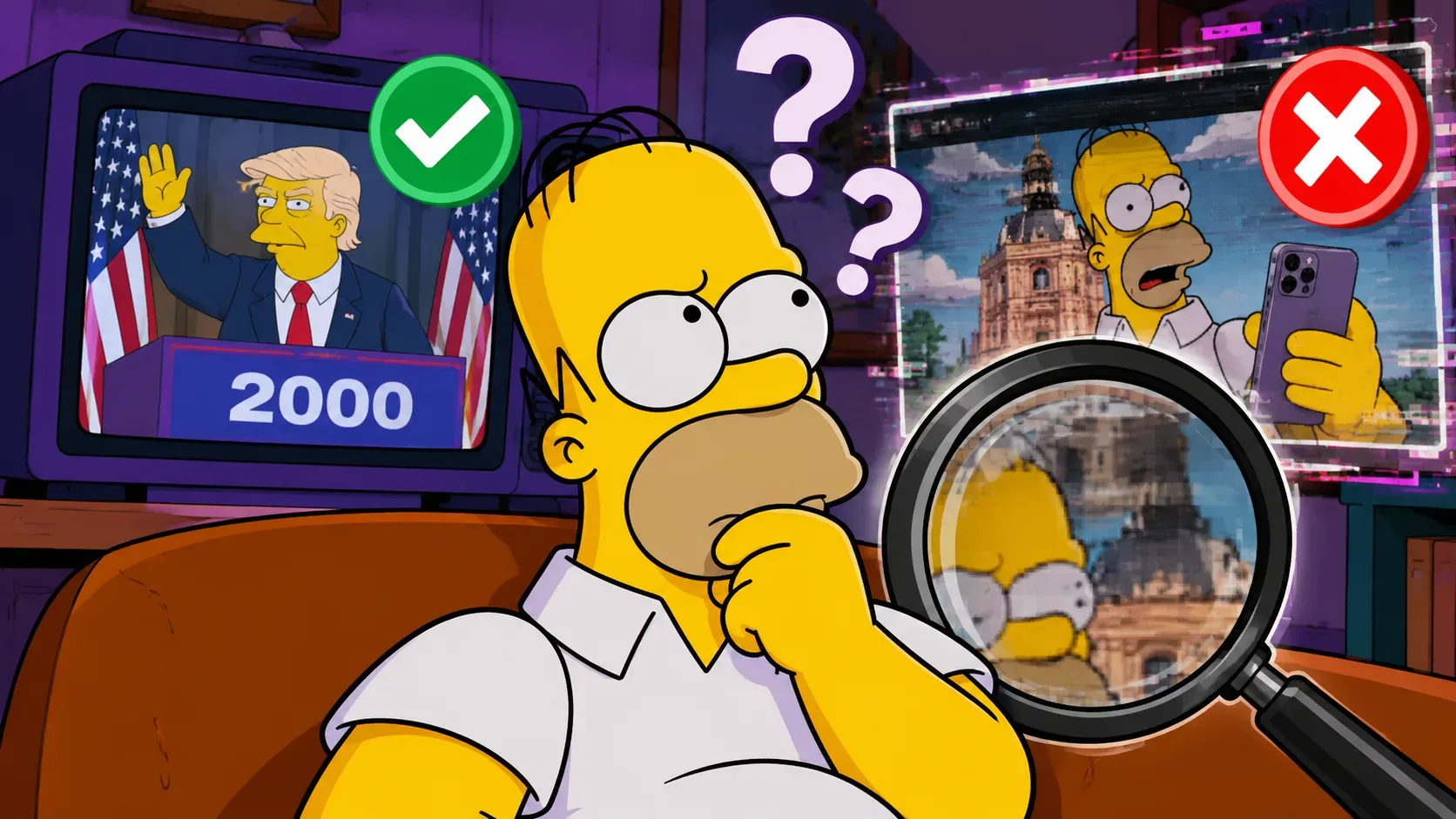
The Simpsons has no demonstrated track record of predicting the future. Some famous coincidences come from authentic scenes broadcast years before the events to which they were later compared. Other alleged predictions are fabrications, videos generated or modified with artificial intelligence (AI), or real scenes presented out of context. The difference becomes clear only when the episode, its original airdate, and the material that actually aired are identified.
That changes the question. Rather than asking whether an image “looks like The Simpsons,” we need to establish whether it belongs to an identifiable episode and whether the viral clip changed the dialogue, scene, or date. Two famous cases survive an initial check; several others fall apart when compared with the show's episode catalog.
Two coincidences that really appeared in the show
Donald Trump: the 2000 reference is genuine
In Bart to the Future, season 11, episode 17, originally broadcast in the United States on March 19, 2000, the story imagines Bart's and Lisa's futures. Lisa becomes President of the United States and mentions having inherited problems from an earlier Donald Trump administration. The episode and date appear in The Simpsons Archive's guide, while CBS News documented the reference in a 2016 report.
The line predates Trump's 2016 presidential election victory. But he is mentioned in a satire set in an imaginary future, not in a news report or a statement that the writers knew how an election would turn out. An authentic scene is not evidence of prophetic powers. Nor should every viral image of Trump alongside the Simpson family be treated as part of that episode.
Disney and Fox: the 1998 sign was real, too
Another example appears in When You Dish Upon a Star, season 10, episode 5, originally aired on November 8, 1998. A sign at the Fox studios describes the company as a Disney division, a visual joke about entertainment conglomerates. VEJA described the scene in a December 2017 report; The Simpsons Archive confirms the episode's original broadcast date.
Disney announced a deal involving 21st Century Fox assets in 2017, and the acquisition took effect on March 20, 2019, according to Disney's own announcement. The comparison is valid, with an important qualification: the actual transaction covered specified assets, and the 1998 joke did not lay out the terms, price, or timetable of a future deal.
Four alleged predictions that were debunked
For the examples below, verification does not depend on believing or disbelieving the cartoon's reputation. It compares a specific claim with the episodes and the origins of the images.
| Viral claim | What fact-checkers found | Finding |
|---|---|---|
| The 2025 Los Angeles wildfires had appeared in a 2007 episode. | The cited episode, Little Big Girl (season 18, episode 12), really does involve a fire, but the widespread images of devastation presented as scenes from it are not in that episode. Lead Stories identified images that appear to have been made with AI. | Misleading fabrication, not a documented prediction. |
| The series announced a Third World War in 2025. | EFE Verifica found clips lacking a reliable episode reference and containing visual inconsistencies, including duplicated characters and incorrectly drawn elements. No cited episode substantiated the alleged date. | False claim. |
| An old episode predicted Hulk Hogan's death. | The clip attributed the story to season 6, episode 12, and a fabricated title. The real episode is Homer the Great, which contains no such plot. Lead Stories found AI-generation artifacts and an indication that the material was artificially generated. | Incorrect episode attribution and fabricated scenes. |
| A 1998 scene foretold Ozzy Osbourne's death. | According to Lead Stories, the viral video appeared on July 22, 2025, after news of the musician's death had been published. It displayed signs of artificial imagery, including a duplicated Homer and distorted lettering. | Fake video posted after the event. |
The wildfire case illustrates a particularly common trap: a real storyline can provide the setting for a fabricated clip. Finding out that an episode mentioned a fire, a politician, or a disaster is not enough. You must establish that the exact scene being shared genuinely appears in it.
Why has AI made this kind of hoax more convincing?
Previously, an invented “prediction” might have circulated as a single captioned image. Now creators can produce sequences of frames resembling the show's visual style, add narration, and simulate a passage from an old episode. An on-screen date and a confident voice give it the appearance of a historical record even when no corresponding episode exists.
The cited investigations found concrete clues: Homer appearing twice in one frame, malformed eyes, illegible lettering, inconsistent objects, and nonexistent episode titles. Such signs are useful reasons for suspicion, but their absence does not establish authenticity. Well-made synthetic imagery may look convincing, while video compression and low resolution can also produce visual defects.
An “AI-generated content” label can be helpful evidence, but it cannot replace an origin check. Automated AI detectors should not be treated as conclusive evidence on their own. The strongest confirmation comes from comparing the clip with the original episode and tracing when the post first circulated.
How to verify an alleged Simpsons prediction
- Ask for an identifiable source. Record the season, episode number, original title, and year. “An episode from years ago” is not specific enough to check.
- Check the original airdate. Consult an episode guide and distinguish the first US broadcast from reruns, dubbed editions, and recent uploads. The Simpsons Archive documents historical dates; Disney+ has a themed collection of episodes associated with “predictions.”
- Compare the full scene. If possible, find the officially distributed episode. Examine its context, dialogue, characters, and editing, not just a cropped frame.
- Look for the oldest post. An image published after an event cannot document a prediction made before it. The Ozzy Osbourne case shows why upload times matter.
- Inspect visual details without relying on them alone. Distorted faces or hands, strange text, and duplicated characters are warning signs, not standalone verdicts.
- Read fact-checks about the precise claim. Search for it in organizations such as Lead Stories and EFE Verifica, and distinguish among a “real episode,” an “altered scene,” a “nonexistent scene,” and an “overstated comparison.”
If the scene is real, has the prediction been proven?
No. A long-running satirical cartoon explores countless ideas about politics, technology, human behavior, and disasters. Some may resemble news events that occur afterward. Selecting only the best-known matches while ignoring storylines that never came true creates a misleading impression of accuracy.
The safest editorial test separates three questions: Did the scene exist? Was it broadcast before the event? What did it actually say? Trump and Disney/Fox pass the existence and timing tests, but they remain examples of satire and coincidence rather than demonstrations of supernatural ability. Documented fabrications fail before the coincidence question even arises.
Sources and references
- Disney+: collection of episodes associated with predictions
- The Simpsons Archive: season 11 episode guide
- CBS News: the Trump reference in Bart to the Future
- The Simpsons Archive: season 10 episode guide
- VEJA: the Disney and Fox joke
- The Walt Disney Company: 2019 acquisition closing announcement
- EFE Verifica: false claim of a world war in 2025
- Lead Stories: fabricated California wildfire imagery
- Lead Stories: false Hulk Hogan video
- Lead Stories: false Ozzy Osbourne video