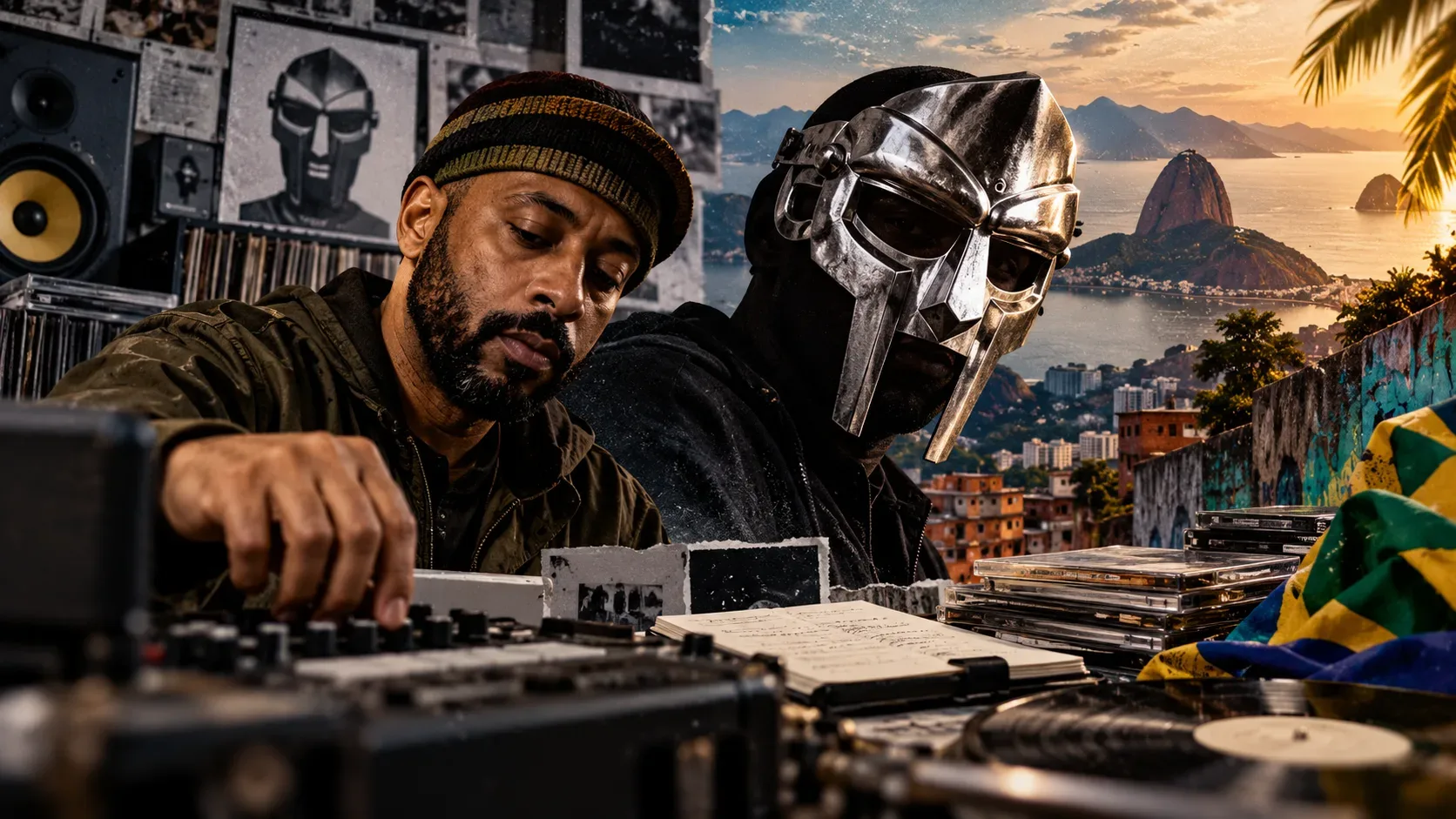
Madlib's trip to São Paulo in late 2002 connected two pivotal stages in the making of Madvillainy: while the producer was creating new beats in Brazil, copies of preliminary recordings made with MF DOOM circulated beyond the duo's control and eventually reached the internet. Stones Throw confirms that the demos were copied during that visit and that the leak disrupted the project. This does not mean the entire album was recorded in Brazil, nor does it establish who released the material.
Before Brazil, Madvillain had already recorded demos in Los Angeles
Madlib and MF DOOM began working together in 2002 at the house Stones Throw used in Los Angeles. Madlib's studio, known as the Bomb Shelter, occupied a former fallout shelter. According to the label, Figaro and Meat Grinder emerged during their first meetings, followed by further recordings. DOOM wrote and tracked vocals over beats prepared by the producer; the material was not yet a finished album.
That origin is crucial to the Brazilian chapter. The official demo tape, subsequently issued by Stones Throw, contains early DOOM vocal recordings tracked and quickly mixed in Los Angeles. São Paulo was therefore a setting for beatmaking, the circulation of copies, and a change in the album's trajectory, not evidence that those vocals were recorded in Brazil.
São Paulo in 2002: Brazilian records, an SP-303, and new beats
Madlib traveled to Brazil for the Red Bull Music Academy. Stones Throw places his stay in late 2002, while Pitchfork's 2004 review specifies November. Jeff Weiss's later Pitchfork feature describes his search for samba and Tropicália records in shops across São Paulo.
His improvised hotel-room setup was minimal: a portable record player, an SP-303 sampler, and a borrowed cassette deck. Photographs published by the label document the process. Stones Throw directly associates the Brazilian sessions with beats used on Strange Ways and Rhinestone Cowboy. Pitchfork's feature additionally names Raid; that detail should be attributed to the publication rather than presented as an exhaustive list of songs produced in the city.
Rhinestone Cowboy provides the most telling connection: a beat worked on during the trip eventually appeared in a finished-album track that addresses the leak itself. This link is documented, but it does not establish that the entire song was written or recorded in the hotel.
How the demos leaked, and what remains unknown
Madlib brought compilations of unfinished material to listen to. Available accounts mention working CD-Rs and, in Pitchfork's later reconstruction, a cassette copy. Stones Throw says the demos were copied during the Brazil trip and made their way onto the internet. These documents do not establish a verified chain of custody tracing every transfer or safely identifying the person responsible.
Retrospective sources also differ on timing. In a 2024 statement, Stones Throw dates the online leak to November 2002. Pitchfork's March 2004 review, however, says the discs circulated a few months after the trip; its 2014 feature describes the leak as approximately 14 months before the official album release. The well-supported connection is between the late-2002 visit and the premature circulation. These sources do not consistently establish one precise date for the first online posting.
The consequences are clearer than the culprit. The label and participants in the production recount that DOOM and Madlib lost momentum when they realized their unfinished material was already circulating. Restarting the project took months of 2003. This describes the participants' reaction, not the motive or identity behind the copying.
Demos versus the finished album: what changed?
The demos are not an identical advance edition of the LP released on March 23, 2004. The official tape sequence, lasting 12 tracks and 36 minutes, preserves early vocal takes, working titles, and a different running order. The correspondences below come from Stones Throw's published track list:
| Title on the official demo | Corresponding final-album title | What the comparison shows |
|---|---|---|
| One False Move | Great Day | A working title for an early recording; the tape also contains an instrumental version. |
| Just for Kicks | Meat Grinder | An early version of the track known by its final name. |
| Stakes | Supervillain Theme | Another instance of a working title changing for the release. |
The differences extend beyond names. According to historical accounts published by Stones Throw and Pitchfork, DOOM rerecorded vocals and revised lyrics throughout 2003. Pitchfork describes more animated performances on the demos and a deeper, more controlled delivery on the completed album. Tracks such as Accordion and Rhinestone Cowboy are absent from that 12-track tape list; the latter references the leak in its lyrics.
Nor should the official tape be conflated with every bootleg copy circulating in the early 2000s. Pitchfork's 2025 review notes that the titles and sequence on the official reissue do not match those of one of the most widely shared unofficial versions in every respect.
A documented timeline of Madvillainy and its demos
- 2002, before the trip: Madlib and MF DOOM start recording in Los Angeles; Figaro and Meat Grinder are among the first experiments.
- Late 2002: Madlib attends the Red Bull Music Academy in São Paulo, hunts for records, develops beats using portable equipment, and the copying of demos connected to the leak takes place.
- Late 2002 into 2003: unfinished recordings circulate online; retrospective accounts disagree about the precise date. Album work loses momentum before resuming.
- Second half of 2003: DOOM continues revisions and rerecordings; the Money Folder and America's Most Blunted single marks the duo's first official release according to the label's history.
- March 23, 2004: Madvillain's completed album, Madvillainy, is released.
- 2008 and 2013: the demo sequence receives an official cassette edition in a 2008 box set, then a separate cassette release in 2013.
- 2024 and 2025: Stones Throw announces the first vinyl edition of the demos for the album's 20th anniversary, with direct shipments scheduled for November 2024 and wider distribution in 2025.
Which recording helps explain the story?
The 2004 Madvillainy album is the finished version. The official Madvillainy Demos release allows listeners to compare it with an earlier stage of the work. One is the product of later revisions; the other documents a preliminary sequence whose early circulation almost halted the project. Listening to or comparing these releases does not reveal the leaker's identity. What the record supports is that the Brazil trip became part of the album's story through both the beats made in São Paulo and the premature exposure of the demos.
Sources and references
- Stones Throw: production photos and account of Madvillainy
- Stones Throw: album history and the Brazil trip
- Stones Throw: ten years of Madvillainy
- Stones Throw: official demo tape track listing
- Stones Throw: anniversary vinyl edition of the demos
- Pitchfork: Jeff Weiss feature on the history of Madvillainy
- Pitchfork: 2004 review of Madvillainy
- Pitchfork: 2025 review of Madvillainy Demos