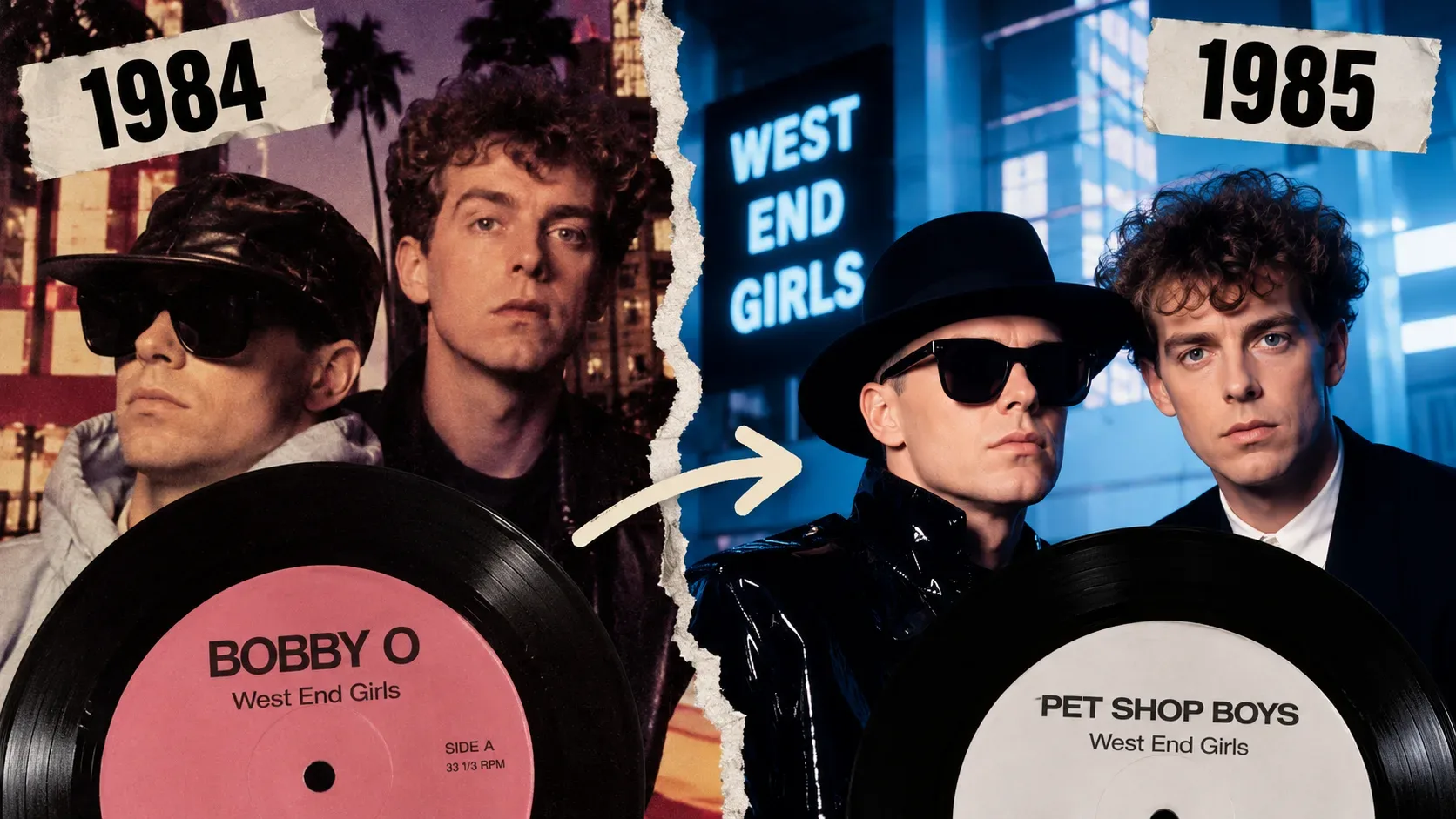
Pet Shop Boys rerecorded West End Girls in 1985 because they wanted to release the song again after signing with Parlophone, but did not control the original 1984 master produced by Bobby Orlando. Working with Stephen Hague, Neil Tennant and Chris Lowe made a fresh recording that was slower, more atmospheric and deliberately cinematic. That second version, released on 28 October 1985, reached number one on the UK singles chart in January 1986.
These were therefore not merely two remixes of an identical recording. They are two separate studio performances of the same song, made with different producers and launched under different commercial circumstances. Tennant later explained both the business context and the new sonic direction, while the duo's official chronology establishes the dates.
What happened between 1984 and 1985?
The first West End Girls grew out of Tennant's contact with New York producer Bobby Orlando, also known as Bobby O. Released in April 1984, it circulated primarily through the dance-music scene. According to Pet Shop Boys' official history, it became a club hit in Los Angeles and San Francisco and a smaller hit in France and Belgium. That is not the same as a major international sales breakthrough.
In an interview with Laura Snapes published in The Guardian on 5 June 2020, Tennant recalled that at one stage in 1984, the original was available in London as an import. Such limited circulation matched the duo's early ambitions, but the response in a few markets showed that the song might reach a much broader audience.
The next obstacle involved their contract. The group's chronology records that Pet Shop Boys signed with Parlophone in March 1985 following negotiations under which Orlando surrendered contractual rights in exchange for royalties on future sales. Tennant also explained, in an account revisited by MusicRadar, that they did not own the 1984 recording and therefore could not simply reissue it. Recording it afresh offered the song another opportunity under their new label.
Tennant and Lowe rerecorded it with Stephen Hague in August 1985. The new single arrived in the UK on 28 October. The distinction in dates matters: the song was not written from scratch in 1985, and the earlier recording did not cease to exist when the new single appeared.
1984 versus 1985: the key differences
| Feature | 1984 recording | 1985 recording |
|---|---|---|
| Producer | Bobby Orlando (Bobby O) | Stephen Hague |
| Release | April 1984 | 28 October 1985 |
| Sound | Closer to New York hi-NRG, with a direct dance beat | Slower tempo, more spacious arrangement and darker urban atmosphere |
| Production details | Original recording from the Orlando sessions | Footsteps and traffic in the opening, backing vocals and a sampled trumpet sound |
| Commercial context | Club play and imports, with success in particular markets | Parlophone release and entry into the UK singles chart |
| How to identify it | Look for Bobby Orlando production credits and the 1984 release | Look for Stephen Hague credits, the 1985 single or the album Please |
This comparison covers the two underlying recordings. A 12-inch single, a seven-inch single and a dance mix may also present different edits or remixes. The physical format alone cannot establish which master is playing.
What did Stephen Hague change in the sound?
The most substantial change was in musical presentation. Hague slowed the tempo and restructured the recording. Tennant told The Guardian that they wanted something cinematic: the introduction should suggest film noir, with a person walking down a street and an unsettling chord. Rather than just polishing the old mix, they rebuilt how the composition would unfold for listeners.
In Rhino's retrospective, the musicians describe adding recorded street sounds and traffic. The arrangement also featured backing singer Helena Springs and a trumpet-like solo performed by Hague using an Emulator sampler. Those touches belong to the recording that became widely familiar in 1985 and 1986. MusicRadar's production history also draws on accounts of changes to the tempo and structure.
The contrast corrects another common misconception: the spoken delivery and core concept were already present during the Bobby O era. Tennant said the song emerged from a combination of rap, dance music and images of London after dark. In the 2020 interview, he indicated that the second recording did not fundamentally change its meaning. It changed the sonic staging of that world.
Why did the second recording become a bigger hit?
No single studio trick explains its success. The first record had already attracted attention in clubs and parts of Europe, giving some listeners a sense of familiarity when it returned. At the same time, Tom Watkins becoming their manager, a deal with a major label and the Hague recording gave the project different means of reaching audiences. Tennant told The Guardian about a combination of timing, earlier exposure and chance, not a guaranteed hit-making formula.
In the United Kingdom, Official Charts lists the Parlophone release entering its weekly ranking in November 1985 and spending two weeks at number one in January 1986. Rhino reports that the song also topped the US Billboard Hot 100 for the week of 10 May 1986. These are country-specific chart results, not a single worldwide ranking. They demonstrate the wider commercial reach of the new recording.
Which version appears on Please, and how can you tell the releases apart?
The debut album Please, released on 24 March 1986, features West End Girls as its second track. It uses the Stephen Hague recording associated with the 1985 single, not the original Orlando master. The official 1985 single listing names a seven-inch edition backed with A Man Could Get Arrested, plus a 12-inch edition featuring an additional dance mix.
When examining a physical or digital release, check the year, production credits and mix title rather than relying only on its sleeve or the song name. Bobby O credits and a 1984 issue point to the initial recording. Stephen Hague credits and the 1985 Parlophone issue identify the rerecording that helped launch the duo's first album. Later remixes need to be identified separately, even when built from the 1985 master.
Sources and references
- Pet Shop Boys, 1984 chronology
- Pet Shop Boys, 1985 chronology
- Pet Shop Boys, West End girls single listing
- Pet Shop Boys, Please album listing
- Laura Snapes, Neil Tennant interview in The Guardian
- Rhino, West End Girls recording retrospective
- MusicRadar, history and production of both recordings
- Official Charts, UK chart history for West End Girls