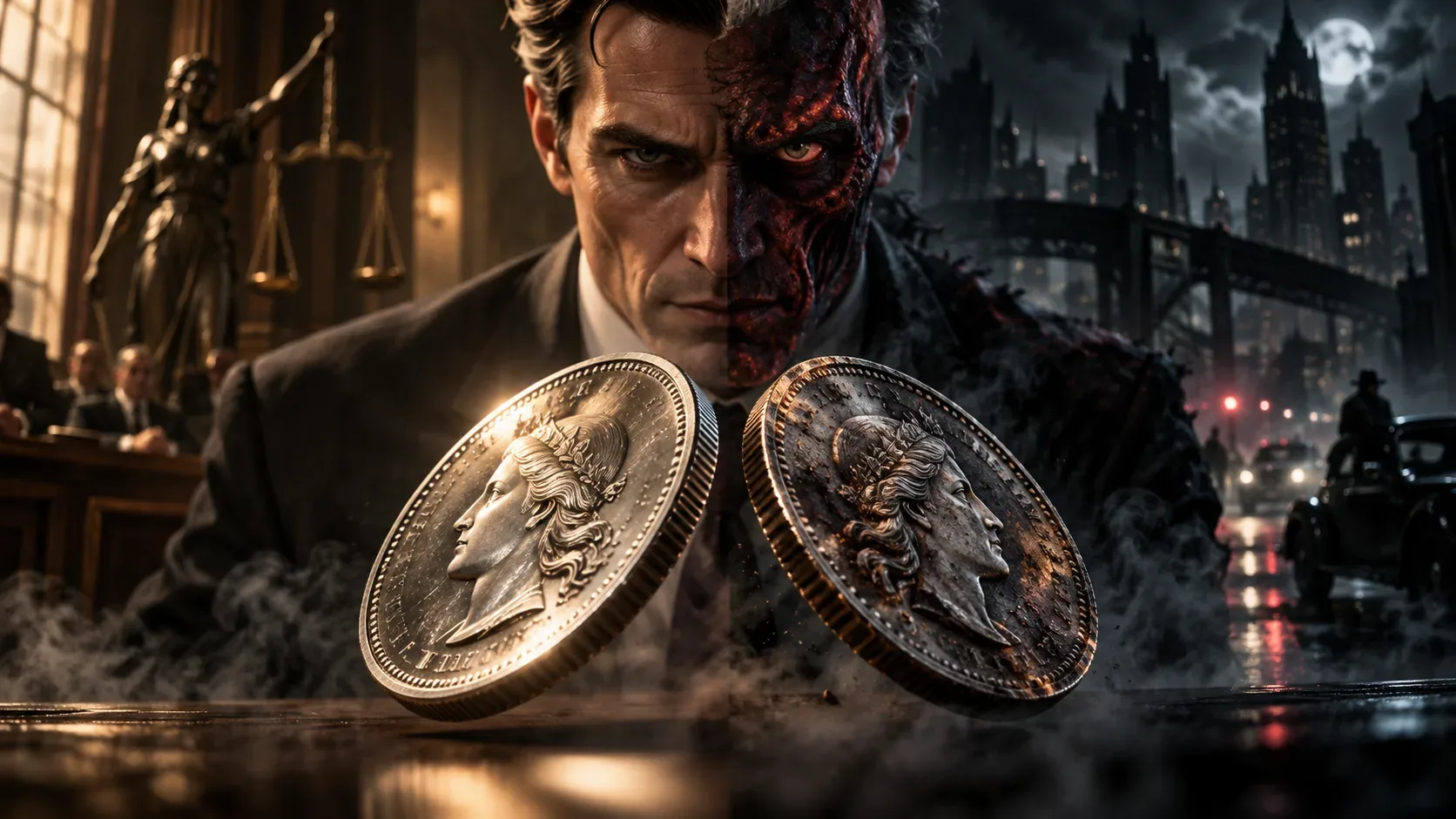
Two-Face's coin has two heads because it began as a trick coin bearing the same image on both sides. There was no genuine heads-or-tails choice: the result was predictable. Once one face is scratched or burned, the object acquires two visibly different outcomes and becomes the instrument Harvey Dent uses to choose between his conflicting impulses. Its backstory, however, changes from one comic or film to another.
Minor spoiler warning: this explanation discusses Harvey Dent's transformation and details of the coin in different Batman continuities.
The Detective Comics #66 origin: the coin belonged to Sal Maroni
When the villain debuted in Detective Comics #66 in 1942, the district attorney was still called Harvey “Apollo” Kent. His surname changed to Dent in 1948's Batman #50. According to DC's own retrospective, the double-headed coin originally belonged to the mobster known as Boss Maroni. Harvey uses it as evidence during the gangster's trial. Maroni responds by throwing acid at the prosecutor, disfiguring part of his face.
After the attack, the coin takes on another purpose: one side is marked, reflecting the contrast between Harvey's uninjured and scarred halves. He begins consulting that sign to guide his choices. The original story continues in Detective Comics #68, also published in 1942. The idea therefore did not begin as a present from Batman or a coin picked up at random.
Why two heads, and what does the damaged side change?
An ordinary coin has different designs on its obverse and reverse. A double-headed trick coin repeats the front design on both sides: before any damage, calling the toss a matter of “luck” is a performance, since it will always land heads up. Marking one face does not create a real tails side. It simply makes the intact side distinguishable from the damaged one.
That contrast is the basis of Two-Face's symbolism. The intact face evokes the former district attorney and the possibility of sparing someone; the damaged face represents the violence and bitterness associated with the villain. It expresses Harvey's personal rules, not any guarantee of justice or impartiality: even a decision entrusted to a coin is still a decision made by someone who has chosen to obey it.
The version involving Harvey's father in later comics
The 1942 story is not the only origin. In 1990's Batman Annual #14, the story The Eye of the Beholder, by Andy Helfer and Chris Sprouse, ties the coin to Christopher Dent, Harvey's abusive father. He used a double-headed coin to pretend the boy had a chance of avoiding punishment, although the outcome was rigged. DC explicitly acknowledges this family-related variation in its character retrospective.
That revision gives the object a meaning that predates the acid attack: the false choice was already part of Harvey's childhood. The two accounts should not be spliced into a single sequence. In the original telling, the coin's first connection is to Maroni and his trial. In the 1990 retelling, family history moves to the center of the explanation.
What did the films and animations change?
Batman Forever (1995): two heads and a scratched side
In Joel Schumacher's film, Tommy Lee Jones plays a Two-Face who flips a coin with one damaged face to decide other people's fates. A film prop described in a Van Eaton Galleries auction listing bears the inscription “Gothamus Unus” and has a deliberately scratched side. Its appearance adapts the concept to that movie's Gotham; the physical prop does not establish that its fictional backstory matches the 1942 comic.
The Dark Knight (2008): the explosion burns the coin
In Christopher Nolan's version, played by Aaron Eckhart, Harvey initially uses a double-headed coin and turns apparent randomness into a way of demonstrating control over the result. After the explosion that also disfigures him, one side of the coin is burned. The coin's significance changes along with the character: a trick that once guaranteed one outcome now produces two different visible signs. The film links the object to Harvey's father, but that does not justify importing the childhood abuse depicted in the 1990 comic into this movie's backstory.
A numismatic article from PCGS identifies a two-headed Peace Dollar in the cinematic representations from 1995 and 2008. The actual 1922 silver dollar, however, displays Liberty on one side and an eagle on the other, as PCGS's documentation shows. The fictional double-headed version is therefore an alteration of the design, not the normal form of that American coin.
Animation: even the denomination and the person who gives Harvey the coin can change
According to PCGS, Batman: The Animated Series (1992) and its related comics also depicted the coin as a George Washington quarter instead of the usual silver dollar. In the animated film Batman: The Long Halloween, Part One (2021), a DC article describes Batman handing Harvey a two-headed coin during a discussion about destroying Carmine Falcone's money. This is specific to that animated adaptation and must not be confused with the 1942 introduction.
How to tell the different versions apart
| Work and year | Origin or appearance | Key difference |
|---|---|---|
| Detective Comics #66 (1942) | Boss Maroni's coin is used as evidence at his trial. | Harvey uses a marked side after his disfigurement. |
| Batman Annual #14 (1990) | The double-headed coin is connected to Harvey's father. | The rigged choice becomes a symbol of childhood trauma. |
| Batman: The Animated Series (1992) | Depicted as a 25-cent coin. | The denomination and design change, not its symbolic purpose. |
| Batman Forever (1995) | A stylized prop has one scratched side. | Its design is tied to the movie's Gotham. |
| The Dark Knight (2008) | At first, the coin has the same design on both sides. | One face is burned in the explosion. |
| Batman: The Long Halloween, Part One (2021) | Batman gives Harvey the coin in the animated movie. | Its narrated provenance differs from Maroni's in 1942. |
The connecting idea is the illusion of impartiality. A double-headed coin originally leaves nothing to chance; after one face is marked, it turns Harvey's internal division into a visible rule. Its provenance, size and design vary across continuities, but the object keeps the question at the heart of the character: who is responsible for a choice made in the name of luck?
Sources and references
- DC Comics: Making a Dent: Twenty-two Facts About Two-Face
- DC Comics: Batman vs. Two-Face: collection of classic stories
- Den of Geek: The Batman 2 Will Feature Harvey Dent’s Father, But Which One?
- PCGS: Two-Face Coins
- PCGS CoinFacts: 1922 Peace Dollar: original design
- Van Eaton Galleries / iCollector: A Batman Forever Two-Face Prop Coin
- Lessonbucket: The Dark Knight: sequence analysis
- DC Comics: Batman: The Long Halloween Asks Some Hard Questions About Two-Face