Spoiler warning: this article reveals the ending of Resident Evil (2026).
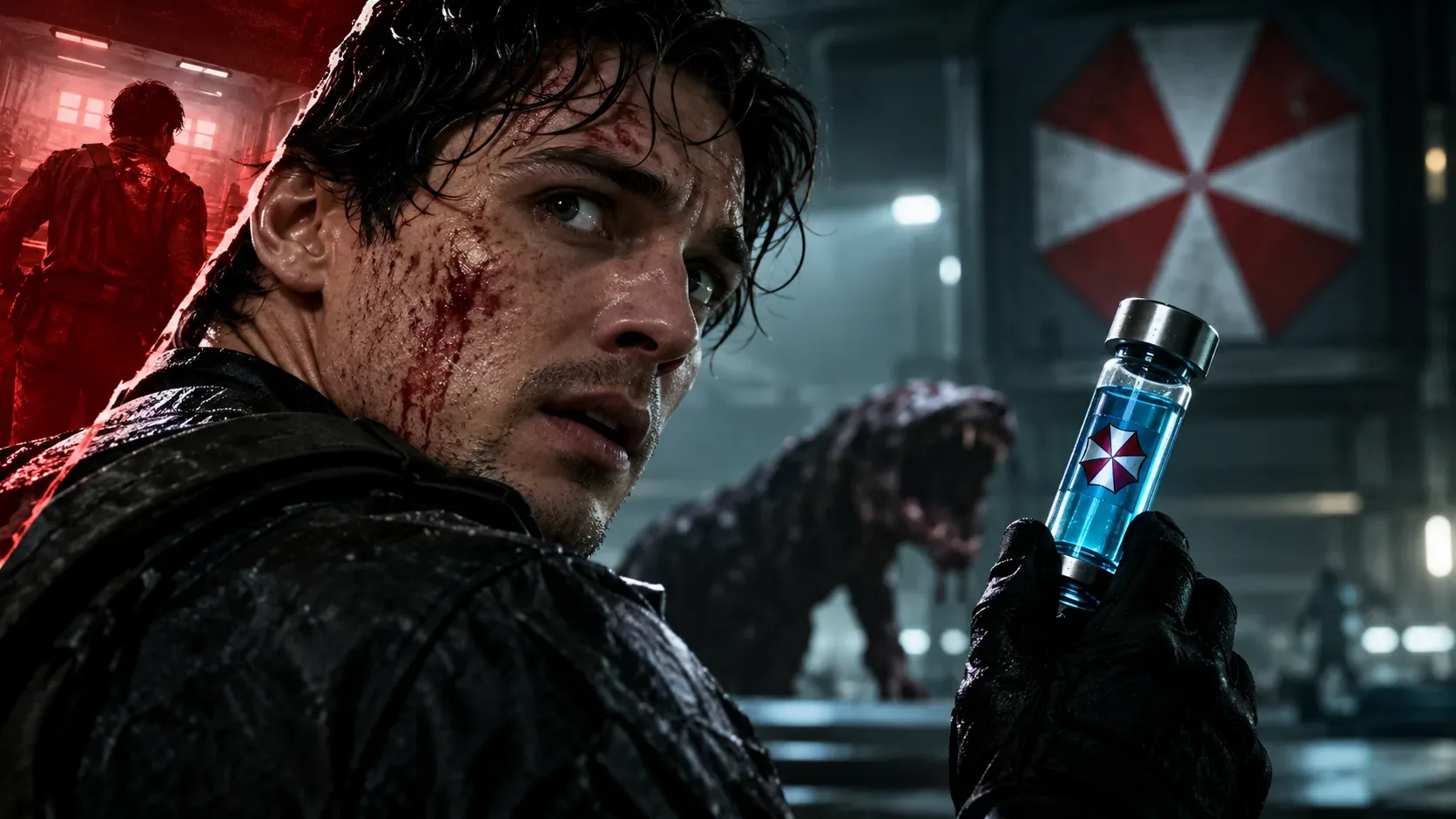
Zach Cregger changed the order of the final confrontation and the way Bryan is shown in Resident Evil (2026). In the ending originally filmed, the syringe containing the antidote broke near the beginning of the laboratory confrontation. In the released version, the dose remains available longer and the scientists still try to use it. Bryan is not saved, but the possibility of a cure stays alive for viewers until the final moments.
This comparison draws on the director's explanations reported by TheWrap and GamesRadar+, along with coverage of the released cut. The film, starring Austin Abrams, opened in Brazilian theaters on September 17, 2026, and in the United States on September 18, according to Sony's official sites. Here, “alternate ending” means the earlier version Cregger described, not a second publicly released ending.
What happens to Bryan in the released ending
Bryan is a medical courier carrying material essential to making an antidote for the infection spreading through Raccoon City. Along the way, an infected girl bites him. Although the infection spreads through his body, he reaches Raccoon City General Hospital and delivers the material to scientists who manage to prepare a dose.
His transformation begins before they can treat him. Monstrous appendages burst from his body, attack the researchers and stop the injection from being administered. Bryan still shows desperation for the cure, but loses control, kills the team and ends up transformed into a creature.
Outside the hospital, on an elevated walkway, the antidote falls many stories toward the ground. The film shows the fall, not the impact. It therefore confirms that Bryan never received the dose, but does not show whether the container survived or was destroyed.
Original assembly versus theatrical cut: what actually changed
The decisive difference is not a rescue of Bryan that was removed from the story. Cregger reworked the progression of the same tragedy. His interview describes changes to when the antidote is put in jeopardy, how clearly Bryan is seen and how long the attempt to save him remains possible.
| Part of the sequence | Originally planned and filmed version | Theatrical cut |
|---|---|---|
| Antidote's immediate fate | The syringe drops and shatters when Bryan grabs a female scientist early in the attack. | A scientist pockets the syringe, leaving an attempt to administer the dose possible until the end. |
| Bryan's visibility | After pulling a woman into the ceiling, much of his monstrous form is obscured by fog and darkness. | The edit shows more of Bryan's performance and transformation, including footage incorporated after principal photography. |
| The scientists' actions | Once the dose is destroyed, the scene mainly follows Bryan attacking the scientists. | The researchers continue trying to administer the antidote as the laboratory descends into chaos. |
| Audience suspense | Any chance of reversing the infection disappears early. | The question of whether he can be saved remains as long as the syringe is available. |
| Last confirmed outcome | The director described the broken syringe, but a complete alternate cut has not been released for a shot-by-shot comparison. | Bryan transforms; the syringe falls from high above the ground, without a shot confirming that it breaks on impact. |
How Cregger assembled his plan B
According to the director, he had filmed a precautionary shot of a scientist putting the syringe in his pocket, as well as an attempted injection during filming in Prague. That footage allowed him to rearrange the confrontation after principal photography had wrapped, instead of relying solely on the sequence in which the dose shattered immediately.
There was another problem: Bryan almost disappeared into the fog once his transformation began. To restore Austin Abrams' presence in the scene, the production recorded an additional performance at a Scanline volumetric capture stage in Los Angeles. The digital material provided the basis for newly constructed monster imagery in post-production. That reconstruction helped keep Bryan's emotional struggle visible even as he mutated.
Why the chance of a cure needed to last longer
Cregger explained that when the syringe broke early, the response was that the story already felt finished. All that remained was watching the monster attack the scientists. Keeping the antidote in play turned each attempt to use it into another opportunity, however slim, to stop the infection.
Abrams also discussed, in the interview covered by TheWrap, the importance of preserving Bryan's humanity until nearly the last moment. That intention does not mean the theatrical version has a happy ending. What changes is the audience's experience: hope fades gradually instead of disappearing as soon as the confrontation begins.
Was the antidote destroyed? Does Bryan survive?
Those are two different questions. Bryan's documented ending is clear: he is not cured and completes his transformation. The film does not establish any return to his human condition. As for the dose, the released cut does not show the syringe breaking when it hits the ground. Calling it definitively destroyed would add a detail the image does not confirm.
The originally filmed version, by contrast, explicitly had the syringe break inside the laboratory. That distinction matters: in the theatrical version the treatment disappears from view; in the original plan it stopped being an option at the start of the violence. Neither account establishes that anyone recovered the antidote or that Bryan could be saved after the final scene.
Is a complete alternate ending available to watch?
The interviews document an earlier assembly and contingency footage, but that is not the same as releasing a complete second cut. The sources consulted do not confirm that version has been made officially available. The comparison above is limited to the events described by the director and the story in the released movie.