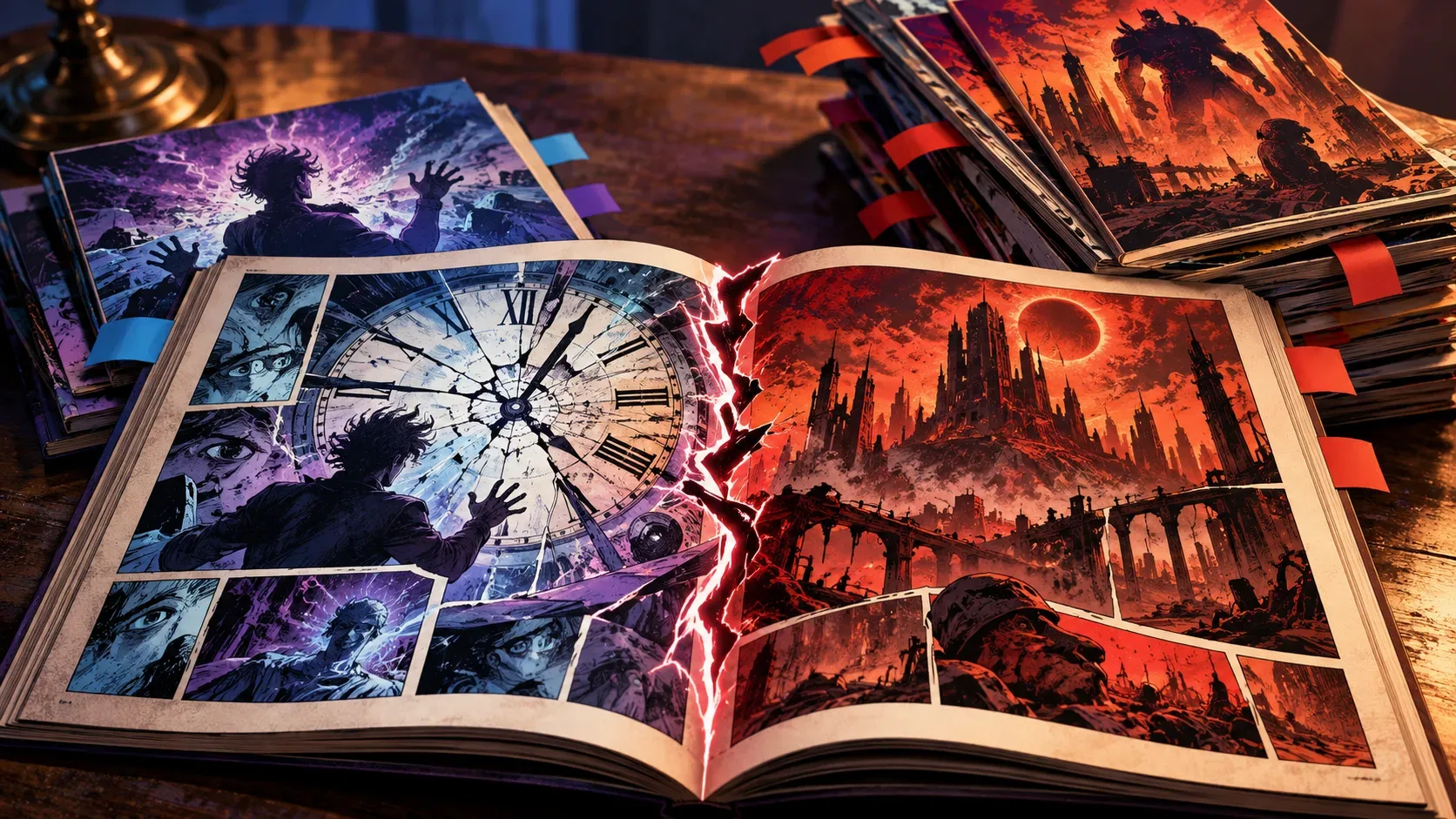
No, you do not have to read Legion Quest before Age of Apocalypse. The 1995 crossover proper begins with X-Men: Alpha #1, which introduces the world ruled by Apocalypse. Even so, the four central Legion Quest issues are the best preparation for seeing firsthand why that reality exists, rather than relying on later explanations. A short route takes only a handful of comics; the complete reading experience is a different undertaking.
Spoiler warning: from this point on, the article reveals the event that creates the Age of Apocalypse and discusses the structure of its conclusion.
What does Legion Quest add to the story?
In the story leading up to the event, David Haller, also known as Legion and the son of Charles Xavier, travels into the past to kill Magneto. He wants to stop Xavier’s former friend from becoming an enemy. The attempt goes wrong: Xavier dies protecting Magneto. Without Professor X in the history that follows, Apocalypse begins his conquest earlier, and an alternate timeline takes shape.
That causal link is what Legion Quest shows directly. X-Men: Alpha #1 presents the outcome instead: an America dominated by Apocalypse and a mutant resistance led by Magneto in Xavier’s memory. Marvel’s official guided tour recommends starting with Legion Quest, while another Marvel reading list identifies Alpha as the beginning of the Age of Apocalypse universe. Both are valid: one prioritizes the cause, the other marks the event’s opening issue.
Which Legion Quest issues are actually worth reading?
To reduce the prelude to the essential time-travel conflict, the editorial selection below uses four issues. It is not meant to reproduce every chapter and connection in Marvel’s extended reading order.
| Priority | Issues | What you get |
|---|---|---|
| Short core | Uncanny X-Men #320; X-Men (1991) #40; Uncanny X-Men #321; X-Men (1991) #41. | Legion’s plan, the journey through time, and the decisive change to history. |
| Expanded prelude | X-Factor (1986) #109 and Cable (1993) #20, in addition to the four issues above. | Additional viewpoints and repercussions of the crisis for other characters. |
| Optional setup | X-Men (1991) #38-39; X-Factor (1986) #108; Uncanny X-Men #319. | Background from the ongoing stories before the crossover, without being required to understand its premise. |
Reading guides organize these books differently. How to Love Comics places X-Factor #109 and Cable #20 in a six-part Legion Quest sequence; collected editions and abridged guides emphasize the four alternating Uncanny X-Men and X-Men issues. Thus, “four essentials” is a condensed editorial recommendation, not the official name of a complete collection.
Recommended short route: ten issues
This is an entry route, not a replacement for every storyline in the event. It combines the timeline’s origin, the new setting, one representative miniseries, and the overall ending:
- Legion Quest: Uncanny X-Men #320, X-Men #40, Uncanny X-Men #321, and X-Men #41.
- Starting point: X-Men: Alpha (1995) #1.
- One arc in the new reality: Amazing X-Men (1995) #1-4.
- Event finale: X-Men: Omega (1995) #1.
Amazing X-Men follows one branch of Magneto’s resistance, but it cannot account for every mission converging in the finale. Jumping directly from that miniseries to Omega leaves intentional gaps in this abbreviated route. If your only goal is to recognize the setting and the ending, even Alpha and Omega can serve as a structural overview, but two issues are not the same experience as reading the saga.
What should you add to follow more of the 1995 crossover?
For four months, Marvel temporarily replaced its regular mutant titles with series set in this alternate reality. Alongside Alpha and Omega, the eight main strands each have four issues:
- Amazing X-Men #1-4 and Astonishing X-Men (1995) #1-4;
- Factor X #1-4 and Gambit and the X-Ternals #1-4;
- Generation Next #1-4 and Weapon X (1995) #1-4;
- X-Calibre #1-4 and X-Man (1995) #1-4.
A broader route interleaves these miniseries and adds X-Universe #1-2 and the Age of Apocalypse: The Chosen special. X-Men Chronicles #1-2 supplies earlier history from within the alternate reality; other retrospective stories appeared later and are not required to read the 1995 launch. X-Men: Prime #1 acts as an epilogue after Omega. For an issue-by-issue sequence, follow Marvel’s official reading list or the detailed How to Love Comics guide rather than treating all these publications as essential.
What do you miss by skipping Legion Quest?
Skipping the prelude does not prevent you from grasping the core setup: Xavier died in the past, Apocalypse rules the alternate present, and Magneto leads the X-Men. What you lose is the detail behind the cause. You get less context for Legion’s decision, Xavier and Magneto’s earlier friendship, Bishop’s role in the time-travel crisis, and the weight of the altered continuity. The first Alpha issue introduces the new circumstances, but it does not fully replace the earlier event’s scenes.
What if you read collected editions?
Check the contents, not just the title on the cover. Marvel’s 2015 X-Men: Age of Apocalypse Vol. 1: Alpha collection already includes Uncanny X-Men #320-321, X-Men #40-41, and Cable #20, alongside Alpha and the opening issues of other series. The Age of Apocalypse Omnibus also includes those issues and the major 1995 arcs. Buying a separate prelude without checking its contents may mean paying twice for the same stories.
Practical choice: start with Alpha to sample the alternate reality immediately; add the four central Legion Quest issues to understand its origin; choose the expanded order if you want to follow how different missions connect in Omega.