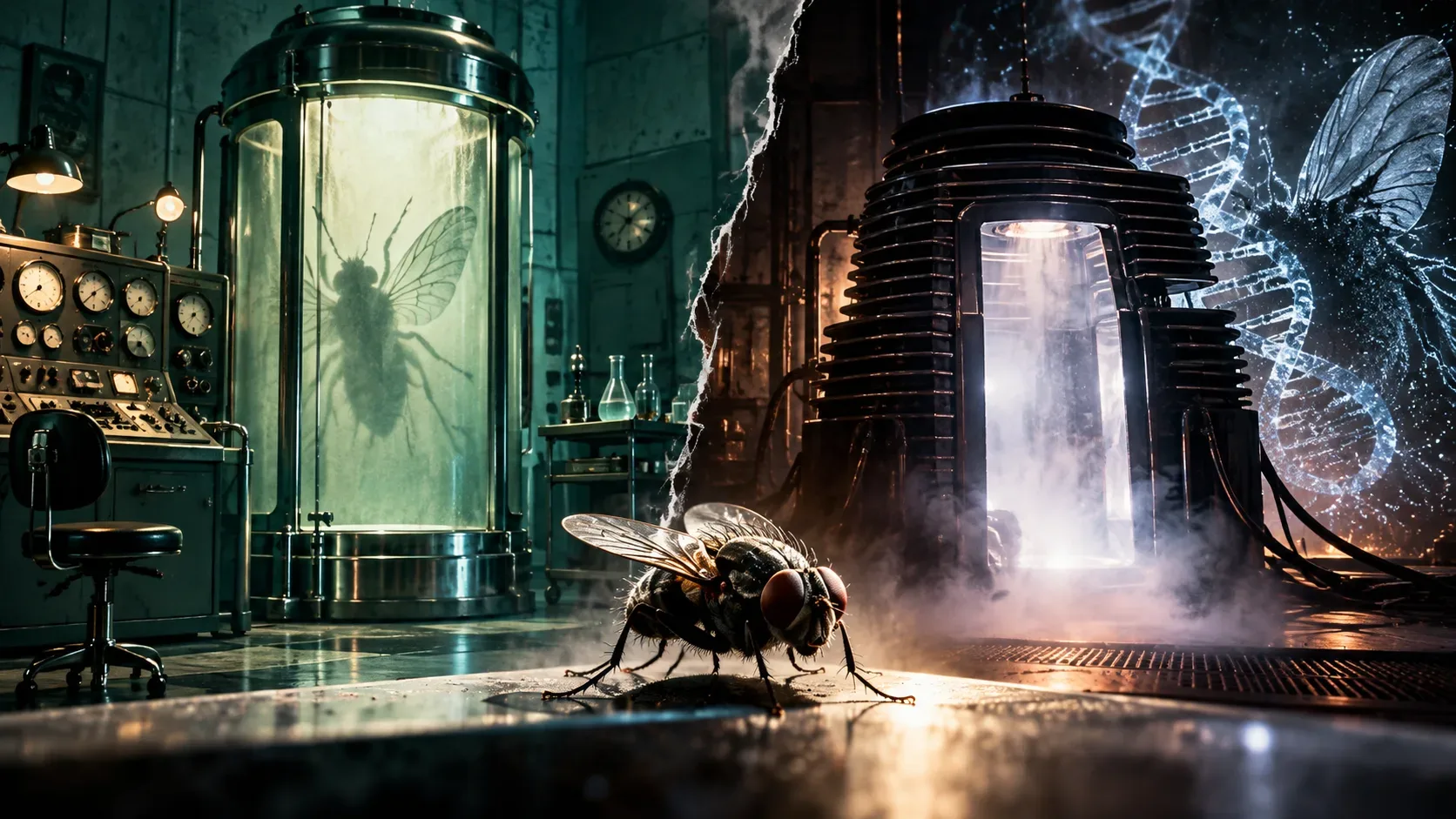
Spoiler warning: this article reveals plot details from the 1958 and 1986 films. The 1986 remake of The Fly replaced the near-instant exchange of body parts between a man and an insect with a genetic fusion that gradually transforms the scientist. The change originated in Charles Edward Pogue's screenplay concept and was developed by David Cronenberg. An accident that produced an already disfigured creature in 1958 thus became a story about the progressive loss of human identity, both physically and emotionally.
What did the machine do in the 1958 film?
Directed by Kurt Neumann and written by James Clavell from George Langelaan's short story The Fly, published in 1957, the original is known in Brazil as A Mosca da Cabeça Branca. André Delambre (Al Hedison, later known as David Hedison) builds a device that disintegrates matter in one chamber and reconstructs it in another. When he tests it on himself, he fails to notice a fly inside.
The outcome is commonly called a head swap. That is a convenient but incomplete description: André acquires the insect's head and one arm, while the fly carries the corresponding human parts. Within the film's rules, the machine mixes their atoms as it reconstructs both organisms. This is not yet the gradual genetic mutation introduced in the 1986 version.
The story begins after the tragedy. Hélène (Patricia Owens) admits responsibility for her husband's death, and the explanation unfolds as a flashback amid suspicions from the family and the police. The horror arises from André's appearance, but also from the mystery of what happened in the laboratory and why his wife acted as she did.
How does the 1986 version change the transformation?
The scientist is now Seth Brundle (Jeff Goldblum), whose invention is documented by journalist Veronica Quaife (Geena Davis), with whom he begins a relationship. Teleportation remains the premise. When a fly accidentally enters Seth's pod during his test, however, the computer combines the organisms at a molecular and genetic level rather than producing two bodies with exchanged parts.
The effects do not appear all at once. Seth emerges seemingly intact and experiences a period of unusual energy and physical ability. His behavior and body then begin to change, with increasingly disturbing symptoms. The ongoing transformation lets the story explore how he interprets those symptoms and how Veronica responds as someone she loves deteriorates.
The genetic explanation is a science-fiction rule within the story, not evidence that a human and fly could biologically fuse. Its dramatic purpose is to turn the same accident into a series of stages, keeping the protagonist's face and emotional reactions central for longer.
Who decided to abandon the head swap?
Giving Cronenberg sole credit for the change would overlook a key stage of development. In an interview, screenwriter Charles Edward Pogue explained that he had devised the idea of mixing genes instead of exchanging heads before the director joined the project. His reasoning was also dramatic: a character who retained a human face during the transformation could express emotions and carry major scenes without relying on notes or gestures to communicate.
Cronenberg rewrote the script and shares its writing credit with Pogue. The American Film Institute catalog records Cronenberg's statement from 1986 that nearly all of the metamorphosis concept was already in Pogue's screenplay. The Canadian Film Encyclopedia identifies another major change made by Cronenberg: moving away from a domestic structure closer to the original and centering the story on Seth, Veronica and her former partner, Stathis Borans.
These were two complementary creative decisions, not one person's single invention: Pogue proposed replacing the instantaneous swap with a transformation that could unfold onscreen, and Cronenberg reshaped the characters, conflicts and tragic tone around it.
How did the story and the horror change?
In 1958, viewers piece together the events leading to André's death. His already established deformity explains a mystery and Hélène's dilemma. In 1986, the audience watches the change as it happens: a scientific breakthrough that initially appears promising becomes a threat to Seth's body, personality and relationship. Instead of relying primarily on the moment a creature is revealed, the horror grows with every stage of the transformation.
The makeup effects supervised by Chris Walas make those stages visible. Yet the difference cannot be explained simply as a technological upgrade over 1958. The script was structured so the effects would trace a physical and emotional progression, rather than present a newly designed monster alone.
The essential differences between the two versions
| Aspect | 1958 | 1986 |
|---|---|---|
| Protagonist | André Delambre, a married scientist. | Seth Brundle, a scientist involved with journalist Veronica. |
| Teleportation failure | Atoms are recombined, giving the man a fly's head and arm and the insect human parts. | Human and fly are fused at a molecular and genetic level into one organism. |
| Timing | The altered body is revealed as the aftermath of an earlier accident. | A gradual metamorphosis alters both body and behavior. |
| Story structure | Investigation of a death and Hélène's account in flashback. | The experiment, romance and Seth's deterioration unfold as the story progresses. |
| Source of horror | Exchanged identity, a concealed creature and a family secret. | Progressive loss of body, self-control and emotional bonds. |
The endings reveal why the change matters
In the 1958 film, unable to reverse the accident, André asks Hélène to kill him using an industrial press. Later, the tiny fly bearing human parts is discovered trapped in a spider's web. The image provides physical confirmation that both organisms were affected and resolves the mystery framing the story.
In 1986, Seth attempts another fusion, this time involving Veronica and the child she is carrying. His plan is interrupted; his transformed body also becomes fused with components of the teleportation device. At the end, Veronica responds to Seth's silent request to end his suffering. There is no separate fly with a human head to find: the tragedy is concentrated in one person who has undergone a progressive transformation.
That difference in mechanism changes the entire drama. The original asks how an impossible accident ended in death. The remake follows what happens when the scientist has time to recognize the transformation, try to fight it and gradually lose the person he used to be.
Sources and references
- 20th Century Studios: The Fly (1986)
- American Film Institute: The Fly (1958)
- American Film Institute: The Fly (1986)
- Canadian Film Encyclopedia: The Fly
- American Cinematographer: The Fly, reportagem de 1986
- Haines His Way: entrevista com Charles Edward Pogue
- Apple TV Brasil: A Mosca da Cabeça Branca (1958)