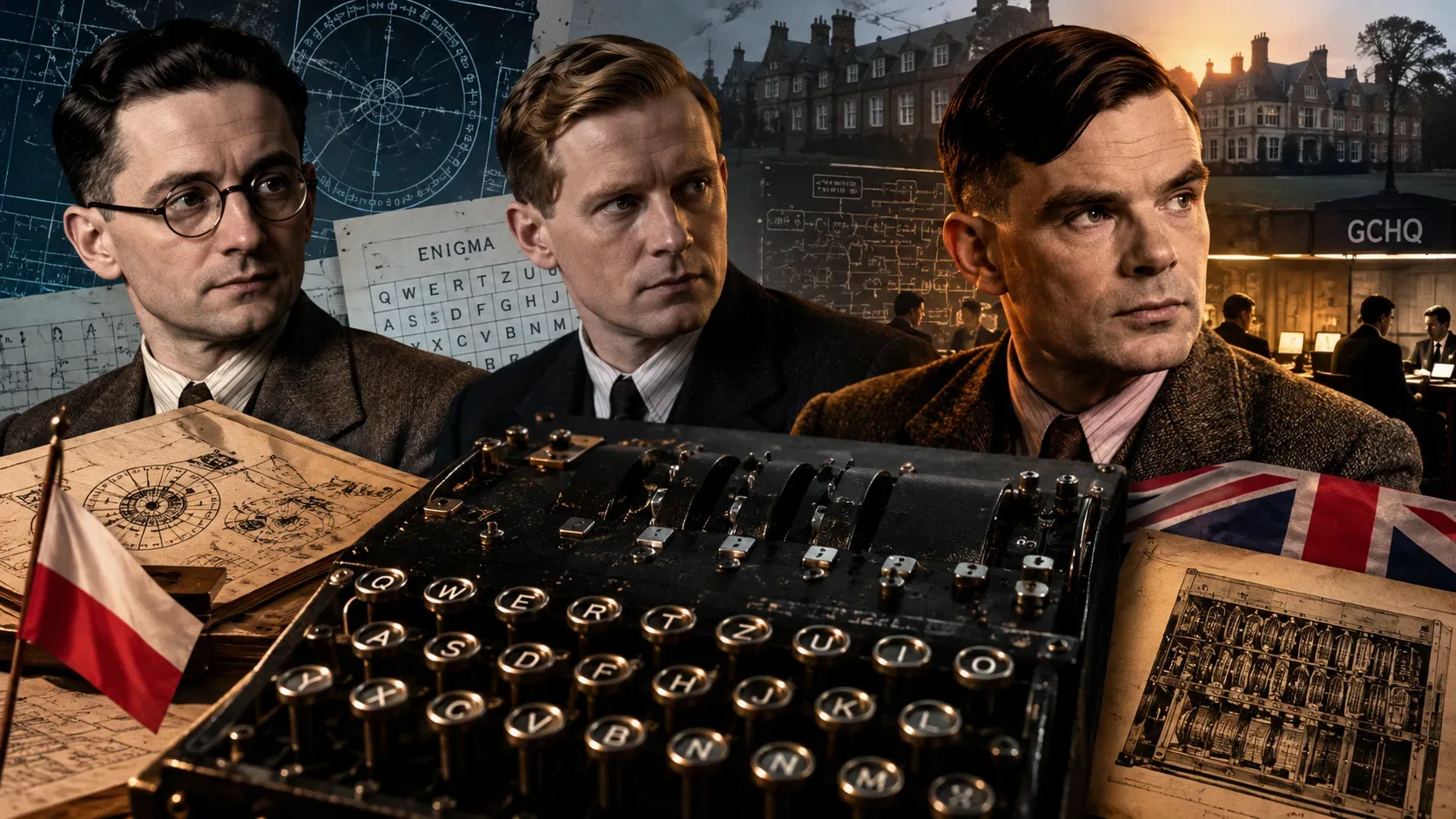
The first bombe used against Enigma before Alan Turing was developed by a Polish team led by Marian Rejewski. By 1938, Poland’s Cipher Bureau was using the bomba kryptologiczna, an electromechanical machine that helped identify Enigma settings. Turing later designed a British Bombe at Bletchley Park using a different approach, with major contributions from Gordon Welchman. These were not the same machine.
The documented history is longer than the narrative of The Imitation Game (2014). The film places Turing at the centre, but British successes followed earlier Polish breakthroughs and cooperation with the French. That chronology does not diminish Turing. It shows the foundation on which he worked and why a new machine was needed.
Who were Rejewski, Różycki and Zygalski?
Marian Rejewski, Jerzy Różycki and Henryk Zygalski were mathematicians working for the Polish Cipher Bureau. During the 1930s they studied the German military Enigma, established aspects of its internal workings and developed ways of recovering the settings used for messages. Crucial advances therefore came before Turing began his wartime work at Bletchley Park in September 1939.
Enigma did not perform a fixed letter substitution. Its rotors changed the electrical path whenever a key was pressed, and the settings created a vast number of possibilities. Cryptanalysts were not trying every combination blindly; they exploited properties of the system and German operating procedures to narrow the search.
What did the Polish bomba of 1938 actually do?
The bomba kryptologiczna automated part of the search for Enigma settings. It exploited weaknesses in the German indicator procedure, which communicated message settings. The UK’s National Museum of Computing explains that the method relied on the simpler operating practice used at that time and that the Polish machine was technically unlike the later Turing-Welchman Bombe.
The word “bombe” here refers to codebreaking equipment, not an explosive. Nor did finding a setting mean that every message was automatically read: interception, educated assumptions, operators and additional checks still mattered.
Pyry in July 1939: the crucial exchange
On 25 and 26 July 1939, Polish, French and British representatives met near Warsaw, in the Pyry area. According to GCHQ, Britain’s signals intelligence agency, the meeting revealed just how far Polish researchers had progressed, including the design of their electromechanical bomba. The exchange substantially redirected British Enigma research.
Germany had already strengthened Enigma security and changed operating practices, weakening some earlier techniques. Pyry was therefore not the delivery of a permanent solution. It transferred knowledge that helped address a new challenge. In January 1940, Turing met Polish cryptanalysts, including Rejewski, in Paris, after they had reached France following the invasion of Poland.
Was the British Bombe a copy of the Polish machine?
No. The British Bombe retained the broader idea of electromechanical key searching but tackled a different technical problem. Turing relied on cribs, guesses about likely passages of plaintext, together with a feature of Enigma: no letter could be encrypted as itself. Those relationships enabled the machine to rule out impossible settings.
Gordon Welchman contributed the diagonal board, which reduced false stops and greatly improved efficiency. The British Tabulating Machine Company handled the engineering and manufacture. The National Museum of Computing dates the first British Bombe, named Victory, to 14 March 1940, and a machine incorporating Welchman’s improvement to August of the same year. The “Polish bomba of 1938” and “British Bombe of 1940” are distinct but historically connected solutions.
Timeline: the stages the film compresses
- 1930s: Rejewski, Różycki and Zygalski make major advances against military Enigma in Poland.
- 1938: the Polish team uses an electromechanical bomba to exploit indicator procedures.
- 25-26 July 1939: Polish codebreakers share methods and findings with French and British counterparts at Pyry.
- January 1940: Turing meets Polish cryptanalysts in France to develop the technical exchange.
- March and August 1940: the first British Bombe and a version incorporating Welchman’s improvement enter service.
How does The Imitation Game change the picture?
The 2014 film is a biographical drama centred on Turing, played by Benedict Cumberbatch, rather than a complete account of Allied codebreaking. By giving little space to the Polish work that preceded him, it can suggest that the solution began from scratch at Bletchley Park. GCHQ and the National Museum of Computing document a more interconnected history.
Alastair Denniston offers another example of dramatic licence. The film casts him as an obstacle to its protagonist; GCHQ’s own historical account says he recruited Turing and approved his 1940 trip to meet the Polish codebreakers. Monash University professor Graham Farr also describes the film as a blend of genuine events and substantial fictionalisation.
The answer thus depends on the technical distinction: Rejewski and the Polish team created the pioneering bomba in 1938; Turing, Welchman and British teams developed the 1940 Bombe. Breaking Enigma was a collaborative international process, not one isolated flash of invention by a cinematic hero.