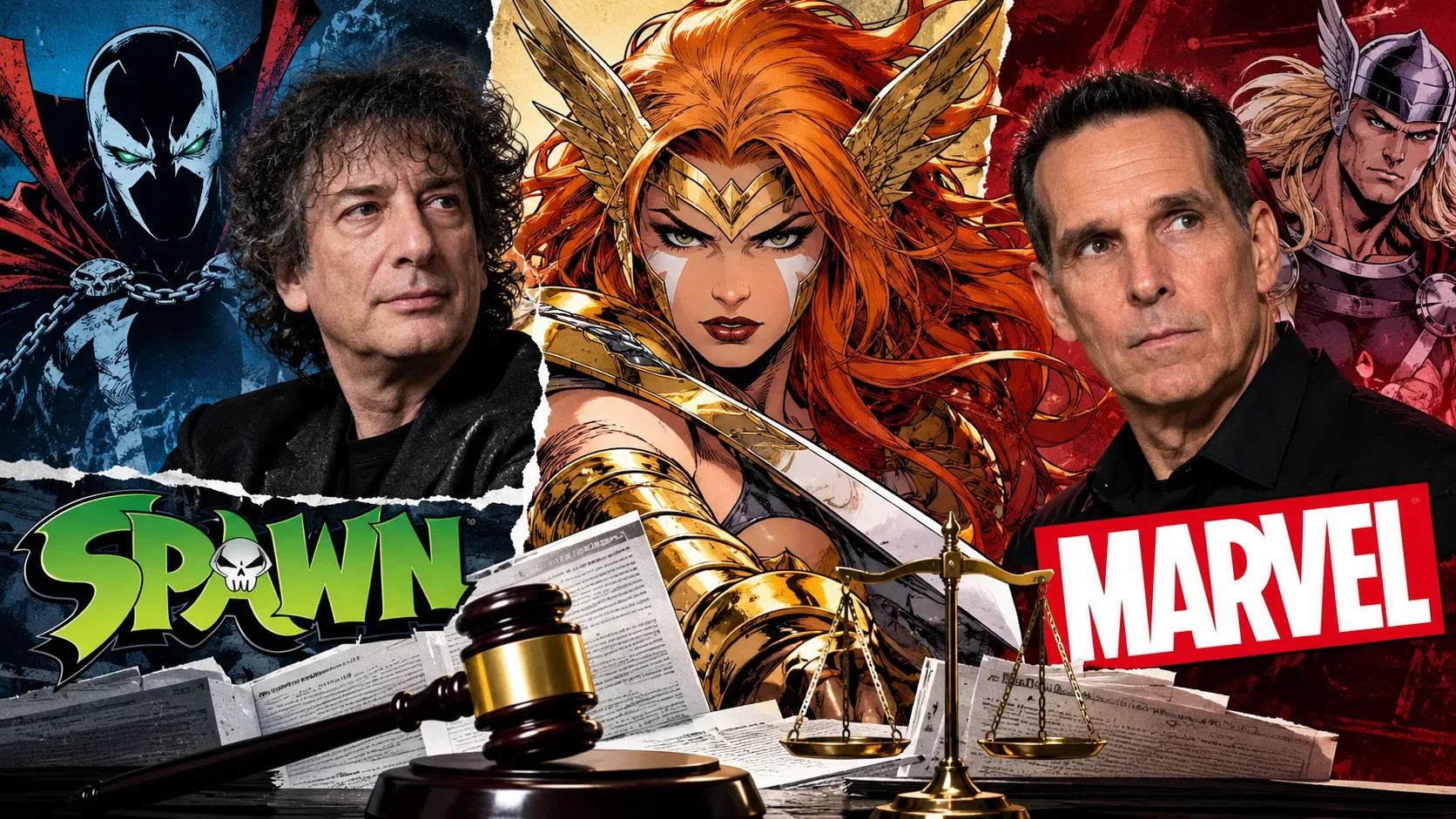
On February 3, 2012, a US federal court recognized Neil Gaiman as a 50% joint copyright owner of specific publications: Spawn #9 and #26 and Angela #1, #2 and #3, including their contents. The judgment did not declare Gaiman Angela's sole owner or transfer the character to Marvel. It left the parties' future rights and obligations to their settlement agreement; Angela's move to the other publisher came later.
That distinction clarifies a story often reduced to a single sentence: the co-creation by Gaiman and Todd McFarlane, the litigation, the commercial settlement and Angela's new origin in Marvel comics were separate steps.
Where Angela began in Spawn comics
Angela debuted in Spawn #9, published by Image Comics in 1993. Gaiman wrote a guest script for McFarlane's series, and McFarlane illustrated the issue. In that story, she was an angelic hunter of Hellspawns and an adversary of protagonist Al Simmons. Image's own issue listing identifies the writer and artist, establishing both contributions without crediting either person with the entire creation.
The character became prominent enough to headline a three-issue miniseries in 1994, again written by Gaiman. He also prepared material for Spawn #26, connecting the main series with Angela's story. Those publications help explain why the dispute named particular works rather than the whole Spawn franchise.
Why Gaiman and McFarlane went to court
The disagreement concerned joint authorship, credit and the commercial use of collaboratively created work. Gaiman filed suit in 2002. Alongside Angela, the dispute covered other characters introduced in Spawn #9, including Medieval Spawn and Count Cogliostro. McFarlane challenged the scope of Gaiman's contributions and the resulting copyright ownership.
In 2004, the US Court of Appeals for the Seventh Circuit upheld the ruling recognizing Gaiman's contribution. It examined their oral arrangement and found that the script was not automatically a work made for hire owned exclusively by McFarlane: the necessary written instrument for that arrangement or a written copyright transfer was absent. The opinion also assessed why Gaiman's storytelling contributions could support authorship rights alongside McFarlane's drawings.
What the 2012 final judgment actually established
The final judgment, in case 02-cv-48-bbc and signed by Judge Barbara B. Crabb, expressly established Gaiman's 50% joint ownership of the copyrights in Spawn #9, Spawn #26 and Angela #1, #2 and #3, together with the contents of those publications. The precise list matters: it was not a finding that he owned half of every Spawn issue or all rights to Angela.
The judgment provided that the parties' future rights and obligations would be resolved under their settlement agreement. It also dismissed all remaining claims and counterclaims with prejudice and noted the parties' waiver of the relevant appeals. It did not reproduce the settlement's commercial provisions.
Consequently, saying that a court 'gave Gaiman all of Angela in 2012' conflates two different legal mechanisms. The explicit judicial finding concerns joint ownership of identified publications; any subsequent exclusive allocation of rights must be attributed to the settlement and supported by separate evidence.
The settlement and Angela's move to Marvel
Rich Johnston's Bleeding Cool coverage, updated in March 2013, reported that the arrangement with McFarlane left Gaiman in full control of Angela. A later report from the same outlet, published in December 2022, says Gaiman sold the character's rights to Marvel Comics. These accounts help establish the sequence, but they are journalistic reporting about the deal, not the contract itself.
The court documents reviewed do not specify the price of any sale to Marvel, reproduce the full assignment documents or order that the character be transferred to the publisher. The careful conclusion is that the contractual resolution made it possible to exploit Angela outside Spawn and that her incorporation into Marvel became public in 2013. There is no basis to attribute a transfer not described in the 2012 judgment to that judgment.
How Spawn's former hunter became Thor's sister
Angela's editorial debut in the Marvel Universe took place at the end of Age of Ultron #10, published on June 19, 2013. Contemporary coverage announced her arrival and subsequent involvement in Guardians of the Galaxy. This placed her in a fictional continuity different from Spawn's; it did not automatically make earlier Image stories part of Marvel continuity.
The Asgard connection followed. In 2014's Original Sin: Thor & Loki - The Tenth Realm, Thor and Loki investigate a Tenth Realm called Heven and a sister Thor never knew he had. Marvel's official listing for Angela: Asgard's Assassin #1, released on December 3, 2014, identifies Angela as an Asgardian and Thor's sister, raised in Heven to hate Asgard. The series credits Kieron Gillen and Marguerite Bennett as writers, with artwork by Phil Jimenez and Stephanie Hans.
That new origin was a Marvel storytelling decision, a revision of fictional continuity. Thor's family relationship is not in the court judgment and does not legally explain the acquisition of rights. Who was entitled to publish Angela and who she became within the story are entirely different questions.
Timeline: from co-creation to new continuity
- 1993: Angela appears in Spawn #9, written by Neil Gaiman and illustrated by Todd McFarlane.
- 1994: she headlines a three-issue miniseries written by Gaiman; Spawn #26 is among the works later identified in the judgment.
- 2002: Gaiman files a lawsuit against McFarlane and related companies.
- 2004: the Court of Appeals upholds recognition of Gaiman's authorship interest.
- February 3, 2012: the final judgment declares 50% joint ownership of five specified issues and refers future obligations to the parties' settlement.
- 2013: following the settlement reported in the press, Angela enters Marvel comics and appears in Age of Ultron #10.
- 2014: The Tenth Realm storyline and Angela: Asgard's Assassin establish her Asgardian identity and relationship to Thor.
Sources and references
- Image Comics: Spawn #9, official listing
- US Court of Appeals: Gaiman v. McFarlane, 2004 opinion
- US District Court: Gaiman v. McFarlane, final judgment, February 3, 2012
- Bleeding Cool: updated report on Angela joining Marvel (2013)
- Bleeding Cool: report on Angela and Tom Brevoort's comments (2022)
- Marvel: Age of Ultron #10 (2013)
- Marvel: Original Sin #5.1 (2014)
- Marvel: Angela: Asgard's Assassin #1 (2014)