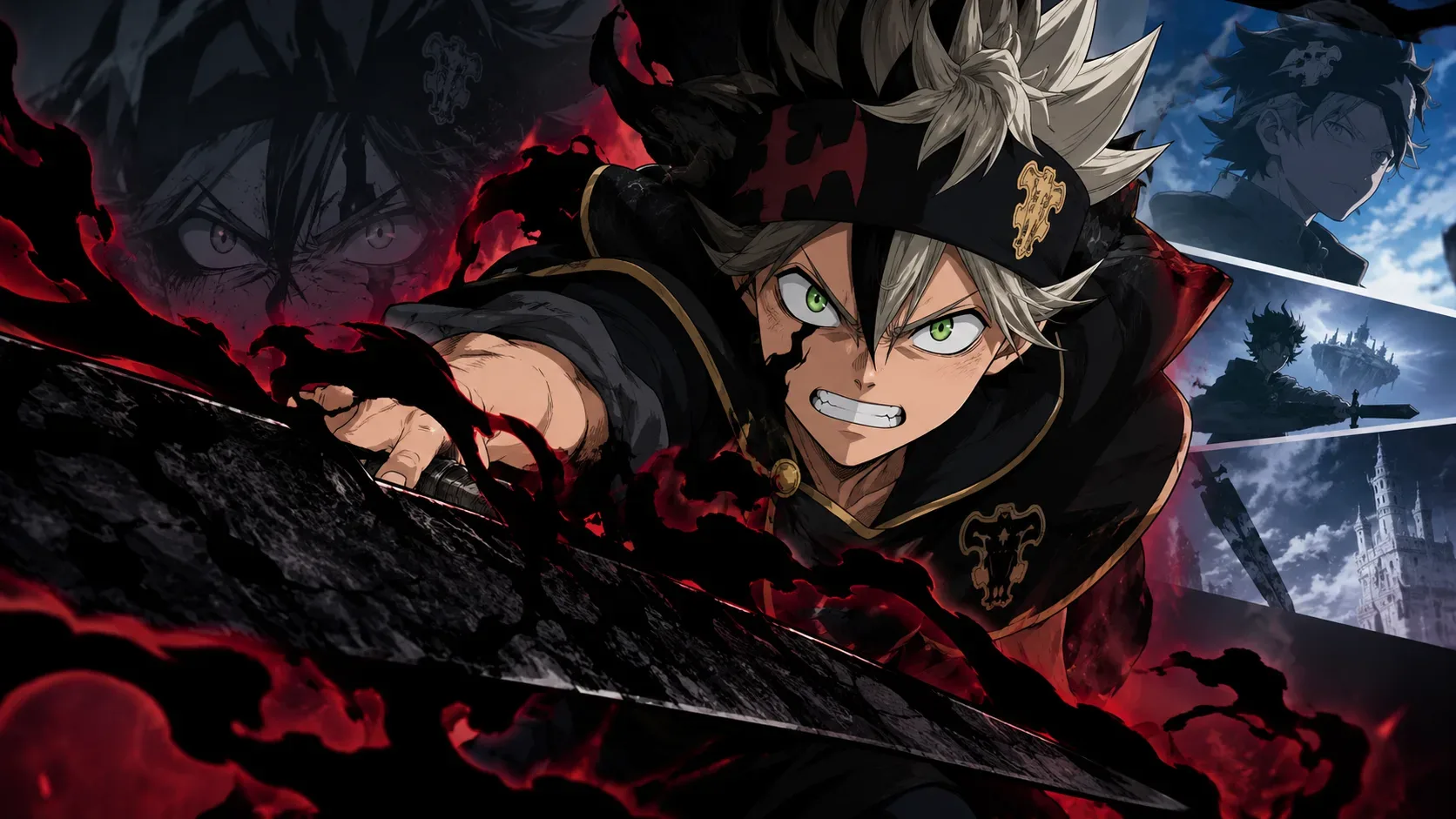
In Black Clover, Asta's Anti-Magic neutralizes magical energy when it comes into contact with it. That is why his swords can cut through spells, repel attacks and, in certain circumstances, remove lingering magical effects. But the power does not erase ordinary physical objects or make Asta invulnerable. He still has to reach the target, use the right technique and survive the encounter.
The contrast drives Yūki Tabata's story: Asta was born without mana and cannot produce ordinary magic. His five-leaf grimoire grants him access to weapons charged with a force that opposes magic. The anime's official character profile emphasizes both his complete lack of magical power and the physical strength required to wield those weapons.
Spoiler warning: the explanation below discusses revelations from anime episodes 167 through 170 and later manga events, which appear under Manga only. The anime's new season began in October 2026, but that does not mean it has already adapted the later developments described here.
Where does Anti-Magic come from if Asta has no mana?
Asta is not turning normal mana into Anti-Magic. The energy is linked to Liebe, the devil associated with his five-leaf grimoire. Gaining access to that power does not make Asta a conventional mage. Precisely because he possesses no mana of his own, he can wield weapons that interfere with other people's magic without having a personal mana reserve to nullify.
This relationship becomes an explicit part of the story when Asta bargains with the devil and later attempts to forge a partnership. Episodes 169 and 170 cover Nacht's binding ritual and Liebe's past. The origin explains what the power is, but it does not remove the practical constraints on using it.
What can each of Asta's four swords actually do?
| Weapon | Main application | Important limitation |
|---|---|---|
| Demon-Slayer Sword | A broad blade that cuts and repels magic; its flat surface can deflect spells. | Asta still has to intercept or reach the spell. Weight and speed remain factors. |
| Demon-Dweller Sword | Can draw on power associated with allies and send attacks over a distance, including Anti-Magic slashes later in the story. | Greater range does not mean guaranteed accuracy or automatic removal of every wide-area attack. |
| Demon-Destroyer Sword | Its Causality Break ability can remove sustained magical effects, including those involved in reincarnation. | It targets supernatural effects, not every physical consequence of an earlier fight. |
| Demon-Slasher Katana | Yami's katana becomes Asta's fourth Anti-Magic weapon; the manga later develops its selective cutting ability. | It does not nullify everything in the vicinity without targeting or control. |
The distinctions matter because cutting a projectile, ending an ongoing effect and attacking from afar are different problems. During the reincarnation storyline, Demon-Destroyer has a role that a conventional strike with the first sword cannot simply replace. In the fight with Dante, shown in episode 167, Yami's loaned katana expands Asta's options.
It is equally important to distinguish acquiring a weapon from fully mastering it. The 2026 anime season already presents the katana as part of Asta's grimoire, but abilities developed further down the manga timeline should not be attributed in advance to aired episodes.
What stops Anti-Magic from solving every fight?
- Contact, range and timing: to cancel a spell, Anti-Magic must reach its magical component. Projected slashes extend Asta's reach, but they do not eliminate the need for accuracy and reactions.
- Ordinary matter remains: a natural rock, falling debris or a purely physical blow does not vanish because it is not made of mana. Removing magical reinforcement does not necessarily erase the momentum of a real object.
- Strength and skill still matter: the power cannot replace conditioning, movement, ki-reading and teamwork. Asta can be outmaneuvered, caught off guard or injured before he lands a counter.
- The remaining effect must be magical: removing an ongoing curse is not the same as automatically restoring everything that happened because of it. Demon-Destroyer has a specific ability, not a universal undo function.
The most accurate interpretation is not that some elemental category of magic is universally immune. Instead, success depends on the encounter: an attack may be too fast, arrive from several directions or cause a physical hazard that remains once its magical part is removed. Crunchyroll's analysis likewise stresses that, especially early on, Anti-Magic is constrained by sword fighting and Asta's own physical ability.
How does the ability develop in the anime?
Early missions and the elf conflict: Asta learns to combine his weapons with strength, technique and ki-sensing. Black Asta form improves his access to devil power, but does not replace strategy. Discovering new uses for individual swords goes hand in hand with increasingly complex opponents.
The Dark Triad arc: in episode 167, the battle against Dante forces Asta into a riskier bargain with the devil. In episodes 169 and 170, Nacht supervises the binding ritual and Liebe's background comes to light. These steps illustrate the difference between having Anti-Magic and controlling it completely.
The anime's 2026 return: Crunchyroll scheduled Season 2 for October, beginning on October 3 and covering the raid on the Spade Kingdom. This continues beyond the original run of 170 episodes. The adaptation's return is not evidence that every later manga arc has already been animated.
Manga only: Devil Union, Zetten and sharing Anti-Magic
Devil Union: Asta and Liebe combine their power in a much stronger transformation. At first, the stated duration is roughly five minutes, as shown in chapters 282 and 288 and described in specialist reporting. VIZ's official description of volume 29 already presents Asta as having mastered the union. That initial time restriction belongs to a particular phase, not necessarily to every future improvement.
The Land of the Sun and Zetten: this technique stresses the concentration and release of power at the right moment. For Asta, it refines the application of Anti-Magic rather than granting conventional mana. The official volume 35 synopsis identifies Zetten training and the battle with Lucius's Paladins as part of this phase.
Sharing Anti-Magic: in chapter 367, Asta succeeds in transferring some of his power to members of the Black Bulls. His use of Demon-Dweller shows a system far more flexible than the initial image of one mana-less swordsman. It does not follow that anyone can use Anti-Magic in any manner; the event depends on greater control, compatibility and specific circumstances.
Can Asta beat any mage simply because he has Anti-Magic?
Winning is never automatic. Opponents can exploit distance, speed, terrain, physical attacks or an opening before Asta can cancel a spell. As the story goes on, his tools become more versatile, but outcomes still depend on execution and danger. The key question is not only whether an enemy uses magic that can be negated, but whether Asta can apply the right form of Anti-Magic in time.
That is why his development needs to be read arc by arc. The early swords establish the basic rule; the closing episodes of the original anime run establish his relationship with the devil; and Devil Union, Zetten and Anti-Magic sharing belong to later manga developments. They represent different levels of mastery of the same principle, not proof that the ability never had limits.
Sources and references
- Site oficial de Black Clover: perfil de Asta
- Crunchyroll, Sean Aitchison: análise da antimagia
- Crunchyroll: episódio 167, Juramento Negro
- Crunchyroll: episódio 169, O Ritual de Aprisionamento do Demônio
- Crunchyroll: episódio 170, Futuro Distante
- Crunchyroll: programação de outubro de 2026
- VIZ: Black Clover, volume 29
- VIZ: Black Clover, volume 35
- VIZ: Black Clover, capítulo 367
- ComicBook.com, Nick Valdez: limite da União Demoníaca
- ComicBook.com: melhoria da Espada Destruidora
- ComicBook.com: antimagia compartilhada com os Touros Negros
- ComicBook.com: espada nova na segunda temporada