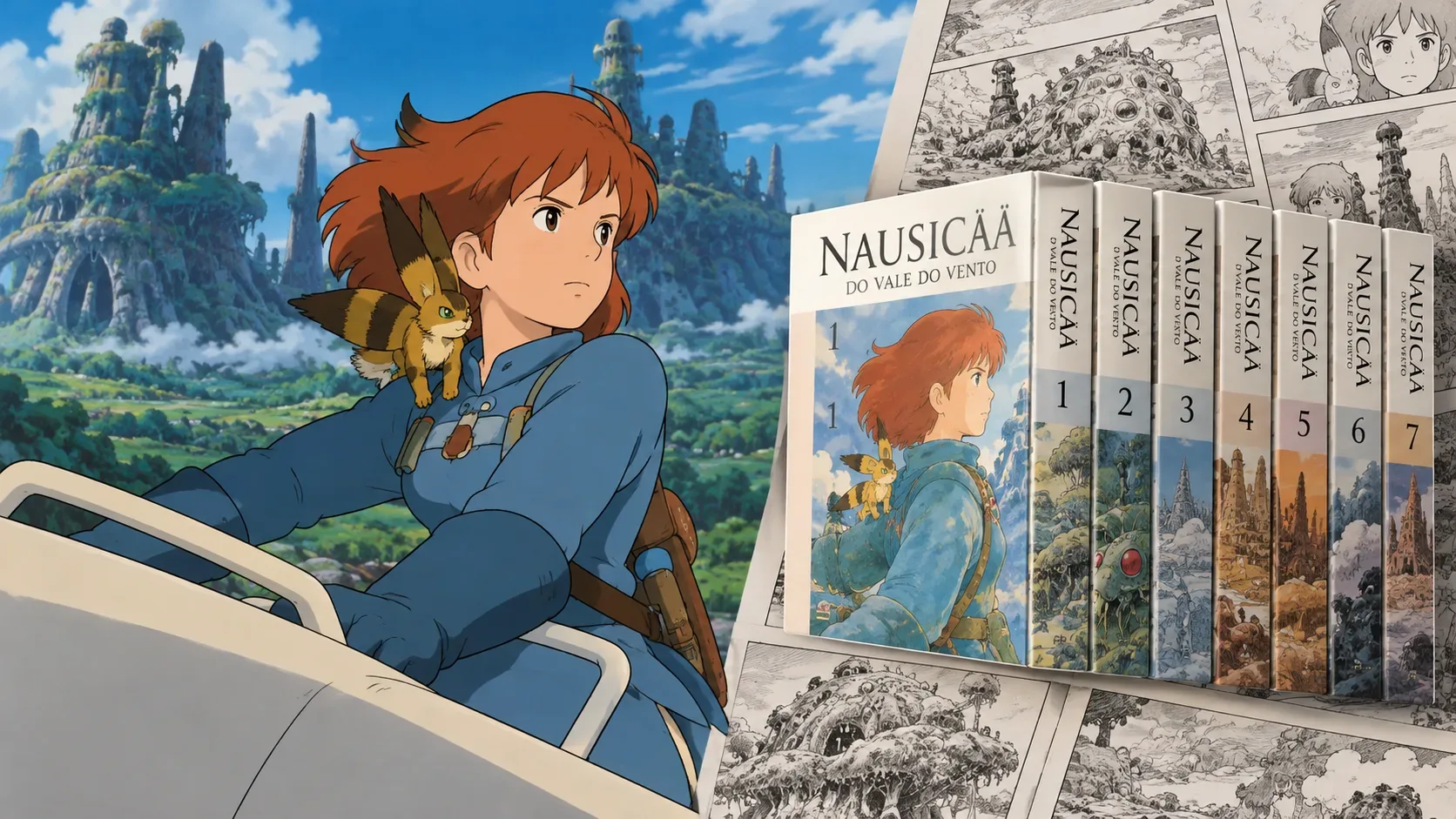
The 1984 film Nausicaä of the Valley of the Wind draws roughly on volumes 1 and 2 of Hayao Miyazaki’s seven-volume manga. That does not mean those books were adapted page for page: Miyazaki rearranged events, changed the conflict and crafted a self-contained ending. If you want the complete manga story, start with volume 1, not volume 3.
Why does the film cover only the beginning?
Miyazaki began serializing the manga in 1982, and the film opened in Japanese theaters on March 11, 1984. Serialization did not conclude until 1994. Most of the story had yet to be written when the movie was produced. Brazilian newspaper Folha de S.Paulo describes the film as adapting the first two volumes, while the Japanese outlet Magmix places the material roughly around the middle of the second. The difference in wording is a reminder that there is no exact chapter-by-chapter cutoff.
The movie introduces the Valley of the Wind, Nausicaä’s bond with the Ohmu, the toxic forest and the threat of war. But its narrative has to reach a conclusion within approximately 116 minutes. Studio Ghibli’s official film page credits Miyazaki with the original work, screenplay and direction, and names Topcraft as the production studio. Studio Ghibli was founded in 1985.
A seven-volume reading map without ending spoilers
This overview uses the publisher VIZ’s official descriptions, not a complete chapter-by-chapter reading or recap. Caution: it mentions broad developments and characters from later volumes, but does not disclose the manga’s ending.
| Volume | What to expect | Connection to the film |
|---|---|---|
| 1 | Nausicaä, the Ohmu, environmental destruction and conflict over scarce resources are introduced. | Familiar foundations, though the political relationships and context already differ. |
| 2 | The war expands, along with ominous signs from the southern forest. | The movie draws on some related material, but does not reproduce the volume’s events or endpoint exactly. |
| 3 | Kushana and Torumekian power struggles take a greater role alongside the war against the Doroks. | The manga pursues conflicts that do not follow directly from the movie’s self-contained ending. |
| 4 | The ecological and military crisis intensifies, including weaponized mutant spores. | Part of the manga’s larger story, beyond the film’s adapted material. |
| 5 | Imperial power plays unfold as an increasingly severe ecological threat spreads. | The narrative moves beyond the more concentrated conflict of the film. |
| 6 | Nausicaä’s journey raises deeper questions about the forest and the legacy of the ancient world. | Later developments that should not be inferred from the film’s conclusion. |
| 7 | The saga reaches its conclusion and addresses its central questions about humanity and its world. | The manga’s own conclusion, not the ending created for the film. |
Why not jump straight to volume 3?
Because watching the film is not equivalent to reading volumes 1 and 2. One major change concerns political alliances: in the film, Torumekia occupies the Valley of the Wind; in the manga, the Valley has an alliance with Torumekia, while the war with the Doroks is central. Kushana’s characterization and the scale of the conflict also develop differently. Those differences matter for understanding later volumes.
The film ends its own version of events rather than stopping at a point where volume 3 picks up. Readers who skip the opening books will encounter relationships and decisions established differently from the animated version. These are best understood as two related tellings by the same creator, not as a perfectly compressed opening followed by a ready-made sequel.
Which edition should you read?
In Brazil, publisher JBC announced on February 10, 2026 that volumes 6 and 7 had completed its seven-volume edition, which it began publishing in 2022. Folha de S.Paulo reported the completion of the Brazilian release on February 19. The practical reading order is volumes 1 through 7.
Edition formats can be misleading. VIZ also sells a complete deluxe box set containing two large hardcover books. Those two books contain the entire story; they are not volumes 1 and 2 of the traditional seven-volume division. The number of physical books in a particular edition is therefore not a measure of what the film adapted.
Sources and references
- Studio Ghibli: official 1984 film page
- VIZ: complete seven-volume manga listing
- VIZ: volume 1
- VIZ: volume 2
- VIZ: volume 3
- VIZ: volume 4
- VIZ: volume 5
- VIZ: volume 6
- VIZ: volume 7
- VIZ: complete deluxe two-book edition
- JBC: Nausicaä Manga Celebration, February 10, 2026
- Folha de S.Paulo: reporting by Henrique Artuni, February 19, 2026
- Magmix: film and manga comparison, May 15, 2023